Wednesday, March 9, 2022

Very Memoir


Genderqueer
by Maia Kobabe
[Saint Louis, Mo.] : The Lion Forge, LLC, 2019.
239 p. : chiefly col. ill. ; 21 cm. 

There's a lot to like and admire about Genderqueer.  This graphic novel memoir reveals with great honesty Kobabe's life of coming to terms with eir (Kobabe uses e/em/eir pronouns) gender identity. Assigned female gender at birth, this graphic novel follows Kobabe's intensely personal (often painful) struggle to figure out what eir gender/sexuality/identity is. 

The thing I like so much about this memoir is that it really opens up to the reader how intense and real the gender struggle can be for someone who does not fit into the more "normative" categories of gender and sexuality. Kobabe, a very sensitive person, is often tormented as e figures out what e thinks/feels about dating, coming out, pronoun use, clothing use, appearance, family dynamics, friendship, seeing the doctor, etc. A reader can learn so much about how many obstacles to self-realization exist in our society. However, the book is ultimately hopeful as Kobabe gets closer and closer to figuring out and embracing eir true self.

My only hesitancy about the book, is it's intense preoccupation with self. Of course, it's a memoir, but there were times when I just wanted the author to look beyond eirself and reflect on the lives of others who are in similar or even worse situations - but that's probably just me!


Tuesday, March 8, 2022

Dystopia Now


The Looting Machine
by Tom Burgis
 New York : PublicAffairs,  c2015.     
 xi, 321 p. : ill., map ; 24 cm.     

This is a powerful book that examines the power and endurance of the entrenched systems that pillage the resources of Africa. It is an indictment of the many legal (and illegal), but grossly unethical networks of banking rules, corporate laws, governments, militaries and paramilitaries that vacuum up the untold wealth fuel and mineral wealth of the African continent and keep it in the hands of a tiny minority of wealthy and well-connected people (while immiserating the vast majority of citizens in those countries where the wealth is found.)

This is not exactly the kind of book most students would pick up and read cover-to-cover, but it would be VERY useful to students doing any research on globalization, world poverty, corruption, mining, economics, especially in relation to the nations of Nigeria, Angola, South Africa, etc. It is a great resource for understanding how even when liberation governments come to power, they are often overtaken by the global systems of off-shoring, international finance/loans, and powerhouse nations like the US and China that seek to control profits gained from extractive industries.

The author Tom Burgis deserves great deal of credit for doing dogged (and intrepid) research as he visits both the glittering high-rises of corporate/financial power (e.g. Hong Kong, New York, and Harare)  conflict-torn sites (e.g. Nigeria, Congo, Zimbabwe) of mining and extraction.

It's a complicated and painful book to read, but one that anyone who lives in more wealthy countries should read since the wealth of Africa is deeply entwined with the wealth of those better-off countries.

Tuesday, February 8, 2022

Powerful Debut


Black Girl Unlimited
by Echo Brown
New York : Henry Holt and Co., 2020.
294 p. ; 22 cm.

This is a super creative and really well written debut YA novel.  The subtitle of Black Girl Unlimited is The Remarkable Story of a Teenage Wizard, and it's back cover states, it is "Part memoir, part magic" - and these are two good clues to the power of this novel. This is no Harry Potter wizardry, but instead a kind of rare natural/supernatural inheritance of access to the power and mystery of the "in between zone." 

The novel deals head on with hard issues of sexual assault, drug addiction, poverty and crime - but does it in a way that is not despairing, but also not falsely optimistic. The hero of this novel is the main character, Echo Brown (see, there's the part memoir) who is academically talented and motivated. She only gradually realizes that she is a wizard and that her power as one is limited but can grow.  One of the coolest aspects is that as a wizard she can occasionally stop time and use that stopped time to try and influence others for the better.

The novel is a great story of the power of determination, bravery, family ties, intellectual curiosity and bravery in the face of addiction, poverty, racism and violence. 

My only hesitations with the novel (which I was surprised to not see brought up in reviews) are the heavy use of vernacular from characters in her poor neighborhood (including her Mom and brothers). And then there is an unfortunate description of one of the most powerful elderly women wizards as being "a quarter Cherokee on her mother's side" according to everyone in Echo's neighborhood, and who is also said to have "learned all her magic stuff from her grandmother." 

That said, it's a powerful novel about obstacles and triumphs facing a young black girl as she comes of age and gets in touch with her inner strength and power.
     

Wednesday, January 12, 2022

It's Confusing Down There


The Man Who Lived Underground
by Richard Wright
New York, N.Y. : A Library of America Special Publication, [2021] 
 xii, 228 p. ; 22 cm.

When you see that there is a "new" Richard Wright novel out in the world, well of course you have to read it - which is exactly what I did! Apparently this compact novella appeared as a short story, but in its full form was rejected by Wright's publisher. It seems the opening set up of the hero, a Black man named Fred Daniels, being arrested and tortured by police into confessing to a double-murder he's innocent of was just too much.  The scene is still excruciating, but not so shocking in this age of learning about police abuses of power. 

Though this portrayal of racist police violence and terror is horrifying, it serves as the launching off of the main action of the book: Fred Daniels escapes the police and goes to live for a number of days in the sewers beneath the city.  Here he wanders through the maze of the city's underground digging and tunneling into several places where he wrestles with guilt, greed, corruption and disillusion. He is able to peer into a Black church service, view a savings vault, and jewelry storage area. In his isolation and darkness he also begins to become a bit unhinged.

I liked a lot about this book, but I have to say that the movements and the descriptions of the underworld actions of the protagonist are pretty confusing. How he chisels through bricks and squirms into basements is hard to follow. The passage of time is not clear, and extreme changes in the main character make it seem like he is underground for months, when in fact it is only three days. I wish the writing had been a little more exact; I think it would have really added to the power of the book.

These issues aside, the book is also wonderful for including a long essay - "Memories of My Grandmother" - that is an exquisite revelation of Wright's thoughts about his writing, discussing origins, influences, the blues and jazz among other things. It's well worth the read.

I'm glad I read this novella and I will definitely recommend it to any student interested in Richard Wright. 

Thursday, January 6, 2022

Bent Twisted Broken


Bent Heavens
by Daniel Kraus
New York : Square Fish, Henry Holt and Co., 2021.
1st Square Fish ed. 
291 p. ; 22 cm.      

Pretty much everything I wrote about Kraus' earlier novel, Scowler, applies to this novel. I wanted to like Bent Heavens, but I found it profoundly unsatisfying on several levels. I feel bad being so negative because Kraus explains (in an author's note at the end of the book) that he wrote this as a protest against the torture regime implemented under the Bush-Cheney administration.  It feels odd to dislike this book so much since it got starred reviews in Booklist and School Library Journal. 

The premise of the book is interesting. High schooler Liv's father (a high school English teacher) had a complete mental breakdown years previous when he insisted he was abducted by aliens. Then after being released he actually disappears and has been gone for two years. He left behind gruesome contraptions for trapping said aliens. Liv and her loner friend, Doug, check the traps weekly until one day, they catch an alien! 

Instead of turning the creature in to the authorities, Doug suggests torturing it as a way of both punishing it for what the aliens did to Liv's father and possibly getting it to reveal what happened (it can't speak but can squeal and whimper). There's a lot of gruesome beatings, cutting, and hurting that goes on in a torture shed on Liv's property - and I just NEVER believed Liv would go along with it.  I also think that Doug is that stereotype oddball loner type that supposedly is predisposed to sadism. By two thirds of the way through the book, I had guessed at the "wow" plot twist that ends the novel and so was neither surprised nor moved (unlike reviewers).

Well, obviously I did not like this novel. Instead of the heavy handed torture, a more subtle use of torture like that endorsed by Bush-Cheney would have been more pointed - e.g. forced nudity, sleep deprivation, sensory deprivation, water-boarding, etc.  Also having the alien able to communicate in some basic ways would have been more effective, too. Instead the plot zig zags into the nonsensical and absurd which left me wondering if I even read the same book as the people who starred this mess.

Tuesday, December 14, 2021

Picture It!


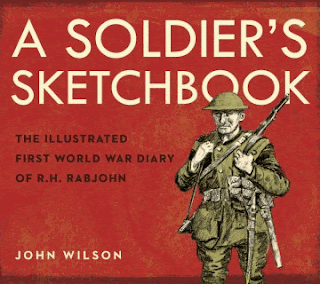
A soldier's sketchbook : the illustrated First World War diary of R.H. Rabjohn
by R.H. Rabjohn/John Wilson
Canada : Tundra Books, [2017]     
112 p. : ill. ; 22 x 24 cm.

I'm always interested in WWI, the war that turned the European violence inward instead of outward and ripped the façade off the elegant civilization of Europe at a cost of the deaths of millions of combatants and many civilians.

This WWI book is a special addition to the literature of that "Great War." It consists of the sketches from the war done by R.H. Rabjohn, a soldier from Canada, who saw combat from April 1917 until the end of the war on November 11, 1918. 


It was Rabjohn's official duties as a soldier-sketch artist that allowed him to carry a sketch book (something that was prohibited to other soldiers). He also kept a diary and the author, John Wilson, has done a fine job of organizing the sketches and diary entries into a logical and easy to follow whole.  Doing drafts and support work at the front meant that Rabjohn was frequently in great danger and witnessed first hand the horrors of trench warfare that marked WWI.  

Given its visual appeal, shortness, and direct narrative, this book would be a great way of introducing World War I to teens and hopefully would interest some in wanting to know more about this nation shattering event - the tragic consequences of which continue into the present.


Friday, December 10, 2021

Piece of My Heart


Janis Joplin: Rise Up Singing
by Ann Angel
New York : Amulet Books, 2010.
vii, 120 p. : ill. (some col.) ; 27 cm.

This is another outstanding biography for young people, which again confirms my suspicion that the best biographies are those written for young adults. I'm thinking e.e. cummings, Georgia O'Keeffe, Yoko Ono, etc. One of the strengths is that these biographies are lean and specific - and if (as in the case of this biography of Janis Joplin) they include great photos and graphics then it's hard to put them down.  

I really liked the breezy and yet serious tone of this biography.  Breezy, in that it tries to convey the liberating influence of the times (1960s) and the excitement of a talented woman coming into her own, but serious in following Joplin's struggles with bullying and boredom as a teen, insecurity as a rising star, and addiction as she became extremely famous (addiction that would kill her by overdose as a young woman).

I also enjoyed learning about Joplin's roots in Port Arthur, Texas, and her rise to fame based solely on her natural talent and hard work developing that talent. It's really hard to believe that she did not come from any musical or singing background.  I also appreciated reading about the widespread and fertile cultural landscape of the 60s as cafes, music venues, and coffeeshops proliferated. 

It's a sad story, too, of course as we follow Joplin's phenomenal rise to fame, the encouragement of excesss from fans and the industry, and her battle with alcoholism and heroin addiction - a wicked combination that would prove to be fatal to her when she was still very young.   

It's a super biography that I would recommend. Oh, and the title of this post, is the title of one of her well-known songs.