Showing posts with label US history. Show all posts

Wednesday, April 21, 2021

Misrule of Law


They Called Us Enemy
by George Takei [also Justin Eisinger and Steven Scott ; art by Harmony Becker]
Marietta, GA : Top Shelf Productions, [2019]
204 p. : chiefly ill. ; 23 cm.

This graphic novel is a super addition to books on the internment/incarceration of Japanese Americans during WWII.  As most people know, Pres. Roosevelt (FDR) ordered the seizure and imprisonment of Japanese Americans shortly after the Japanese attack on Pearl Harbor which officially launched the US into the Second World War.  This act was clearly racist, unconstitutional and immoral - though it took about 40 years for the US government to admit it was wrong and pay restitution to survivors.  It took even longer for the Supreme Court to condemn (in 2018) its complicity in this crime (re the Korematsu ruling of 1944).  All this is covered in the book, but the heart of the book is in Takei retelling the story from the viewpoint of a child experiencing his family's ordeal of being arrested, transported and imprisoned in two different internment camps.

The child's viewpoint is in fact Takei's. He was about 5 years old when his family was ordered out of their Los Angeles home and deported by train to Arkansas.  He captures the innocence of a young child taking in much of the experience as a grand adventure though being confused at the crying and hushed whispers of the adults. The book is also strengthened by the life of George Takei who was one of the original stars of Star Trek and who is currently a significant online personality with millions of followers on Facebook and Twitter.   

I learned a lot in this book.  It was especially painful to see how parents tried to figure out what was best to keep their families safe - as when loyalty oaths were offered to the detainees and some out of conscience refused to sign them.  He also gives kudos to both the young Japaneses American men who chose to enlist and fight in the war and to those who refused and were imprisoned at Leavenworth. 

I thought the book was really tight up until the very end. It felt a little jumpy and didactic in the last 20 pages or so as Takei keeps trying to hold up the successes of the US system of government when it finally confronts this injustice.  That being said, it is a powerful and moving book and I would highly recommend it.
     

Friday, March 26, 2021

13 in 13


Kent State: Four Dead in Ohio
by Derf Backderf 
New York : Abrams ComicArts, 2020.
279 p. : chiefly ill., maps ; 27 cm.

Meticulously researched and passionately drawn and retold, this graphic novel account of the Kent State Massacre of May 4, 1970 is superb.  This is a great book for bringing a tragic history alive.  Having known about the Kent State killings for decades, I was surprised by how much I learned and by the emotional power of Backderf's storytelling.      

In Backderf's graphic novel about the serial killer Jeffrey Dahmer he centers it around his actually being a high school "friend" of Dahmer.  In Kent State, Backderf opens the book with a personal touch: his childhood memories of Ohio National Guard troops being used near his hometown to crush a Teamster's strike in the days before they were sent on to the Kent State campus where they wounded and killed 13 people in just 13 seconds. 

In this retelling Backderf manages to recreate the personal lives of significant figures in the Kent State tragedy.  We learn about student life on campus, radical activists, the peace movement, the culture of the college town, and the utter incompetence and immorality of political and military leadership at the time - leadership that was willing to kill, lie, and cover-up.  In the aftermath of the massacre, leaders lie about the protesters, the culpability of the men who fired on the students, and the leaders who gave the orders (one officer, Capt. Ronald J. Snyder even lied under oath about finding a gun on one of the students killed).  

I would highly recommend this book to any adult or young adult.  There is a lot to think about and learn from this terrible event of 1970.  In addition to the carefully structured story and illustrations, Backderf also includes copious notes at the back of the book that fill out information and indicate the pages in the novel that they refer to. 


Wednesday, October 16, 2019

Reconstruction Redux

Dark Sky Rising: Reconstruction and the Dawn of Jim Crow by Henry Louis Gates, Jr.
New York : Scholastic Focus, [2019]
 225 p. : ill. ; 22 cm.

I'm pleased that Reconstruction is being written about more lately.  It strikes me that it is one of the most important periods in American history, a period where the promises of democracy and racial justice had a brief and shining moment and then were crushed under a wave of white supremacist violence and terror that still infects the body politic of the US.  Reconstruction helps one understand the latest rise of white nationalism that has essentially taken over the modern Republican Party.

Reconstruction offers hope and not just despair, though.  It shows that with vigorous federal power and protections for all citizens, there could be a society where power is shared by all people and not just a privileged few. It also shows how powerful the appeal of dignity and freedom is for people who have been deprived of it - and how that appeal can motivate them to strive for great achievements. 

This book has a some of the feel of the Indigenous People's History of the United States for Young People that I read this summer.  Gates wrote the book with upper middle and high school age students in mind.  That keeps it from being overly heavy and keeps the reader from getting lost in too much information.  It is a book I would recommend for both young adults and regular old adults - like me!

Tuesday, July 25, 2017

His Last Battle

Personal Memoirs of U.S. Grant by Ulysses S. Grant
New York : Barnes & Noble, 2003.
xxx, 820 p. : ill., maps ; 21 cm.

I've been wanting to read this memoir ever since I saw a quote of Mark Twain's praising it as one of the finest pieces of American writing.

The back story of this book (which is told in the introduction of this volume) is also pretty amazing.  Retired from the military and from being President, Grant had lost all his money and so set about writing the book to raise money for his family.  About the same time he began writing he was stricken with throat cancer and so began his race against death to finish his work.  Like his campaigns in the Civil War, he was successful - dying three days after finalizing his manuscript, and making his widow and survivors wealthy with the royalties from his book which ended up being a huge bestseller.

But how is the book? I would agree that it is very well written, and reveals Grant's subtle, but sharp intellect.  It is also very interesting to see Grant carefully praising and criticizing some of the generals of both sides.  He also has a well argued discussion of why the war was so difficult for the North to win.  The only downside for me was that much of the book is taken up with detail after detail of tactics and troop movements.  The maps are not very clear or helpful.  But aside from these issues, I'm glad I read it and it made me curious to learn more about Grant's presidency - which is not covered at all in the book (and is considered to be one the most corrupt in US history).

Probably one of the most compelling aspects of Grant's life, is that he really was a "nobody," from a modest background and with no early signs of being successful as a leader or tactician.  His memoir can serve as a testament to the potentials that are often hidden within individuals - especially those who have not had great successes in their past.  In this vein, Ta-Nehisi Coates gives a spirited endorsement of Grant's Memoirs - especially noting the unfounded suggestions that it was written by Mark Twain.

A great historical read, but probably best for students with a keen interest in the Civil War.


Friday, July 21, 2017

Battle Cry Is Great History

Battle Cry of Freedom: the Civil War Era by James M. McPherson
Oxford [U.K.] ; New York : Oxford University Press, 2003, c1988.
xix, 909 p. : ill., maps, music ; 24 cm.

If you are looking for a one volume history of the Civil War instead of reading five or six separate Civil War histories, then you can't go wrong with McPherson's Battle Cry of Freedom.  It's a masterful handling of the war that ripped the US apart for four extremely bloody years.  Given the quality and clarity of the narrative, I'm not surprised that the book was a huge bestseller and won the 1989 Pulitzer Prize for History.

McPherson begins his book with the US-Mexican War and builds a sound case for considering enslavement (and the unyielding defense of slavery's expansion and power) as the ultimate cause and fight of the war.  McPherson also gives great attention to the cultural and political movements involved before, during and immediately after the Civil War.

It's not a short book (about 900 pages), but it is well written and illustrated with interesting photos and a number of very clear maps.

I read this book this summer as a prelude to reading the Personal Memoirs of U.S. Grant.  It was a really helpful preparation for Grant's long work.  I would highly recommend it.

Tuesday, February 28, 2017

The 911 That Never Should Have Been

The Looming Tower: Al-Qaeda and the Road to 9/11 by Lawrence Wright
New York : Vintage Books, 2007.
540 p. : ill., maps ; 21 cm.

I've read a lot about the Middle East, and about 9/11, but The Looming Tower is one of the best books to pull all the narrative threads together into an informative, compelling and stunning read.

There were several things I learned that surprised me.  I didn't realize how central the Egyptian fundamentalist-jihad movement was to al-Qaeda.  I had no idea that Bin Laden's time in Sudan was marked by his arriving a multimillionaire and leaving virtually broke.  I didn't know that when he left Sudan for Afghanistan, he had no idea who the Taliban were and they were cautious about him, too.  Probably the most painful revelations of the book are the several times that the CIA refused to share information with the FBI which almost surely would have lead to the uncovering and thwarting of the 9/11 plot.  There is more to discover in Wright's definitive history.

I would definitely recommend this book to a student with a keen interest in the background of 9/11 or to a student working on a research project about 9/11.  It is a fine book, one which won the 2007 Pulitzer Prize for nonfiction.      

Friday, January 27, 2017

March Hits a Wall

March: Book one by John Lewis, Andrew Aydin and [illustrated by] Nate Powell
Marietta, GA : Top Shelf Productions, [2013]
121 p. : chiefly ill. ; 24 cm.

I had not planned on reading March just yet, but then current events caught up with history in the strangest of ways, and I knew I had to read it.

March - a graphic novel - recounts the autobiography of the early years of civil rights icon and US Congressperson, John Lewis.  We see his boyhood years in Alabama in the 1950s and his growing awareness of the racist injustices that he wants to change.  By the end of this first book in the series (click links for more about book 2 and book 3), he is a key activist in the Civil Rights movement in Tennessee, has led lunch counter protests, desegregation marches, and met Rev. Martin Luther King, Jr.

Turns out the Lewis' role in history is not over yet.  With the recent election of Donald Trump and his twitter attacks on John Lewis, the Lewis story and the struggle for racial justice are front and center once again.  The controversy has not hurt sales of the March.  Right after Trump's attacks on Lewis, sales of his book skyrocketed on Amazon.  Along with the many prizes that the books in the March series have won (including a National Book Award) the future of this book, at least, looks bright.      


Tuesday, January 10, 2017

A Shot of History

The Duel by Judith St. George
New York, N.Y. : Speak, 2016.
99 p. : ill. ; 23 cm.

This is a wonderful little book of history that should have wide appeal.  How can you not be interested in a fatal duel between a sitting US Vice President and history's most famous US Treasurer (who graces the $10 bill and was founder of the Bank of the United States)?  Not to mention that one of the men in this notorious duel is now at the center of one of the most popular and successful shows on Broadway - Hamilton!

In less than 100 pages, St. George is able to convey the amazing adventures that were the lives of these two US revolutionaries, one who began his life without the benefit of money or a legal father and who was orphaned at a young age.  The other was from a well-to-do family, but also was orphaned early in his life.  Both men, close in age and similarly intelligent, brave and ambitious - have lives that crossed each other during and after the American Revolution.  Their two stories came crashing together in a climatic duel in 1804 across the Hudson from New York City.  Only one of the walked away from the duel.  Who?  Well, you'll have to read the book to find out, and you won't be disappointed.

Definitely a US history book to recommend.

Tuesday, November 15, 2016

Not a Good Spiral


Spiral: trapped in the forever war by Mark Danner
New York : Simon & Schuster, 2016.
267 p. ; 24 cm.

Spiral may make you angry.  Spiral may make you sad.  Whatever your reaction, Spiral is a timely and urgent book that you should read.  Danner, a veteran reporter makes a very damning case that in the reaction to the devastating 9/11 terrorist attacks, the US government has embarked on an unending security/military mission that has increased the spread of global terrorism, has fostered a dangerous and antidemocratic culture of fear, and has perhaps forever destroyed significant parts of the Constitutional framework of US law (and wrecked the already weak framework of international laws of war and human rights that emerged out of the ruins of WWII).

His book is not easy reading.  He presents the details of torture and lawlessness committed by US agents that were the hallmark of the Bush years - none of which were (as required by law) investigated, and some of which (e.g. mass surveillance and assassination) have been codified and expanded by the Obama administration.  He pointedly notes that Obama - by protecting the torturers of the Bush era from prosecution - has essentially made the strict US and international laws against torture all but meaningless, likely guaranteeing that torture will be committed by US operatives again in the future.  He also notes that the expansion of secretive war operations -whether by drones or special forces - has made US military actions free of any democratic oversight.

Danner also presents strong evidence to bear on the fact that not only has the mult-trillion dollar war on terror not ended global non-state terrorism, but has lead to a vast growth in the numbers and reach of global terrorism.

He ends his book with a few suggestions of how the "forever war" could be reigned in and perhaps ended.  They are steps that were unlikely when the book was published and that are clearly not going to happen for at least four more years based on the elections of November 2016.  It's  a heavy book, but well written and researched.  For anyone concerned about the future or interested in the recent past, it offers much to think about.

Monday, August 8, 2016

Exciting Colonial History, Really

Igniting the American Revolution: 1773 - 1775 by Derek W. Beck
Naperville, Ill. : Sourcebooks, [2015]
xi, 467 p. : ill., maps ; 24 cm.

I ended up reading this book when I found it searching our UHS eBook account on my phone (and remembered that I had purchased the book for our library during the year.)  I am pretty ignorant on early US History and woefully uninformed about the US Revolution, and so I thought this would be a good place to start.  It was a good choice.  Beck clearly loves his material and brings the real grit and details of the years 1773-1775 to life.

I learned several things right off that I had not really gathered from the history I was taught in school.  The battles of Lexington and Concord were terrible and grueling affairs for both the British forces and the American rebel militias.  I just never realized how long the battle went on and how far the British had to march under withering and mobile gunfire as they tried to get from Concord back to Boston.  Also I had always learned that the British fought traditionally (in silly lines and formations) while the Americans used a more lethal guerrilla style of attack - well, sort of, but not really.  During the French Indian-War (or the Seven Years War) the British learned how to fight guerrilla war.  During the march to and from Concord the British deployed light infantry roving attack groups to flush out, counter and destroy American ambushes on their main column, BUT they ran out of ammunition and were simply outnumbered and exhausted.

The thing I most enjoyed is that you could really appreciate the appalling risks that the rebels were taking and knew they were taking in violently breaking British law.  I also like that though Beck acknowledges that he considers himself a patriot and partial to the American cause, he is able to be very even-handed and shows the rashness and brutality of the burgeoning US radical movement - in addition to the block-headed policies and decisions being made by Parliament and the the Crown back in England.

I'll recommend this to any student wanting to read a good book about the lead up to the American Revolution. 

Tuesday, May 3, 2016

I Think I'll Skip the Movie

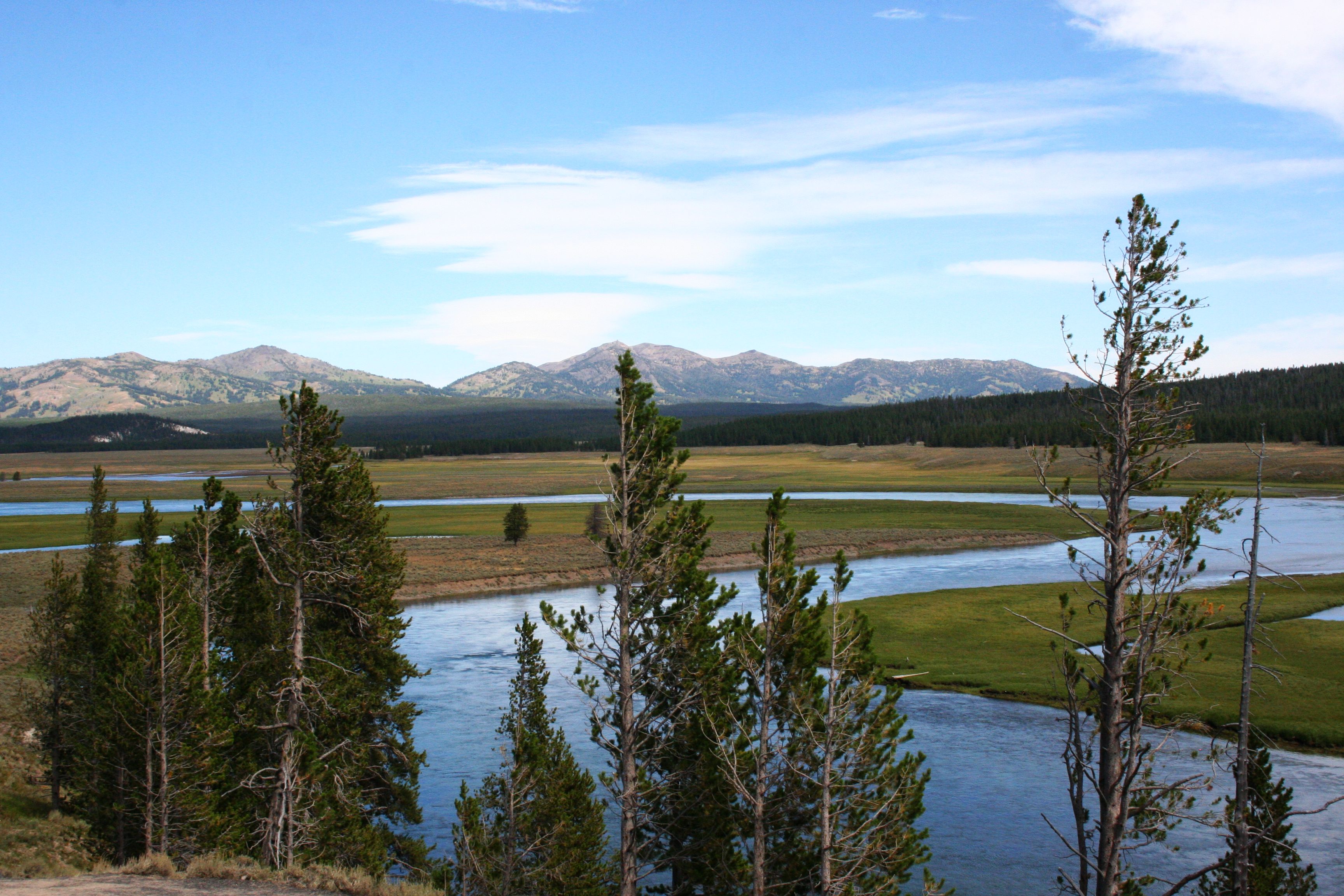
Yellowstone River
The Revenant by Michael Punke
New York : Picador, 2015.
262 p. : maps ; 21 cm.

Given that the movie version of this book was critically acclaimed, I decided to give it a read.  I'm glad I did.   It's not a great book, but it is a good one.  Punke has taken the mostly true story of Hugh Glass, an 1823 frontiersman, and fictionalized it into a solid revenge and survival tale.

I found The Revenant a compelling read, hard to put down, as Glass manages to survive harrowing experience after harrowing experience.  Beginning with his near fatal mauling by a grizzly to his almost being killed in an ambush toward the end of the novel, Glass is a fascinating figure - damned to experience shocking pains and injuries, and yet charmed in that he always walks away from them a survivor.  The revenge aspect was less interesting to me.  Part of what fuels Glass' survival is his determination to live and bring retribution to the men charged with watching over him, who instead robbed and abandoned him.  It's not a noble pursuit, but it feels realistic.

Along the way, there is some subtle and fascinating changes in Glass' attitudes about satisfying his desire for revenge.  But the power of the novel lies in Glass' remarkable skills, grit and ability to make quick and risky decisions that ultimately save his life.

The movie on the other hand, seems to have opted to bump the violence levels up several notches and to make revenge and gore the heart of the film - "pain porn" one reviewer calls it.  I think that's too bad, since in a more compassionate director's hands the film really could have wrestled with the troubled spirit of the frontiersmen and the ultimate emptiness of revenge attained.  That is at the heart of Punke's novel and is why I'll stick with the book and let others suffer through the film.    

Wednesday, April 6, 2016

In Greed We Trust


Griftopia by Matt Taibbi
New York : Spiegel & Grau Trade Paperbacks, 2011.
299 p. ; 21 cm.

How can you not want to read a book by the author who described the sleazy investment bank, Goldman Sachs, as "a great vampire squid wrapped around the face of humanity, relentlessly jamming its blood funnel into anything that smells like money"? Taibbi writes with a lot of emotion (often peppering his prose with well-deserved name calling and occasional cuss words) but also with a quiver full of meticulously documented facts and knowledge.  He manages to make a raucous, fun read out of a subject that is both very complicated - can you say Collateralized Debt Options and Credit Default Swaps? - and very infuriating .  

After reading this book, you will never look at mortgages, investments, bailouts and Wall Street in the same light.  This is a book which will shake your faith in the fairness of the financial system in the US, but it will also make you smarter as you start to understand the outright fraud and criminality that lead to the great crash of 2008.  

And you might even find yourself laughing out loud as you read it.  So what are you waiting for?  Read it!


Tuesday, February 23, 2016

Rough Cotton

The Half Has Never Been Told by Edward E. Baptist
New York : Basic Books, a member of the Perseus Books Group, [2014]
xxvii, 498 p. : ill., maps ; 25 cm.

Read this book!  If you love history, read this book. If you want to see US history in a very new way, read this book.  If you want to have many of your assumptions about slavery and the Civil War turned on their heads, read this book.  The Half Has Never Been Told is long, complicated, riveting, and incredibly well written - read it!  For me this book brought to mind the books - Slavery by Another Name and Guns Germs and Steel - for it's power to tilt one's understanding of history and how power works.

I can't say enough about what an important and interesting book this is.  I'll be recommending it to any students who love history, and to any teachers interested in history.

Lastly, I'd be remiss not to note that I first heard of this book on a list of recommended books from Ta-Nehisi Coates who's book Between the World and Me is another book to recommend again and again!  

Monday, August 24, 2015

Civil Rights Sailors and the Big Explosion

The Port Chicago 50: Disaster, Mutiny, and the Fight for Civil Rights by Steve Sheinkin
New York : Roaring Brook Press, 2014.
1st ed.
200 p. : ill. ; 24 cm.

From the dynamic cover, to the epilogue - I loved this book.  It is an amazing story of unsung Civil Rights heroes who took against racism in the US Navy during WWII and helped force greater opportunities for African Americans in the military - and at great cost to themselves.

This book has all the elements of a great tale - a massive tragic explosion, tales of personal courage, rumors of a conspiracy, the suspense of a trial/court martial, and a positive but not rosy ending. And in telling the tale, Steve Sheinkin brings to life the stories of very young men who simply wanted to be given a fair opportunity to be part of the US war effort in WWII.

I really like this book for bringing together so many important threads - worker safety, segregation and racism during WWII (including extreme violence against enlisted African Americans in the south), the stirrings of the great Civil Rights movements of the 50s and 60s, the early career of Thurgood Marshall, and the ways in which change occurs in fits and starts through resistance and personal courage.  And it's all done in the relatively brief space of just over 160 pages (along with great photos and illustrations).

I would recommend this book to any student interested in WWII, disasters, the Civil Rights Movement, the military, and US history in general.
   

Wednesday, August 19, 2015

Terrific Fair, Fairly Terrible

The Devil in the White City by Erik Larson
New York : Vintage Books, 2004, c2003.
1st Vintage Books ed.
xi, 447 p. : ill., maps, music ; 21 cm.

This is a fantastic and haunting book about the 1893 World's Fair in Chicago. Larson's book manages to convey just how incredible the feat of Chicago's hosting the world's fair was (having just over 2 years to organize and build the entire fair venue) - while also telling the story of serial killer Henry H. Holmes and his immense frauds and scams that helped him elude capture for so long.

The book is a wonderful glimpse into the turn of the century world of the US and Chicago, which had been destroyed by fire only a little over twenty years before.

The reader gets to learn so much about the founding architects of Chicago, the landscaping prowess of John Olmsted - creator of NYC's Central Park - the amazing invention of the Ferris Wheel and the massive turnout of visitors to the fair (including a one day attendance total of over 750,000 people!).  Following the story of killer, H.H. Holmes, also gives the reader a feel for the fast and loose business dealings of the day, the ease with which people could assume false identities, and the plodding nature of police investigations at the turn of the century.

I will definitely recommend this book to anyone who is interested in Chicago history, true crime stories, and just an amazing read.

Thursday, March 19, 2015

Better Than Fiction (and Worse)

Twelve Years a Slave by Solomon Northrup
New York, NY : Penguin Books, 2013.
xxxviii, 240 p. : ill ; 20 cm.

When the movie, Twelve Years a Slave, came out about 2 years ago, I knew I would want to read the book.  At the time, I bought a couple of new copies of the book for my library, and I've finally gotten around to reading it - stunning!  I can't say enough about what a fine book this is.

I thought that since this autobiography was written over a hundred and fifty years ago, it might be a bit formal or stiff, but it is wonderfully written.  There are several things that make the story of Northrup's ordeal such a tour de force.  First, the circumstances of his living thirty years a free man, only to be kidnapped and sold into slavery make the story immediate and chilling.  The reader can imagine the experience in a visceral way different from narratives of those born into slavery. Northrup's tale reads like a modern Kafkaesque story of one man's descent into a horrifying alternate universe.  As Fredrick Douglas said of Twelve Years a Slave, "It chills the blood."  

Also, since Northrup was so concerned that he not be accused of fabricating his narrative, he includes specific names and details that make the action of the book terribly real and give the book a cinematic effect.  Steve McQueen, the director of the Oscar winning film of the same name, writes in the Foreword, "The book read like a film script, ready to be shot."

I'm not sure I'll be able to get a lot of students to read Twelve Years a Slave, but I'm going to give it a try.  I'll feel certain telling them it's a book that will blow them away - more than any dystopian fiction novel could!

Wednesday, February 25, 2015

Comic Wonders

The Secret History of Wonder Woman by Jill Lepore
New York : Alfred A. Knopf, 2014.
xiv, 410 p. : ill. (some col.) ; 25 cm.

This is an amazing book of history, culture, and biography.  Jill Lepore has used her research into the origins of the Wonder Woman comic character to present a rich history of US feminism, bohemianism, pop culture and alternative lifestyles.

Lepore's history has at it's heart, the creator of Wonder Woman, William Marston - scholar, psychologist, pro-feminist, huckster, man of secrets and passions.  The book begins with the early US feminist struggles for suffrage and birth control and brings the story up to the present.  We find out in the course of the book that the people involved in Wonder Woman's origins include the famous feminist, Margaret Sanger - and that Marston has legitimate claims to the invention of the "lie detector."

The book is a personal history of Marston the two women who lived with him most of their lives and who had children with him, a history of the phenomenal rise of comic books in the US [and the "moral" backlash against them], a glimpse into the period of WWI, WWII, and - of course - a history of the the US feminist movement in the 20th century.  There is a lot in this well-researched book.

I'd recommend this book for any student interested in the history of comic books, interested in the women's rights movement in the US, or interested in 20th century US history and culture. The main drawback for this book is that it's kind of long for a high school history book - but with it's index, it would serve well for any research projects.

Friday, December 12, 2014

The War to End All War Protests

From LOC
Unraveling Freedom by Ann Bausum
Washington, D.C. : National Geographic, c2010.
88 p. : ill. (some col.) ; 26 cm.

This is one of those short, but visually stunning and well written books that National Geographic has been putting out for young readers (e.g. photobiographies Bylines & Knockout about Nelly Bly & Joe Louis, respectively, or Denied, Detained, Deported about abuses of US immigration).

I really enjoyed reading this book for the way that Bausum brings alive the times of WWI and makes the assaults on liberties and freedoms by the US government feel very contemporary. She is good at comparing the various attempts to propagandize, censor, and stifle dissent to similar actions that have accompanied other US wars, including the latest "war on terror."

I was struck, in reading the book, at how US trends of anti-intellectualism and blind patriotism have strong roots in domestic policies during WWI.  In the frenzy of anti-German propaganda (see graphic above), not only was German language instruction virtually wiped out of the US education system, but over half the states banned teaching any foreign language.

There is a lot to recommend about this book to any student interested in US history during the period of WWI and its aftermath.

Tuesday, May 27, 2014

Study War No More

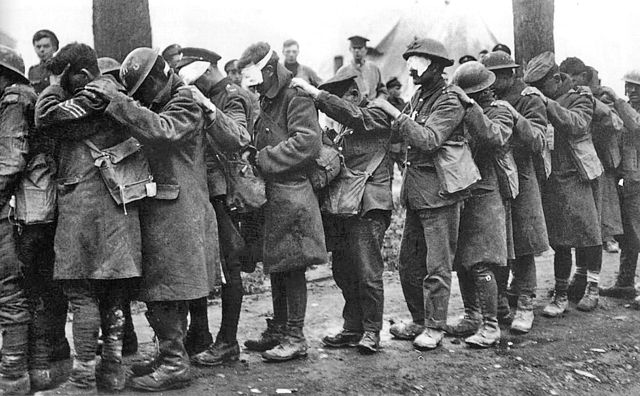
British 55th (West Lancashire) Division troops blinded by tear gas  during the Battle of Estaires, 10 April 1918
The First World War by John Keegan
New York : Vintage Books, 2000.
xvi, 475 p. : ill., maps ; 21 cm.

I've been slogging through a lot of books of European history and especially WWI - The Proud Tower, The Sleepwalkers, and now Keegan's First World War, which I pointedly finished on Memorial Day.

World War One is truly emblematic of the sickening, meaningless, barbarous, and utterly worthless human phenomena of making war - particularly modern warfare.  Especially painful is the fact that WWI essentially lay the groundwork for WWII.  As Keegan states in the closing pages of his book, "The Second World War was the continuation of the First...."

When I finished this book, I was left numbed by the staggering numbers of young men killed in the WWI.  This passage toward the end of Keegan's work gives a sense of the monstrous carnage that WWI unleashed.
"To the million dead of the British Empire and the 1,700,000 French dead, we must add 1,500,000 soldiers of the Hapsburg Empire who did not return, two million Germans, 460,000 Italians, 1,700,000 Russians, and many hundreds of thousands of Turks...."
In what moral universe can a person truly reckon with or comprehend such massive slaughter?  And then to realize that these numbers will be increased by a factor of six or seven (including many more civilians) in the horrors of WWII leaves me feeling despair.

I will say that Keegan has managed to pull together a readable and lucid account of WWI which is no small accomplishment.  He also manages to tell the story with moral conviction, but a light ideological touch, so that the reader is allowed to form her own opinions about where the guilt and responsibility lies for the nightmare that WWI was. I would definitely recommend it to a student who is interested in a detailed but compact history of the "Great War."

Monday, December 2, 2013

Kurlansky's Tasty History

The Big Oyster: history on the half-shell by Mark Kurlansky
New York : Random House Trade Paperbacks, 2007, c2006.
xx, 307 p. : ill., maps ; 21 cm. 

What a fun way to learn about the history of New York City!  Kurlansky again finds a way to entertain and inform while presenting his discoveries about another item that humans put in their mouths.  He has tackled salt, and cod (which I reviewed here about a year ago).

Like his other books, this one is well-written, fascinating, and very informative.  In it you'll learn that for many years in the 1800s, New York City was the oyster capital of the world - but that in a short time ballooning population and industrialization led to the demise of the rich oyster beds of the New York harbor - due to pollution and and over-harvesting. Kurlansky does a great

There is a lot to The Big Oyster - it is a practical history of the early years of New York City, with a lot about the earliest European settlement of the area to the bustle of the 19th and 20th centuries.  But it is also a social history and a foodways history - including recipes from various eras.  Finally, it is both an environmental history and cautionary tale about the squandering of precious natural resources.

I would definitely recommend this book to anyone curious about the history and culture of America's most dynamic city, New York.