Frida & Diego: Art, Love, Life by Catherine Reef
Boston : Clarion Books/Houghton Mifflin Harcourt, 2014
168 p. : ill. (some col.) ; 26 cm.
Most people have some passing familiarity with the art of Frida Kahlo and Diego Rivera, but this is one of those great non-fiction books for young adults that really expands the range of information about these two stunning Mexican painters.
The book is richly illustrated with photos and includes back matter featuring a nice selection of famous works by the two artists. The back of the book also includes a timeline and copious notes by the author.
I really loved how this book does not condescend to young adults and manages to objectively convey the very unconventional nature of Rivera and Kahlo. The book also skillfully conveys the artistic excellence of both artists - showing that Rivera was definitely more famous, prolific and well paid, while Kahlo was truly both a skilled (and self-taught) and truly original painter. The book conveys the deep and complex love that existed between these two as they married, split up, and eventually remarried.
I also appreciated that Reef was able to honestly portray what a sexist user Diego Rivera was, but she also conveys the poignant tenderness that he held for Frida, and the deep bond between them.
"Stuck in the hospital [1950], Frida missed seeing Diego receive the National Prize for Plastic Arts....She saw her husband often, though, because he took the room next to hers, to be nearby at night. Diego's presence comforted Frida like nothing else. He read poetry to her and rocked her to sleep. About once a week he brought in a borrowed movie projector and showed her the old Laurel and Hardy films....he did whatever he could think of to lighten her mood, even if he had to shake a tambourine and dance around the room, or roar like a bear with his arms raised and fingers curved like a claws." (p.101)
I would definitely recommend this book to any student interested in knowing more about Frida Kahlo or Diego Rivera... or both!
Showing posts with label Mexico. Show all posts
Monday, December 10, 2018
Thursday, April 12, 2018
Made in Mexico - ¡Si!
Photographic: the life of Graciela Iturbide by Isabel Quintero + Zeke Peña
Los Angeles : The J. Paul Getty Museum, [2018]
95 p. : chiefly ill. ; 24 cm.
What a great little book! I love that this introduction to the photography of Graciela Iturbide is published by the Getty Museum. Using the medium of the graphic novel (along with inserted actual photos by Iturbide - such as this phenomenal one of a woman with iguanas on her head) is a brilliant way to introduce a visual artist.
I also appreciate the writing of this book. The movement of the narrative is both informative and clear, but also dreamy and poetic. Take for instance this passage from page 18 - where Iturbide has taken her first photo while on a plane:
I become a bird in the heavens
and am filled with birds.
The camera awakens wings.
The wings give me new eyes.
And I will never stop flying.
It is also great that a book celebrates a living artist - a woman artist, and a Mexican artist, too! Wonderful!
Los Angeles : The J. Paul Getty Museum, [2018]
95 p. : chiefly ill. ; 24 cm.
What a great little book! I love that this introduction to the photography of Graciela Iturbide is published by the Getty Museum. Using the medium of the graphic novel (along with inserted actual photos by Iturbide - such as this phenomenal one of a woman with iguanas on her head) is a brilliant way to introduce a visual artist.
I also appreciate the writing of this book. The movement of the narrative is both informative and clear, but also dreamy and poetic. Take for instance this passage from page 18 - where Iturbide has taken her first photo while on a plane:
I become a bird in the heavens
and am filled with birds.
The camera awakens wings.
The wings give me new eyes.
And I will never stop flying.
It is also great that a book celebrates a living artist - a woman artist, and a Mexican artist, too! Wonderful!
Monday, November 4, 2013
Homo Cursorius
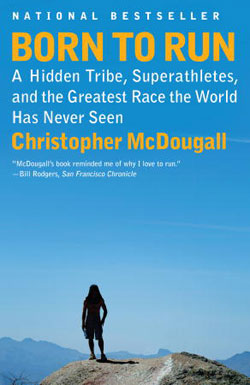
Born to Run: a Hidden Tribe, Superathletes, and the Greatest Race the World Has Never Seen by Christopher McDougall
New York : Vintage Books, 2011, c2009.
1st Vintage Books ed.
287 p. ; 21 cm.
For the past couple of months my son has been insisting that I had to read Born to Run - so I did. He was right; it was a great read! Not perfect, but pretty amazing!
The book is an exuberant introduction to the phenomena of ultrarunning, but it is more than that. It is a celebration of human running, of adventure and determination, and the amazing - and often larger than life - personalities of ultrarunners. Even more, the book serves as a provocative look at human origins, evolution and the possibility that modern humans (all of us!) are born with the capacity to run far longer and farther than most of us have ever run - and to do it with minimal injuries. This last aspect has McDougall casting a rather critical eye on the whole modern running shoe industry.
McDougall's hook for the book is his search for the enigmatic indigenous people of Northwest Mexico, the Tarahumara who survived contact with the Spaniards by avoiding engagement with them, opting instead to live in the very sparse, barren, and rugged terrain of the Copper Canyon in Mexico. The Tarahumara also happen to be world class endurance runners, and McDougall's renewed interest in long distance running (which had hobbled him with injuries) is rekindled during his successful search for the Tarahumara. His contact person, almost-mythical gringo runner and hermit called el Caballo, draws McDougall into his wildly ambitious plans to stage a race in the dangerous Copper Canyon pitting the greatest ultrarunners from North America against the greatest Tarahumara runners. As you can imagine, the outcome is hair-raising and almost unbelievable.
I have to admit that when I first began reading the book, I was a bit put off by McDougall's overblown style and descriptions - every character is the most amazing, most awesome, most eccentric, most etc. etc., that one could imagine. However, on Googling some of the characters in the book, they have in fact accomplished ridiculously grueling feats of running endurance - and often faster and more energetically than any other humans on the planet. My only other complaint is that the book would have been much better with at least some photos - particularly of the characters who populate the book.
This book will definitely have you thinking a lot about running, whether you are someone who has never run before or are a seasoned marathoner. And it does it with fun, adventure and a true zest for the subject. Not bad for a book on something as common as running from here to there!
New York : Vintage Books, 2011, c2009.
1st Vintage Books ed.
287 p. ; 21 cm.
For the past couple of months my son has been insisting that I had to read Born to Run - so I did. He was right; it was a great read! Not perfect, but pretty amazing!
The book is an exuberant introduction to the phenomena of ultrarunning, but it is more than that. It is a celebration of human running, of adventure and determination, and the amazing - and often larger than life - personalities of ultrarunners. Even more, the book serves as a provocative look at human origins, evolution and the possibility that modern humans (all of us!) are born with the capacity to run far longer and farther than most of us have ever run - and to do it with minimal injuries. This last aspect has McDougall casting a rather critical eye on the whole modern running shoe industry.
McDougall's hook for the book is his search for the enigmatic indigenous people of Northwest Mexico, the Tarahumara who survived contact with the Spaniards by avoiding engagement with them, opting instead to live in the very sparse, barren, and rugged terrain of the Copper Canyon in Mexico. The Tarahumara also happen to be world class endurance runners, and McDougall's renewed interest in long distance running (which had hobbled him with injuries) is rekindled during his successful search for the Tarahumara. His contact person, almost-mythical gringo runner and hermit called el Caballo, draws McDougall into his wildly ambitious plans to stage a race in the dangerous Copper Canyon pitting the greatest ultrarunners from North America against the greatest Tarahumara runners. As you can imagine, the outcome is hair-raising and almost unbelievable.
I have to admit that when I first began reading the book, I was a bit put off by McDougall's overblown style and descriptions - every character is the most amazing, most awesome, most eccentric, most etc. etc., that one could imagine. However, on Googling some of the characters in the book, they have in fact accomplished ridiculously grueling feats of running endurance - and often faster and more energetically than any other humans on the planet. My only other complaint is that the book would have been much better with at least some photos - particularly of the characters who populate the book.
This book will definitely have you thinking a lot about running, whether you are someone who has never run before or are a seasoned marathoner. And it does it with fun, adventure and a true zest for the subject. Not bad for a book on something as common as running from here to there!
Tuesday, September 4, 2012
A Readable History of Mexico
The Life and Times of Mexico by Earl Shorris
New York: W. W. Norton, 2006.
800 p.
This summer I did things a little differently. I was interested in reading a fairly new book on Mexican history and found one recommended (see the SF Chronicle) that we did not have in our school library collection. This is a fairly long book for a school collection and so I bought and read the eBook version for my Nook.
At first I didn't think I'd care for the book. It is very much concerned with discovering the unique nature of the Mexican character - something that I'm not so interested in, and - frankly - something I'm a little suspicious of. However, the book really started getting interesting to me during its treatment of the US-Mexican war, and I found myself learning a lot about the war that I had never known.
Shorris' coverage of the Mexican Revolution was equally interesting and so I stuck with the book to the end and I'm glad that I did. The book offers the reader a lot to think about - including what policies and events make nations rich and poor. It also takes the reader through the tumultuous early years of the 21st century when NAFTA was wreaking havoc on the economy of Mexico, the the maquiladoras were springing up at a phenomenal pace, and the PRI was losing its grip on complete control of the nation's political system.
I was hoping that Earl Shorris might eventually write a revised version, but I found out that he died about the same time that I was reading his book.
New York: W. W. Norton, 2006.
800 p.
This summer I did things a little differently. I was interested in reading a fairly new book on Mexican history and found one recommended (see the SF Chronicle) that we did not have in our school library collection. This is a fairly long book for a school collection and so I bought and read the eBook version for my Nook.
At first I didn't think I'd care for the book. It is very much concerned with discovering the unique nature of the Mexican character - something that I'm not so interested in, and - frankly - something I'm a little suspicious of. However, the book really started getting interesting to me during its treatment of the US-Mexican war, and I found myself learning a lot about the war that I had never known.
Shorris' coverage of the Mexican Revolution was equally interesting and so I stuck with the book to the end and I'm glad that I did. The book offers the reader a lot to think about - including what policies and events make nations rich and poor. It also takes the reader through the tumultuous early years of the 21st century when NAFTA was wreaking havoc on the economy of Mexico, the the maquiladoras were springing up at a phenomenal pace, and the PRI was losing its grip on complete control of the nation's political system.
I was hoping that Earl Shorris might eventually write a revised version, but I found out that he died about the same time that I was reading his book.
Subscribe to:
Posts (Atom)