Showing posts with label World War II. Show all posts

Wednesday, April 21, 2021

Misrule of Law


They Called Us Enemy
by George Takei [also Justin Eisinger and Steven Scott ; art by Harmony Becker]
Marietta, GA : Top Shelf Productions, [2019]
204 p. : chiefly ill. ; 23 cm.

This graphic novel is a super addition to books on the internment/incarceration of Japanese Americans during WWII.  As most people know, Pres. Roosevelt (FDR) ordered the seizure and imprisonment of Japanese Americans shortly after the Japanese attack on Pearl Harbor which officially launched the US into the Second World War.  This act was clearly racist, unconstitutional and immoral - though it took about 40 years for the US government to admit it was wrong and pay restitution to survivors.  It took even longer for the Supreme Court to condemn (in 2018) its complicity in this crime (re the Korematsu ruling of 1944).  All this is covered in the book, but the heart of the book is in Takei retelling the story from the viewpoint of a child experiencing his family's ordeal of being arrested, transported and imprisoned in two different internment camps.

The child's viewpoint is in fact Takei's. He was about 5 years old when his family was ordered out of their Los Angeles home and deported by train to Arkansas.  He captures the innocence of a young child taking in much of the experience as a grand adventure though being confused at the crying and hushed whispers of the adults. The book is also strengthened by the life of George Takei who was one of the original stars of Star Trek and who is currently a significant online personality with millions of followers on Facebook and Twitter.   

I learned a lot in this book.  It was especially painful to see how parents tried to figure out what was best to keep their families safe - as when loyalty oaths were offered to the detainees and some out of conscience refused to sign them.  He also gives kudos to both the young Japaneses American men who chose to enlist and fight in the war and to those who refused and were imprisoned at Leavenworth. 

I thought the book was really tight up until the very end. It felt a little jumpy and didactic in the last 20 pages or so as Takei keeps trying to hold up the successes of the US system of government when it finally confronts this injustice.  That being said, it is a powerful and moving book and I would highly recommend it.
     

Monday, November 30, 2020

Remission


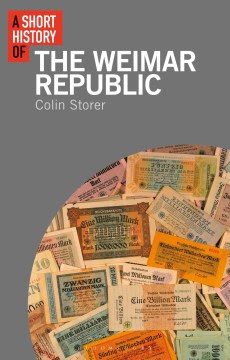
A Short History of the Weimar Republic by Colin Storer
London : Bloomsbury Academic, 2019, c2013.
vii, 239 p. : ill., map ; 23 cm.   

I really love history and when I was putting this new book on the shelf the other day, I realized that I really don't know much about the Weimar Republic, that dynamic and short-lived German republic sandwiched between the ruin of one world war brought about by its preceding imperial government and the ruin of the Nazi, fascist dictatorship that marked the death of the Weimar Republic.

It was a striking thirteen years that Weimar survived, and the author is as interested in pointing out its successes and achievements as he is in documenting its eventual failure and collapse.  This was where I learned quite a lot of new information. 

I had always assumed - as many have done - that it was the crushing reparations forced on Germany after WWI that doomed the Weimar Republic to economic chaos and eventual disaster.  It's not that this was not a crucial factor in its demise, but I hadn't realized the successes that the Weimar government (under Chancellor Stresemann) had in negotiating down the burdens of its reparations. However, the fragility fo Weimar's economy and its dependence on the chaotic international economic system made it especially susceptible to the onset of the great depression in 1929.  

Storer also wants to point out that politically, Weimar managed to survive as a democratic state longer than other Central European states. He also notes the many artistic, scientific and cultural achievements of Weimar.  

There is a lot to mull over (and grieve) when reading about Weimar. Like many books of history leading up to the rise of the Nazis, one knows how it ends, but the pain is seeing that it didn't have to go the way it did and could have turned out much differently and much better, of course.

I'll definitely keep this book in mind if a student has an interest in the period.  It's an accessible and short introduction to this critical time in twentieth century Europe.


Saturday, June 30, 2018

Ground Zero

Hiroshima by John Hersey
New York : Vintage Books, 1989, c1985.
152 p. ; 18 cm.

I had the good fortune of going to Japan this summer, part of the motivation was knowing a couple from the US who are running the World Friendship Center in Hiroshima.  They suggested reading Hersey's book - which is available online for free at the New Yorker where it was first published in 1946.

I had read the book long ago and was impressed with what a powerful and important book it is.  It tells the story of the atomic bombing of Hiroshima by weaving together the stories of survivors who Hersey interviewed shortly after the bombing.  It is a terrifying retelling of the savage effects of the US bomb and on the strange and random ways that decided who survived and who did not.

Though it was written over seventy years ago, it has immediacy still.  For anyone interested in discovering what it was like to be in the Hiroshima bombing, this remains a powerful testament.

Friday, December 16, 2016

Crimes of the Old-Right


The Prisoners of Breendonk by James M. Deem
Boston : Houghton Mifflin Harcourt, [2015]
xi, 340 p. : ill. (some col.), col. maps ; 24 cm.

Deem has done something that is difficult to do - written a fresh Holocaust book that brings something new to light (a nearly forgotten Nazi-run prison in occupied Belgium), reveals the mundane and depraved day to day sadism and savagery of the Nazis, and rescues from oblivion the humanity of the men who suffered and/or were murdered at this prison.

I couldn't read the book cover to cover. It was just too hard to revisit the beatings, starvation, humiliations, tortures, executions, and day-to-day cruelties committed against the prisoners in Breendonk. However, the book uses a great many photographs, and personal testimonies to bring to life the inmates of the prison - and to put faces and names on the perpetrators of this smaller, but still horrible Nazi concentration camp.

I would definitely recommend this book to students who know some of the basic facts about the Holocaust, but who want to really engage with the people who were involved.  With maps, diagrams, artistic sketches from an inmate, reproduced documents, and many stunning photographs, Prisoners of Breendonk is a powerful read.

Finally, the book is a stark reminder of the horrendous crimes of the original Nazis - and the dangers posed by the current neo-Nazis and so-called "alt-right" groups and leaders experiencing a resurgence of power and influence in the US and Europe.


Saturday, August 6, 2016

Amazing Amazing

The Amazing Adventures of Kavalier & Clay by Michael Chabon
New York : Picador, c2000.
639 p. ; 21 cm.

Michael Chabon's novel won a 2001 Pulitzer Prize and I challenge a reader to not enjoy this  wonderful tale.  It's a gloriously written tale of the starting in the late 1930s and continuing into the 1950s and centers on the golden age of comic books in New York City, but also embraces the Holocaust, Harry Houdini, The Golem of Prague, Brooklyn, gay life, and of course love, friendship and family.

Though we have this book in the UHS library collection, I read it on my cell phone - accessing it through our library's eBook collection.  It's not the first book that I've read on my phone, but it was great to be able to carry it around in my pocket while traveling during the summer.

Fortunately, The Amazing Adventures seems to be doing quite well.  I looked for a copy at my local public libraries and all 6 copies were checked out.  It's a great book and I will definitely recommend it to any student looking for a rewarding literary fiction read from a contemporary author - especially a reader who has an interest in world of comic book writing and publishing back when vast majorities of young Americans regularly read comic books. 

Tuesday, November 17, 2015

Music for the Apocalypse


Symphony for the City of the Dead by M.T. Anderson
Somerville, Mass. : Candlewick Press, 2015.
456 p. : ill., maps ; 24 cm.    

I really loved this book.  If I were writing history for high school students, it's the kind of book I would be really proud of.  Symphony for the City of the Dead sheds light on a major event in history - the 900 day Siege of Leningrad - and does it through a unique lens - that of a world famous composer - Dmitri Shostakovich - who was intimately involved in the event.  M. T. Anderson also is able to handily place the event in the broader historical context of the Russian Revolution, Stalin's Great Terror and the horrors of the Nazi invasion of the Soviet Union during WWII.

There is so much to like about this book.  The reader experiences the heady artistic days of the early Soviet Union, the chilling and murderous days of the Stalinist purges, the horrors of a modern city under siege, and the triumph of art and inspiration amid such loss and violence.

This is a book I will definitely offer to any student looking for good WWII history or nonfiction about classical music, or history of Russia.  I hope it finds an audience. With nice black and white photos, and a clear and passionate style of writing - it should not be too much of a challenge for students, but I fear it might scare some kids off with it's 400 plus pages and their unfamiliarity with the Siege of Leningrad.

I should also mention that for any interested reader, it pairs nicely with David Benioff's wonderful novel, City of Thieves, which is set in Leningrad during the siege.

The book deserves praise and recommendation, and I see that it is on the long list for the National Book Award.


Monday, August 24, 2015

Civil Rights Sailors and the Big Explosion

The Port Chicago 50: Disaster, Mutiny, and the Fight for Civil Rights by Steve Sheinkin
New York : Roaring Brook Press, 2014.
1st ed.
200 p. : ill. ; 24 cm.

From the dynamic cover, to the epilogue - I loved this book.  It is an amazing story of unsung Civil Rights heroes who took against racism in the US Navy during WWII and helped force greater opportunities for African Americans in the military - and at great cost to themselves.

This book has all the elements of a great tale - a massive tragic explosion, tales of personal courage, rumors of a conspiracy, the suspense of a trial/court martial, and a positive but not rosy ending. And in telling the tale, Steve Sheinkin brings to life the stories of very young men who simply wanted to be given a fair opportunity to be part of the US war effort in WWII.

I really like this book for bringing together so many important threads - worker safety, segregation and racism during WWII (including extreme violence against enlisted African Americans in the south), the stirrings of the great Civil Rights movements of the 50s and 60s, the early career of Thurgood Marshall, and the ways in which change occurs in fits and starts through resistance and personal courage.  And it's all done in the relatively brief space of just over 160 pages (along with great photos and illustrations).

I would recommend this book to any student interested in WWII, disasters, the Civil Rights Movement, the military, and US history in general.
   

Thursday, September 4, 2014

Peculiar, Creepy, and Wildly Inventive

A found photo from Riggs' collection.
Miss Peregrine's Home for Peculiar Children by Ransom Riggs
Philadelphia : Quirk Books, 2013.
382 p. : ill. ; 21 cm.

I might have missed this book if not for a donation from our local Barnes & Noble store.  They gave our library several copies of various books from their "World Book Night"- including Miss Peregrine's Home for Peculiar Children.  I was intrigued by the cover...


...and thumbed through it to see that it was filled with enigmatic,evocative and unsettling photographs from times gone by.  I was definitely hooked.

The novel combines history (WWII and Holocaust survivors), time travel, monsters, the supernatural, danger, and romance - as Ransom Riggs weaves a great story sparked by his own hobby/obsession with old photographs.

I really enjoyed the wonderfully imaginative interweaving of photos and story.  As you read the novel, you will find the related photo reprinted within close proximity the page you're on. The photos are memorable and haunting in their own right, and add an element of "is this true" to what is otherwise a truly "out of this world" thriller.

I will definitely recommend this book to students looking for "something different," students who like fantasy/supernatural, and to any student who enjoys horror/monster/paranormal stories, too.