Showing posts with label nonfiction. Show all posts

Friday, April 29, 2022

Better Than Hollywood Stars


The Secret Life of Stars
by Lisa Harvey-Smith
New York : Thames & Hudson, 2021.
182 p. : ill. ; 22 cm.
     
This is a light (but super informative) read. At times the over-anthropomorphizing of stars is a bit much, but that's the only fault I have with this really good introduction to the wild variety of stars that astronomers and astrophysicists study.

From the sun to massive black holes and all the weird variations in between, this book offers a tempting exploration through what is currently known about stars and also introduces readers to some of the stellar mysteries that astronomers hope to unravel when they get the chance to employ tools like the new Webb telescope. 

Harvey-Smith does a great job explaining some pretty complicated concepts about how stars produce their light and heat and how elements are created in the collapse and explosions of huge stars. I would recommend this to both astronomy fans and to students who are just curious about the stars and current astrophysics.

Tuesday, March 8, 2022

Dystopia Now


The Looting Machine
by Tom Burgis
 New York : PublicAffairs,  c2015.     
 xi, 321 p. : ill., map ; 24 cm.     

This is a powerful book that examines the power and endurance of the entrenched systems that pillage the resources of Africa. It is an indictment of the many legal (and illegal), but grossly unethical networks of banking rules, corporate laws, governments, militaries and paramilitaries that vacuum up the untold wealth fuel and mineral wealth of the African continent and keep it in the hands of a tiny minority of wealthy and well-connected people (while immiserating the vast majority of citizens in those countries where the wealth is found.)

This is not exactly the kind of book most students would pick up and read cover-to-cover, but it would be VERY useful to students doing any research on globalization, world poverty, corruption, mining, economics, especially in relation to the nations of Nigeria, Angola, South Africa, etc. It is a great resource for understanding how even when liberation governments come to power, they are often overtaken by the global systems of off-shoring, international finance/loans, and powerhouse nations like the US and China that seek to control profits gained from extractive industries.

The author Tom Burgis deserves great deal of credit for doing dogged (and intrepid) research as he visits both the glittering high-rises of corporate/financial power (e.g. Hong Kong, New York, and Harare)  conflict-torn sites (e.g. Nigeria, Congo, Zimbabwe) of mining and extraction.

It's a complicated and painful book to read, but one that anyone who lives in more wealthy countries should read since the wealth of Africa is deeply entwined with the wealth of those better-off countries.

Tuesday, December 14, 2021

Picture It!


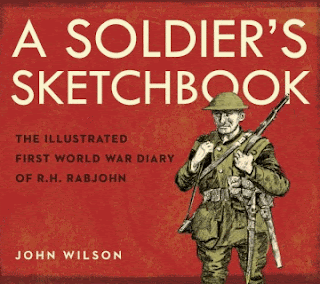
A soldier's sketchbook : the illustrated First World War diary of R.H. Rabjohn
by R.H. Rabjohn/John Wilson
Canada : Tundra Books, [2017]     
112 p. : ill. ; 22 x 24 cm.

I'm always interested in WWI, the war that turned the European violence inward instead of outward and ripped the façade off the elegant civilization of Europe at a cost of the deaths of millions of combatants and many civilians.

This WWI book is a special addition to the literature of that "Great War." It consists of the sketches from the war done by R.H. Rabjohn, a soldier from Canada, who saw combat from April 1917 until the end of the war on November 11, 1918. 


It was Rabjohn's official duties as a soldier-sketch artist that allowed him to carry a sketch book (something that was prohibited to other soldiers). He also kept a diary and the author, John Wilson, has done a fine job of organizing the sketches and diary entries into a logical and easy to follow whole.  Doing drafts and support work at the front meant that Rabjohn was frequently in great danger and witnessed first hand the horrors of trench warfare that marked WWI.  

Given its visual appeal, shortness, and direct narrative, this book would be a great way of introducing World War I to teens and hopefully would interest some in wanting to know more about this nation shattering event - the tragic consequences of which continue into the present.


Thursday, December 2, 2021

Cold (blooded) War - US Style


The Jakarta Method
by Vincent Bevins
New York: Public Affairs, c2020, 2021.
ix, 340 pages : illustrations ; 21 cm  

It's hard to say whether US citizens have very short memories or face such a powerful propaganda apparatus that it takes a bit of hard work and (soul-crushing honesty) to learn the dirty truths of US history and foreign policy. Considering this, books like The Jakarta Method are wonderful (and painful) antidotes to the flood of official misinformation and willful forgetting that plague the US. 

How many US citizens realize that their government actively helped and encouraged the slaughter of about 1 million unarmed, harmless, and law-abiding civilians in Indonesia in 1965 because of their actual or alleged connections to the completely legal and open communist party of Indonesia.  And how many people who know of this vaguely or in more detail, know that it set the pattern for US sponsored/supported ruthless attacks on civilians in Asia, Africa, Central and South America? Bevins does a remarkable job of pulling together this lethal history from the overthrow of Iran to the rise of the extremist president Bolsonaro in Brazil. The reader learns about the deep connections of the Indonesian slaughter with slaughter and atrocities in Brazil, Guatemala, Angola, Vietnam and other states. The numbers and cruelty are truly appalling.

Bevins also does a good job in scoping out to consider the profound effects that such widespread and cold-blooded killing has had in shaping the world we live in now.  He questions what it means to "win" the Cold War when the means were so depraved and terrible.  He wonders about what kind of world we might live in if the pro-democracy, constitutional parties that leaned left or opposed US hegemony had been allowed to survive. Would we see the same appalling wealth inequalities that plague the world, would the rule of law be stronger, and would there be better human rights protections today? 

His book is profound and timely as both in the US and abroad many leaders are encouraging authoritarian rule and promoting lies and violence as a way to preserve their power.

It is a book I highly recommend.

Thursday, April 29, 2021

Define Short


A Short History of the Mongols
by George Lane
London : I.B. Tauris, 2018.
xvi, 236 p. : ill., maps ; 22 cm. 

This is the second "Short History of" book I've reviewed, the previous one being on the Weimar Republic.  I liked that one, but found this history of the Mongols to be too much information for me to take in.  I can't fault the author too much for that, since I think my own ignorance of the period (ca 1206 - 1300) covered in the book made its broad scope overwhelming for me.

Additionally, the events of this period are very convoluted and complex. I think most readers like me will be able to follow along with the rise of Temujin to become the great Genghis Khan, but will be a bit overwhelmed trying to keep track of the rise and fall of his descendants and their khanates - ending with the famous Kublai Khan.   

I think this short history would be a great resource for a student with some prior knowledge of the Mongol Empire, or doing research on that empire.  I think it's a useful resource to have in the library, but will be of limited interest to the general young adult reader.


Friday, April 16, 2021

Rise Above It


Eiffel's Tower for Young People: the Story of the 1889 World's Fair
by Jill Jonnes ; adapted by Rebecca Stefoff.
New York : Triangle Square, 2019.
xi, 354 p. : ill. ; 21 cm.

World's Fairs offer excellent subject matter for history writers.  Think of Eric Larson's macabre and fascinating bestseller about the Chicago World's Fair of 1893. World's Fairs offer a glimpse into the way the dominant culture/s of the time viewed themselves, including who and what was celebrated.  The fairs featured extravagance, spectacle, celebrities and adventure.  The 1889 Paris World's Fair was no exception.  There were bitter rivalries between artists, the spectacle of the Buffalo Bill's Wild West show, a hall of inventions, superstar guests like Thomas Edison, and international rivalries, too. Above all there was the now iconic Eiffel Tower at the center of it all - and at the center of this accessible history - an adaptation for younger readers of Jill Jonnes' Eiffel's Tower. 

I like that this adaptation of Eiffel's Tower moves chronologically, but also builds on storytelling by giving ample time to central characters in the fair: Gustave Eiffel (of course), Buffalo Bill Cody, Annie Oakley, Thomas Edison, the painters James Abbott McNeill Whistler and Paul Gaugin.  Vincent Van Gogh even gets a mention.  Yes, so much was happening at that moment in history.

The book also presents the racism & colonialism running through the fair - exhibits of "model villages and streets" of Frances colonies and targets for colonization. The book also lightly touches on the contradictions of Buffalo Bill's Wild West Show whose company included many Sioux Indians who Cody treated well as workers, but who were also part of the propaganda of the show celebrating the "taming of the US west." 

I'd recommend this book for any student interested in history, especially late 19th century history - a fascinating time when Europe dominated the world not long before descending into the murderous self-destruction of WWI, a period covered in much more detail by Barbara Tuchman in The Proud Tower.   


Monday, February 22, 2021

A Friendly Challenge


The Black Friend: On Being a Better White Person
by Frederick Joseph
Somerville, Mass. : Candlewick Press, 2020.
xviii, 254 p. ; 22 cm. 

This is a great addition to anti-racist books that have been and are being published in recent years.  It's a book by a Black man (one of those super successful, productive and energetic under 30 types that makes people like me feel like a slow, old turtle. Check out his bio here.) It's a welcome addition because - even though it hits hard at white privilege and white supremacy - it is not a "how to" book or a book meant to drop a heavy guilt trip on white people. Instead, Joseph, invites white readers (like me) in on glimpses into his life and how racism has shaped it, and like a good host at a party introduces you to various anti-racist artists and activists though his interview/conversations with them.  He also knows how to drop in funny asides and nudges to go and learn more about Black history and Black culture.  

He does all this in a mere 254 pages and it's no small accomplishment.  The book even concludes with rich end matter: an "encyclopedia of racism" section, a people and things to know section, a playlist section, endnotes and an index! 

I think it would be a great book for high school readers. It would be a good discussion starter on topics such as systemic racism, Black Lives Matter, microaggressions, affirmative action, etc.  His use of anecdotal stories from his own life makes a lot of the learning feel personal and genuine.  Finally his book is a heartfelt call to white readers to become accomplices in dismantling white racism and white supremacy. 

The only thing I found wanting in this book was a recognition of class oppression and how white folks might want to consider that dismantling white supremacy could go a long way toward more economic justice for everyone.  But beyond that, I think Joseph's book is a must for high school libraries. Can you tell I enjoyed this book? Yes I did.

Tuesday, February 9, 2021

More Tangled Than a Chromosome


She Has Her Mother's Laugh: the Powers. Perversions and Potential of Heredity 
 by Carl Zimmer
[New York, N.Y.] : Dutton, [2019]
xiv, 656 p. ; 24 cm. 

This was a long read and - to be honest - a bit above my pay-grade so to speak.  I love science and this is written for lay readers, but the subject matter is pretty darn complicated.  However, it is readable, super interesting and worth the effort.

Though I was pretty good in math and science as a student, the intricacies of probability and statistics always gave me headaches. So, it's no wonder that some of the complexities of inheritance are a bit foggy to me.  That being said, there is a lot that anyone can get from this fine science book.

I think the most interesting take-away from this book is its deep dive into what "heredity" actually means and how the concept is far more messy than many of us think of it.  Zimmer wants us to see that inheritance (even genetic inheritance) is far more complicated than the sum of what we each get from our parents, grandparents, great grandparents, etc. He notes that there is in essence a "heredity" that occurs within each of us as our cells divide and divide and divide - both in their determined specifications and also with accumulated mutations of those cells. He also points out how unusual occurrences such as an individual who is the combination of two fused zygotes can really challenge our ideas of genetic certainty (e.g. a mother whose children do not test as being her children!) He also explores how environment can affect heredity. 

The book also takes a good long look at what we inherit culturally and what an impact it has.  Finally the book really goes into the cutting edge (literally) technologies that genetic engineers are using/developing.  The hardest for me to get are CRISPR (gene cutting DNA code discovered in bacteria and other archea) and gene drives (which spread traits through a species far more than natural reproduction/inheritance).

I read this book because it is one a student requested for the library when they were one of our yearly scholars.  It is a good read, but one that would likely challenge all but the most scientific minded readers.


Monday, November 30, 2020

Remission


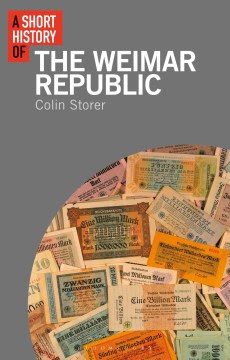
A Short History of the Weimar Republic by Colin Storer
London : Bloomsbury Academic, 2019, c2013.
vii, 239 p. : ill., map ; 23 cm.   

I really love history and when I was putting this new book on the shelf the other day, I realized that I really don't know much about the Weimar Republic, that dynamic and short-lived German republic sandwiched between the ruin of one world war brought about by its preceding imperial government and the ruin of the Nazi, fascist dictatorship that marked the death of the Weimar Republic.

It was a striking thirteen years that Weimar survived, and the author is as interested in pointing out its successes and achievements as he is in documenting its eventual failure and collapse.  This was where I learned quite a lot of new information. 

I had always assumed - as many have done - that it was the crushing reparations forced on Germany after WWI that doomed the Weimar Republic to economic chaos and eventual disaster.  It's not that this was not a crucial factor in its demise, but I hadn't realized the successes that the Weimar government (under Chancellor Stresemann) had in negotiating down the burdens of its reparations. However, the fragility fo Weimar's economy and its dependence on the chaotic international economic system made it especially susceptible to the onset of the great depression in 1929.  

Storer also wants to point out that politically, Weimar managed to survive as a democratic state longer than other Central European states. He also notes the many artistic, scientific and cultural achievements of Weimar.  

There is a lot to mull over (and grieve) when reading about Weimar. Like many books of history leading up to the rise of the Nazis, one knows how it ends, but the pain is seeing that it didn't have to go the way it did and could have turned out much differently and much better, of course.

I'll definitely keep this book in mind if a student has an interest in the period.  It's an accessible and short introduction to this critical time in twentieth century Europe.


Saturday, May 30, 2020

Heavy Lifting


Stamped from the Beginning: the Definitive History of Racist Ideas in America
by Ibram X. Kendi
New York : Nation Books, 2017.  
xi, 582 p. ; 24 cm. 
 
Ibram X. Kendi's Stamped from the Beginning is a long read [more than 500 pages], a painful read, a hard read, and yet a necessary and worthwhile read. As a Kirkus review noted, one can dispute that this is the "definitive" history of racist ideas, but the book is an indispensable tool for coming to terms with the anti-Black racism in the US - and is a powerful tool in offering ways to wrestle with it.  

Kendi, positioning himself as an anti-racist, posits that the project of racism in the US advances not only through the efforts of segregationists (who consider Black people as inherently inferior to whites), but also with the help of assimiliationists who consider black people/culture as being pathological (due to racism) and yet capable of eventually achieving the "standards" of  the best of white culture and civilization. For Kendi, anti-racism is the force that can dismantle the damages of segreationism and assimilationism.  It is a powerful idea.

Kendi traces the history of racism and anti-racism in the US through five historic persons - Cotton Mather, Thomas Jefferson, William Lloyd Garrison, W.E.B. Du Bois, and Angel Davis.  I found the section on Angela Davis to be the most satisfying in that I think it best illuminates the way that capitalism and racism are inextricably bound up.  Davis is also a great role model for the importance of intersectionality. 

This book took me almost a month to get through, so it might be a struggle for most YA readers.  But I'll definitely get the YA version written with Jason Reynolds for this library and look forward to reading through it.


Tuesday, January 14, 2020

Still Our America

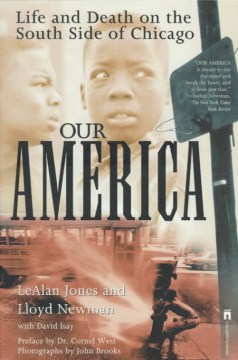
Our America: Life and Death on the South Side of Chicago by LeAlan Jones and Lloyd Newman, with David Isay
New York : Washington Square Press : Pocket Books, c1997.
203 p. : ill. ; 24 cm.

This book is one that is being used as a major text in classes at our high school - part of an "Injustice Project" unit. I wanted to read it since I wondered if it might be dated - having been produced from 1993 - 1996 and published in 1997.

In spite of the book being 20+ years old, it was a compelling read.  I really loved that the adult organizing the book, David Isay, wanted it to be the genuine work of young people who lived in the Ida B. Wells housing projects in Chicago.  The book came out of an award winning WBEZ radio program Ghetto Life 101 which featured recordings and interviews made by the two young authors who were 13 and 14 years old when the project began.

I will be curious how students respond to the book.  A lot has changed since the mid 90s: the high rise projects of the book have been torn down, the crack/cocaine violence has been replaced by other inner city violence, the Internet was a baby, and cell phones did not exist.  A lot is still relevant though - extreme poverty and unemployment falling heavily on Black people, gun crime, wealth inequality, etc.  Also the book just pulls you into the world of the the two authors - they are smart, unpretentious, honest, and aware.  Also the book features great photos by John Brooks, another young man living in the Chicago projects at the time.

I am going to keep my eyes out for something similar to this book, but one that is more contemporary - something like Bus 57.  However, if asked for an interesting read about inner city life in the late 20th century, I'll definitely recommend Our America.

Thursday, January 9, 2020

Public Transportation

The 57 Bus by Dashka Slater
New York : Farrar Straus Giroux, 2017
305 p. ; 22 cm.

A friend read this book and told me I should read it.  I'm glad she did.  It's a timely and interesting non-fiction YA book.

The basic "story" of the book involves two teens from different worlds in Oakland, California whose lives intersect on a city bus when one - a genderqueer student who looks like a boy but wears skirts - is set on fire by another student - a lively, friendly African American young man from another school.  The act was a rash "prank" intended more to harass and perhaps humiliate the targeted student, but it ended up seriously injuring the victim, and was treated as a felonious, adult hate crime.

The book delves into the different world of these two young people and manages to convey the terrible nature of the crime and its effects, while also richly fleshing out the perpetrator.

There is a lot to mull over in this book.  The roles that race, gender identity, family, poverty, policing and criminal justice play in our society.

I really like that the book jumps right in with the crime, and then proceeds to introduce us to the main protagonists in this drama.  It also helps us see the ways that criminal justice serves and does not serve both victims and perpetrators.

This would be a great book to use in a class room to open up discussions of racial justice, criminal justice, gender identity, privilege and income inequality.

In addition to being a relevant read, it's also compelling and well written. I would recommend it.

Friday, November 22, 2019

Varnished Unvarnish

Same but Different: Teen Life on the Autism Express by Holly Robinson Peete, Ryan Elizabeth Peete, & RJ Peete.
New York : Scholastic Press, 2016.
183 p. ; 22 cm.

A teacher assistant stopped in recently to ask about a biography dealing with autism.  We ended up finding this family biography written mainly by two high school twins - the boy "Charlie" has autism and the girl "Callie" does not.

The book is written in alternating chapters where each sibling talks about the experiences of life being a teen and about life dealing with autism. 

The book can be really blunt and honest - the girl talking about frustrations and embarrassing situations, and the boy talking about being frustrated and misunderstood.  What brings the book together is the familial love that binds these young people and the that undergirds their whole family.

I think this is a great, easy to read, and interesting introduction to autism.  I would definitely recommend it.

Wednesday, October 16, 2019

Reconstruction Redux

Dark Sky Rising: Reconstruction and the Dawn of Jim Crow by Henry Louis Gates, Jr.
New York : Scholastic Focus, [2019]
 225 p. : ill. ; 22 cm.

I'm pleased that Reconstruction is being written about more lately.  It strikes me that it is one of the most important periods in American history, a period where the promises of democracy and racial justice had a brief and shining moment and then were crushed under a wave of white supremacist violence and terror that still infects the body politic of the US.  Reconstruction helps one understand the latest rise of white nationalism that has essentially taken over the modern Republican Party.

Reconstruction offers hope and not just despair, though.  It shows that with vigorous federal power and protections for all citizens, there could be a society where power is shared by all people and not just a privileged few. It also shows how powerful the appeal of dignity and freedom is for people who have been deprived of it - and how that appeal can motivate them to strive for great achievements. 

This book has a some of the feel of the Indigenous People's History of the United States for Young People that I read this summer.  Gates wrote the book with upper middle and high school age students in mind.  That keeps it from being overly heavy and keeps the reader from getting lost in too much information.  It is a book I would recommend for both young adults and regular old adults - like me!

Thursday, August 1, 2019

A Terrible History

The African Slave Trade by Basil Davidson
Boston : Little, Brown, c1980.
A rev. and expanded ed.
304 p. : ill., maps ; 22 cm.   

I've seen this book on the shelves many times.  Often when weeding, it comes up as one of our collection's oldest and "outdated" items.  However, the book is often cited as belonging to any non-fiction "Core Collection," and so I have kept it and finally decided to read it.

In many ways it is a really old book. It was first published in 1961 and then this revised version came out in 1980.  I looked for reviews critiquing it as out of date, or recommending a newer treatment of the subject, but did not find anything.

The book is powerful and apparently was a real ground-shifter when it came out.  It provides a very interesting treatment of the European relationships with African states and governments and notes how many of the initial trade relationships were established as between equals, but that the major European states maintained heavy-weapons advantages and eventually assumed a supremacy/colonial attitude toward the African states.  Also the trade in enslaved peoples was initially only part of other trade, but quickly assumed an exclusionary status.  States that resisted had little chance of survival and would face decimation and enslavement if they persisted.

The author emphasizes that the trade relationships brought nothing of real value to the African states while enriching and empowering the European states that shipped and sold the African captives.

Monday, July 8, 2019

Roads of Power

The Silk Roads by Peter Frankopan
New York : Vintage Books, 2017.
xix, 647 pages, 16 unnumbered pages of plates : colored illustrations ; 24 cm.

This is a well-written enjoyable read that sets out to re-establish the historical roots of civilization further east than is common in the "western" canon.  Instead of placing the thread of history as Greece, Rome, Europe, and US-Europe, Frankopan adjusts the narrative to give prominence that part of the world between the eastern Mediterranean and China/India.

In telling the story he conveys how much vibrant politics, culture and trade was occurring in Central Asia both before Greece and Rome came on the scene and during the so called "Dark Ages" too.  There were some interesting parts of the history that I was not familiar with, especially the in roads into Central Asia made by the Vikings as they brought both pillage and trade down the Volga and trafficked heavily in slaves.

The narrative comes fully into the present with the vital role in recent politics that countries like Afghanistan, Pakistan, and India have played and continue to play and the powerful role that the Silk Roads area has played in the era of oil and gas beginning just before WWII and continuing to this day.

The book is a bit of a doorstop for high school readers, but I would recommend it to students needing source material for reports and to any avid history buffs.

Wednesday, May 15, 2019

Little They Them

A Quick & Easy Guide to They/Them Pronouns by Archie Bongiovanni and Tristan Jimerson
Portland, OR : Limerence Press, Inc., 2018.
1 v. (unpaged) : chiefly ill. ; 18 cm.

This is a helpful little (about 60 pages) graphic novel guide to using non-binary pronouns.  It's especially aimed at the good natured cis folks like me, who want to convey openness, support and respect for non-binary gendered folks, especially those who want to be referred to as the singular "they" or "them." The book also touches on the pronoun "ze" and some of its cases when it's "hir" or "hirself."  But that's getting a bit into details....

The book really is a gentle easing into the use of non-gendered pronouns for people who aren't around those pronouns a lot and may get confused or flustered.  It's also just a book to encourage the frustrated or confused (but supportive) to not worry about mistakes - and instead to open up to the attitude of living and learning.

A Kirkus review did mention that the book has its limits of mainly a white person's view, but it is still a good book to have on hand when someone wants to quickly get up to speed on the basics of the new non-gendered pronouns.  Get it!


Tuesday, February 5, 2019

Super Tiny, Super Big

Smash! : Exploring the Mysteries of the Universe with the Large Hadron Collider by Sara Latta
Minneapolis : Graphic Universe, [2017]
72 p. : chiefly ill. ; 24 cm.

This little comic book is more of an hors d'oeuvre than an entree, but there's nothing wrong with that.  Weighing in at a mere 72 pages, and managing to convey the amazing science of the Large Hadron Collider (LHC) without getting bogged down in its wild complexities, Latta has managed to create a work that should whet the reader's appetite to know more.   It did mine!

Though the story-line is a bit corny (a little youngish for high school) the science is admirable.  In one part of the book, in the space of just a couple pages she manages to cover most of the basics of the standard model: the six "flavors" of quarks,  six kinds of leptons, the four fundamental forces and the bosons associated with them - and, of course, the most famous triumph of the LHC, the discovery of the Higgs boson in 2012.

It's nice to have a brief, very accessible book to recommend to a student who is not deep into advanced science, and yet wants to know about particle physics.  If you know such a student, Smash! might be just what they need.

Monday, December 10, 2018

It's Complicated

Frida & Diego: Art, Love, Life by Catherine Reef
Boston : Clarion Books/Houghton Mifflin Harcourt, 2014
168 p. : ill. (some col.) ; 26 cm. 

Most people have some passing familiarity with the art of Frida Kahlo and Diego Rivera, but this is one of those great non-fiction books for young adults that really expands the range of information about these two stunning Mexican painters.

The book is richly illustrated with photos and includes back matter featuring a nice selection of famous works by the two artists.  The back of the book also includes a timeline and copious notes by the author.

I really loved how this book does not condescend to young adults and manages to objectively convey the very unconventional nature of Rivera and Kahlo.  The book also skillfully conveys the artistic excellence of both artists - showing that Rivera was definitely more famous, prolific and well paid, while Kahlo was truly both a skilled (and self-taught) and truly original painter.  The book conveys the deep and complex love that existed between these two as they married, split up, and eventually remarried.

I also appreciated that Reef was able to honestly portray what a sexist user Diego Rivera was, but she also conveys the poignant tenderness that he held for Frida, and the deep bond between them.

"Stuck in the hospital [1950], Frida missed seeing Diego receive the National Prize for Plastic Arts....She saw her husband often, though, because he took the room next to hers, to be nearby at night.  Diego's presence comforted Frida like nothing else.  He read poetry to her and rocked her to sleep.  About once a week he brought in a borrowed movie projector and showed her the old Laurel and Hardy films....he did whatever he could think of to lighten her mood, even if he had to shake a tambourine and dance around the room, or roar like a bear with his arms raised and fingers curved like a claws." (p.101)

I would definitely recommend this book to any student interested in knowing more about Frida Kahlo or Diego Rivera... or both!

Tuesday, September 19, 2017

Forgotten No More

The Forgotten Fifth by Gary Nash
Cambridge, Mass. : Harvard University Press, 2006.
ix, 235 p. : ill. ; 19 cm.

I almost forgot to put up a review of this book that I read toward the end of the summer vacation, but it is a wonderful history book.  The subtitle of the the book explains what this history is about: African Americans in the Age of Revolution.      

The book grew out of a distinguished series of lectures given by Nash at Harvard University and fills in a lot of the missing history of African Americans and their fortunes and activities during the American Revolution.

The book really conveys how unfortunate the Revolution and its outcome was for so many African American slaves, and how the rise of even more vicious White Supremacy and racist hatred affected African American patriots of the Revolution.

I especially wanted to post a review of the book because of the current rising power of White Supremacy in the US.  I also wanted to be sure and mention that this book makes a great companion to the book - In the Shadow of Liberty.

I would definitely recommend this book.