Showing posts with label war. Show all posts

Saturday, June 30, 2018

Ground Zero

Hiroshima by John Hersey
New York : Vintage Books, 1989, c1985.
152 p. ; 18 cm.

I had the good fortune of going to Japan this summer, part of the motivation was knowing a couple from the US who are running the World Friendship Center in Hiroshima.  They suggested reading Hersey's book - which is available online for free at the New Yorker where it was first published in 1946.

I had read the book long ago and was impressed with what a powerful and important book it is.  It tells the story of the atomic bombing of Hiroshima by weaving together the stories of survivors who Hersey interviewed shortly after the bombing.  It is a terrifying retelling of the savage effects of the US bomb and on the strange and random ways that decided who survived and who did not.

Though it was written over seventy years ago, it has immediacy still.  For anyone interested in discovering what it was like to be in the Hiroshima bombing, this remains a powerful testament.

Monday, March 6, 2017

Violent, Unbelievable - That's History

Samurai Rising by Pamela Turner
Watertown, MA : Charlesbridge, [2016]
xiii, 236 p. : ill., maps ; 24 cm

This book had great reviews in VOYA (and other places, too - like the NYT and SLJ).  I had not yet read it, when student asked if I had anything in history to recommend.  Ah ha! I handed him Samurai Rising, and he brought it back several days later saying it was the best thing he'd read in a while.  There's nothing like a student's glowing review to bump a book up to the top of my "to-read" list.

Things I liked a lot about this book:  It's a history - 1160 to1190 in Japan - that I know almost nothing about.  It's well researched with copious notes.  Finally, it's written to be an adventurous, exciting read.

The book is pretty violent - as were most Samurai battles.  There are lots of scenes of hand-to-hand combat with swords, arrows, daggers and copious amounts of blood and corpses.  Strangely, though the violence does not seem gratuitous, as Sarah Miller notes in the NYT review, "Heads topple, limbs are severed, arrows pierce eyeballs, yet these facts are relayed cleanly and directly."

I also appreciated that the author provides an afterward explaining how she made decisions in recreating  the world of the main hero, Minamoto Yoshitsune, even though much of the historic record is sparse.  It's a great insight for students into thinking historically - and creatively.  Finally, I'd be remiss not to praise the illustrations of Gareth Hinds.  His drawings are bold, skillful, uncluttered and yet convey action, emotion and the stately nature of the story being told (the cover graphic at the top is an excellent example of his art).

I was a little stunned to see one review list this as for readers aged 10 - 14.  That would be a very precocious 10 year old! This book should satisfy any high school reader, and frankly I think a lot of adults (myself included) would enjoy this biography.
  

Tuesday, February 28, 2017

The 911 That Never Should Have Been

The Looming Tower: Al-Qaeda and the Road to 9/11 by Lawrence Wright
New York : Vintage Books, 2007.
540 p. : ill., maps ; 21 cm.

I've read a lot about the Middle East, and about 9/11, but The Looming Tower is one of the best books to pull all the narrative threads together into an informative, compelling and stunning read.

There were several things I learned that surprised me.  I didn't realize how central the Egyptian fundamentalist-jihad movement was to al-Qaeda.  I had no idea that Bin Laden's time in Sudan was marked by his arriving a multimillionaire and leaving virtually broke.  I didn't know that when he left Sudan for Afghanistan, he had no idea who the Taliban were and they were cautious about him, too.  Probably the most painful revelations of the book are the several times that the CIA refused to share information with the FBI which almost surely would have lead to the uncovering and thwarting of the 9/11 plot.  There is more to discover in Wright's definitive history.

I would definitely recommend this book to a student with a keen interest in the background of 9/11 or to a student working on a research project about 9/11.  It is a fine book, one which won the 2007 Pulitzer Prize for nonfiction.      

Friday, January 27, 2017

Fists and Crosses

Saints by Gene Luen Yang
New York : First Second, 2013.
170 p. : chiefly col. ill. ; 21 cm.  

After reading Boxers, I had to read this companion to it - which tells the same story, but from the point of view of a young Chinese, Christian convert who find herself on the opposite side of the violent Boxer Rebellion as the hero of Boxers.

All that I wrote in my review of Boxers below, applies to this book as well.  It's a great read and has the same captivating mix of history, supernatural, familial and social conflict, etc.

I'd definitely recommend reading Boxers first, it sets the stage well and makes it satisfying when the narrative exactly overlaps in several key scenes.

Wednesday, January 25, 2017

A Righteous and Harmonious Fist Bump

Boxers by Gene Luen Yang
New York : First Second, 2013.  
328 p. : chiefly col. ill. ; 21 cm.

Yang's American Born Chinese continues to circulate well with readers at our high school, and I hope that Boxers will do the same. With both fiction and graphic novels, the challenge of having historical events as the subject is finding the heart and power of that event and translating it to the genre being used.  I think it is a difficult challenge for any author, but especially for author's of young adult readers - where the desire to get lost in a book is a powerful appeal for readers already surrounded by informational text.  But it can be done, and I think Boxers proves it!

One never forgets that the power of Yang's book is the story and the characters involved in it. There is romance, danger, humor, wistfulness, longing, justice and magic propelling the story forward.  The comic artwork is clear, powerful, and interesting to look at.  Not convinced?  Take a look at some sample pages provide by Macmillian Publishers.

I was struck, after reading Boxers, at how cleverly the story made me want to know more about the actual history - and - at how pathetically little I know of Chinese history.  I had heard of the Boxer Rebellion, but knew little about it.  Furthermore, in reading some of the history that preceded it, I came across references to the Taiping Rebellion - a 14 year civil war that killed an estimate 20 million people!   And this is history that I knew nothing about.

So do I recommend this book? Absolutely.  It is a wonderful work of literary and visual art, and for teachers who might want to include it in a history class, there is even an extensive online teacher's guide to accompany the book.

Tuesday, November 15, 2016

Not a Good Spiral


Spiral: trapped in the forever war by Mark Danner
New York : Simon & Schuster, 2016.
267 p. ; 24 cm.

Spiral may make you angry.  Spiral may make you sad.  Whatever your reaction, Spiral is a timely and urgent book that you should read.  Danner, a veteran reporter makes a very damning case that in the reaction to the devastating 9/11 terrorist attacks, the US government has embarked on an unending security/military mission that has increased the spread of global terrorism, has fostered a dangerous and antidemocratic culture of fear, and has perhaps forever destroyed significant parts of the Constitutional framework of US law (and wrecked the already weak framework of international laws of war and human rights that emerged out of the ruins of WWII).

His book is not easy reading.  He presents the details of torture and lawlessness committed by US agents that were the hallmark of the Bush years - none of which were (as required by law) investigated, and some of which (e.g. mass surveillance and assassination) have been codified and expanded by the Obama administration.  He pointedly notes that Obama - by protecting the torturers of the Bush era from prosecution - has essentially made the strict US and international laws against torture all but meaningless, likely guaranteeing that torture will be committed by US operatives again in the future.  He also notes that the expansion of secretive war operations -whether by drones or special forces - has made US military actions free of any democratic oversight.

Danner also presents strong evidence to bear on the fact that not only has the mult-trillion dollar war on terror not ended global non-state terrorism, but has lead to a vast growth in the numbers and reach of global terrorism.

He ends his book with a few suggestions of how the "forever war" could be reigned in and perhaps ended.  They are steps that were unlikely when the book was published and that are clearly not going to happen for at least four more years based on the elections of November 2016.  It's  a heavy book, but well written and researched.  For anyone concerned about the future or interested in the recent past, it offers much to think about.

Wednesday, October 19, 2016

Storm of Horrors

Storm of Steel by Ernst Jünger
[translated with an introduction by Michael Hofmann]
New York : Penguin Books, 2016.
xxx, 288 p. ; 22 cm.

A couple of years ago I was reading several books on WWI, and I came across references praising this remarkable memoir of trench warfare by Ernst Jünger. I thought I would get to it sooner, but it's not always easy to find - even though recognized as a classic work of the "Great War." I finally added this new edition to our library and just finished reading it.

It is a stunning work.  As others have pointed out, Jünger makes almost no judgments about the war, but simply presents the events and his participation in them over the course of virtually the entire war.  He is able to offer us an unvarnished look at life in the German trenches on the Western Front.  His passages really convey the unimaginable intensity of massive bombardment and the ever present threat of death or horrific maiming.

And strangely, he doesn't really dwell on the deeper meanings of such violence and horror.  Instead he writes rather matter of factly about his and his comrades actions and situation before, during and after many battles - including the Somme and Passchendaele.

I wouldn't recommend this book to a reader as a first book about WWI, since it provides almost no explanations of the where's, how's and why's of the fighting.  But for a student who has read some about the war and wants something visceral and intense, then this is a book I can highly recommend.

Tuesday, May 12, 2015

Feeling Down About Being Wound Up

The Windup Girl by Paolo Bacigalupi
San Francisco : Night Shade Books, c2010.
361 p. ; 23 cm.

"Feeling down" in the title of this post is not meant to be a negative critique of this book, just a description of how its grim view of the future had me feeling (and thinking) about the grim present we are living in.  

Bacigalupi sets his novel in a future Thai kingdom that has survived the collapse of the global carbon economy, survived the ravages of plant and human epidemics sparked by genetically modified organisms, survived catastrophic climate change, and survived the predatory depredations of global corporate raiders.  Quite a future, isn't it?  But will it survive the infighting of factions within its ruling parties, and the attempts of global genetic corporation raiders from the outside?  You'll have to read it to find out!

Notice that I haven't even mentioned the novel's eponymous windup girl, Emiko.  She is probably the saddest and most troubling character in the novel.  A creation of Japanese geneticists, she is one of the "new people" who is meant to be an obedient servant, secretary, assistant and sexual plaything of the male Japanese elite.  Her genetic makeup (along with strict training) compels her to be obedient, and makes her physically stunning.  Unfortunately her "owner" has abandoned her in Thailand where "new people" are hated, in constant danger, and not accepted as having any of the rights of other human beings.  She survives as the grotesquely exploited show-piece of a tawdry strip-club/brothel, but eventually finds herself at the center of explosive events in the kingdom when a foreign corporate agent takes a liking to her.

Bacigalupi has a wild imagination and has done copious research for this novel.  Unlike Ship Breaker, which was clearly a young adult novel, The Windup Girl is an adult novel, but will appeal to sophisticated readers who want to move past The Hunger Games or Divergent for something more complex and weighty.

Monday, March 9, 2015

Lush Life

The Shadow of the Wind by Carlos Ruiz Zafon
New York : Penguin, 2005, c2004.
486 p. ; 22 cm.

I first read Shadow of the Wind about 8 or 9 years ago on the recommendation of an exchange student from Argentina.  He said it was his favorite book and had changed his life.  Well, how can a high school librarian not want to read a book with that kind of intro?  I really liked it - a lot - back then, and have since occasionally recommended it to students.  Recently a student who reads a lot was asking about a recommendation for a book with a lot of mystery and plot and good writing.  I almost forgot about Shadow of the Wind, but then recalled it and suggested it to him.

Well, it had been a long time since I had read it and I thought, maybe it hasn't aged so well, or maybe it's not as good as I remember - and so I decided to read it again.  I was not disappointed.

If you look on Goodreads, you will find a lot of extremely positive reviews and a few cranky dismissals of the book.  I'm going to have to weigh-in on the side of those who love the book.  Yes, the book is a bit melodramatic, yes it is almost overly-romantic, yes it is highly stylized, but (and this is crucial) the book is all those things because it is a passionate homage to the love of literature, the love of justice and compassion, and the love of romantic love.  It also is beautifully written.

It's not a perfect novel, but it is both a delightful and haunting read.  Set in the moral, social and physical wreckage of post Civil War Spain, Ruiz Zafon makes Barcelona a character itself, as the varied heroes of the novel reveal their passionate and complex ways of surviving and being humane in fascist Spain.

If you are someone who loves reading, or literary writing, or an exploration of the passion of love, then you will certainly love Shadow of the Wind.  Not every young adult will find it to be their favorite novel, or the one that changes their life, but some will and will thank you for recommending it.

Tuesday, January 6, 2015

Robophobia

Robopocalypse by Daniel H. Wilson
New York : Vintage Contemporaries, 2012, c2011.
396 p. ; 21 cm.

Robopocalypse picks up a fairly common theme in popular culture - the specter of intelligent machines turning on their human creators.  This has come up in movies such as 2001: a Space Odyssey, The Terminator, and I, Robot.  Wilson writes a tense and informed thriller that picks up at the very end of a cataclysmic war where humans have barely managed to defeat machines with AI that have waged a war of extermination against humanity.  Following this opening, the rest of the novel is a retelling of the events of the initial machine uprising, the ensuing war, and humanity's success in fighting back.  There's a lot of action, exciting plotting, and some gruesome machine-on-human violence (e.g. pluggers - little machines programed to take their sweet, agonizing time boring into humans and drilling away until they reach the heart, where they explode).

Given the exponential growth of computer systems and devices and human dependence on them it is no wonder that people worry about where this technology is taking us.  And it's a question that scientists, such as Stephen Hawkings, and institutions like Smithsonian Magazine, take seriously.  

If you are looking for a fast-paced, exciting tale of dystopian survival - Wilson scores a home run with his book.  With a PhD in robotics from Carnegie Mellon, Wilson writes convincingly of the frightening technological capabilities of interactive machines gone rogue.  There are military droids, assassin "smart" cars, drones, and self-replicating/self assembling machines that nearly succeed in wiping humanity from the globe.  Given the current life/death dependence of human on digital systems (e.g. energy, transportation, finance, military, etc) and the almost limitless spending on "smart" lethal military machines - there is a lot to think about and ruminate over after reading Wilson's book.

My main complaint with the book is that it reads like the novelization of a movie.  Each chapter feels mostly like the set piece of the parts of an action movie - the onslaught, the specific roving bands of survivors, the few "liberated" robots, etc.  If you like that style of fiction you will love this novel.  And if you don't, but like that kind of movie, hold on, because Robopocalypse - in spite of many delays - is still likely to end up as a blockbuster action movie (probably under the direction of Steven Spielberg).

I'll definitely recommend this book to any students who are looking for an action packed dystopian novel.

Friday, December 12, 2014

The War to End All War Protests

From LOC
Unraveling Freedom by Ann Bausum
Washington, D.C. : National Geographic, c2010.
88 p. : ill. (some col.) ; 26 cm.

This is one of those short, but visually stunning and well written books that National Geographic has been putting out for young readers (e.g. photobiographies Bylines & Knockout about Nelly Bly & Joe Louis, respectively, or Denied, Detained, Deported about abuses of US immigration).

I really enjoyed reading this book for the way that Bausum brings alive the times of WWI and makes the assaults on liberties and freedoms by the US government feel very contemporary. She is good at comparing the various attempts to propagandize, censor, and stifle dissent to similar actions that have accompanied other US wars, including the latest "war on terror."

I was struck, in reading the book, at how US trends of anti-intellectualism and blind patriotism have strong roots in domestic policies during WWI.  In the frenzy of anti-German propaganda (see graphic above), not only was German language instruction virtually wiped out of the US education system, but over half the states banned teaching any foreign language.

There is a lot to recommend about this book to any student interested in US history during the period of WWI and its aftermath.

Monday, December 1, 2014

So-so Dystopia

wikimedia commons photo
The Diary of Pelly D by L.J. Adlington
New York : Greenwillow Books, 2008, c2005.
1st HarperTeen ed.
282 p. ; 19 cm.

Tony V runs a jackhammer on City V - just one of the five major cities on a planet colonized by humans long before his birth.  He is working on clearing the city for reconstruction following a war that devastated it.  While working Tony discovers the diary of a girl his age who was in that war. 

L.J. Adlington's novel is creative and clever - the citizens of this world have gills, water is at a premium, there are hints of corporatist totalitarianism and ethnic cleansing - but somehow I just found it not very compelling.  The author of the diary was a young, rich, shallow "it girl" until the civil war started that destroyed her privileged life.  A lot of the novel is the supposed text of this diary, which for me is just too much of the mundane ramblings of this imagined material girl.  The really compelling content of the unraveling of her life and society doesn't come about until the last part of the novel. 

The novel does offer a good starting point for discussing and thinking about civil conflict based on haves and have-nots and on manufactured ethnic conflict.

I read this book due to the glowing teen review of it in VOYA, but I have to agree with Tasha Saecker, of School Library Journal who writes, "The true horrors of what is happening are muted until the end of the book, taking away much of its power. The concept is interesting and the world of Tony V is well rendered, but in the end, the novel disappoints."  Exactly.

Tuesday, May 27, 2014

Study War No More

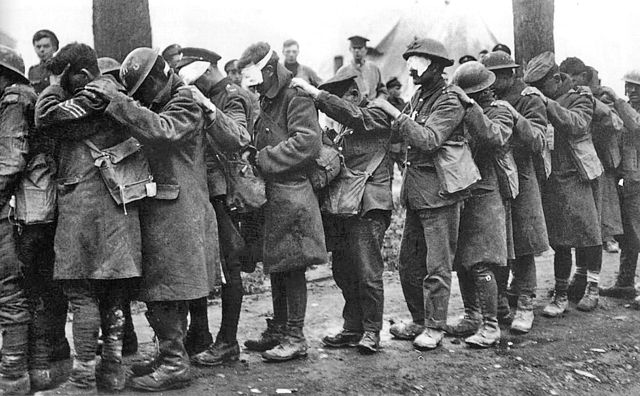
British 55th (West Lancashire) Division troops blinded by tear gas  during the Battle of Estaires, 10 April 1918
The First World War by John Keegan
New York : Vintage Books, 2000.
xvi, 475 p. : ill., maps ; 21 cm.

I've been slogging through a lot of books of European history and especially WWI - The Proud Tower, The Sleepwalkers, and now Keegan's First World War, which I pointedly finished on Memorial Day.

World War One is truly emblematic of the sickening, meaningless, barbarous, and utterly worthless human phenomena of making war - particularly modern warfare.  Especially painful is the fact that WWI essentially lay the groundwork for WWII.  As Keegan states in the closing pages of his book, "The Second World War was the continuation of the First...."

When I finished this book, I was left numbed by the staggering numbers of young men killed in the WWI.  This passage toward the end of Keegan's work gives a sense of the monstrous carnage that WWI unleashed.
"To the million dead of the British Empire and the 1,700,000 French dead, we must add 1,500,000 soldiers of the Hapsburg Empire who did not return, two million Germans, 460,000 Italians, 1,700,000 Russians, and many hundreds of thousands of Turks...."
In what moral universe can a person truly reckon with or comprehend such massive slaughter?  And then to realize that these numbers will be increased by a factor of six or seven (including many more civilians) in the horrors of WWII leaves me feeling despair.

I will say that Keegan has managed to pull together a readable and lucid account of WWI which is no small accomplishment.  He also manages to tell the story with moral conviction, but a light ideological touch, so that the reader is allowed to form her own opinions about where the guilt and responsibility lies for the nightmare that WWI was. I would definitely recommend it to a student who is interested in a detailed but compact history of the "Great War."

Friday, April 25, 2014

Nasty, Brutish, Short...and Helpful

Waterloo: June 18, 1815: the battle for modern Europe by Andrew Roberts
New York : Harper Perennial, 2006, c2005
143 p. : ill., maps ; 21 cm.

Of course I've heard of Waterloo and had a vague idea of when and where it happened.  Also, I've encountered the battle of Waterloo in Les Miserable by Hugo and in Vanity Fair by Thackeray, but never read a history of it.  I enjoyed and appreciated this short book by Andrew Roberts.  This was a great, short and very clear account of the battle.  It really helps the reader appreciate the momentous stakes of the battle, the terrible violence of the conflict, as well as the ways in which the outcome of the battle could have well gone to the French forces under Napoleon instead of to the European forces under Wellington.

It is definitely a short, helpful history of Waterloo that would be useful to any high school student wanting to know more about the last, terrible battle that Napoleon waged - the outcome of which brought the Napoleonic era to a close.

Friday, February 7, 2014

Velvet Gloves and Iron Fists

From the Wikipedia article on the 1848 revolutions
1848: Year of Revolution by Mike Rapport
New York : Basic Books, 2010, c2008.
xii, 461 p. : ill., map ; 24 cm.

You might remember that a while back I wanted to read Barbara Tuchman's Proud Tower, but realized that my background knowledge of 18th and 19th century Europe was sorely lacking - and so read a slim little volume about the Napoleonic Wars - and then was going to read 1848. Well, I've read it, and what an intense and complicated time 1848-1850 was!  Revolutions in Paris, Berlin, Vienna, Venice, Rome, Buda and Pest, Naples, and Florence (among others) pitted liberals, reactionaries, nationalists, imperialists, Papists, monarchists, socialists, revolutionaries, the peasantry, and the nobility in violent conflicts to determine the future of regions, kingdoms, and  Europe as a whole.  By the time 1850 rolled around, the forces of authoritarianism, conservatism and reaction sadly had triumphed - but what an incredible time it was...

In spite of the extreme complexities involved (maps would have been an invaluable addition to this book), Rapport writes well and is able to convey many of the significant underlying themes, conflicts, causes and effects of the year 1848.  His book really is relevant, since much of what stoked the conflicts still exists - extreme wealth and extreme poverty, ethnic versus nationalist tensions, majority rule versus minority protections, and individual rights versus the common good.

I can't say I'd recommend this book to just any student, but if there were a student who loved history and was interested in European history, then this is definitely an excellent read!


Tuesday, January 21, 2014

Nice, Little (Book) - Big, Terrible (Wars)

From Wikipedia
The Napoleonic Wars: A Very Short Introduction by Mike Rapport
Oxford, U.K. : Oxford University Press, 2013
xiv, 149 p. : ill. ; 18 cm.

I'm not sure what recently prompted me to want to read European history.  Perhaps it's the 100th anniversary of the start of WWI - which will be commemorated this August - perhaps it's seeing books on the shelf about Napoleon, or perhaps it's just my wanting to get away from fiction for a while.  Whatever the reason, I recently picked up a book I've been wanting to read for some time: Barbara Tuchman's The Proud Tower (about Europe in the decades just before WWI).  Starting it made me realize that I wanted to know more about the period before Tuchman's book, so I picked up Mike Rapport's 1848: Year of Revolution.  Guess what? Yes, I needed some background for 1848 and so I settled on this fine, little introduction to the Napoleonic Wars.

I love these "Very Short Introduction" books from Oxford.  They cover a wide variety of subjects and are written for lay readers by experts in the field being covered, and are short and concise.  As you can see, this one has just 149 pages, and the book is small enough that Napoleon could have it tucked under his buttons in the David portrait above - and we'd never know it!

Joking aside, the book was really eye-opening to the scale of carnage and destruction that the French Revolutionary and subsequent Napoleonic Wars brought to Europe (and the world).  I had always thought that WW I was the first real mass-carnage, total war to take place in Europe - but Rapport makes the case that the percentages and scale of casualties (along with the global nature of the wars) puts the Napoleonic Wars in the same league as WWI.

I also appreciated his attempt to show the conflicting views on the legacies (good and bad) of Napoleon's expansionism - especially in light of the extreme reactionary responses to his aggression.

Now I'm ready to tackle 1848 and then, hopefully, to take on The Proud Tower.

Thursday, November 14, 2013

Hi Tech Guilt

A version of Think Tank 1's cover from the Top Cow Website
Think Tank 1 by Matt Hawkins
Los Angeles : Top Cow Productions, Inc., 2013
1 v. (unpaged) : chiefly ill. ; 26 cm.

David Loren has a guilty conscience.  He is the main character of this new graphic novel series from Matt Hawkins and Rashan Ekedal, and he's begun to question his role as a super-intelligent weapons developer for a Pentagon think tank that recruited him with a full scholarship to Cal Tech when he was just 14.  

In the 10 years since that time he has begun to question the value of what he is doing (reflecting on the human toll that his lethal creations have) and he wants out.  Unfortunately for David, he's pretty much a prisoner on the high-security base where he lives and works.  But given his technical wizardry, he decides he's going to escape - one way or another.

The story is fast-paced, exciting, interesting and ends with a dramatic twist that sets the reader up for the next installment of Think Tank.  Not bad for a debut graphic novel.

I really appreciated the author's scientific and ethical depth.  The novel ends with a section that explains some of the terms and references found in the story (e.g. DARPA, Einstein quotes, etc.) and contains references to some of the real-world hi-tech weaponry currently being developed by the Pentagon and its private contractors.  A good read for the tech-savvy, current-events aware fan of graphic novels.

For more insight into Think Tank take a look at this interview with Matt Hawkins, or this review of Think Tank 1.

Tuesday, April 2, 2013

History Uncovered

Kill Anything that Moves by Nick Turse
New York : Metropolitan Books, 2013.
370 p. : ill., map ; 25 cm.

In 2001 Nick Turse was a graduate student doing research at the National Archives on PTSD among Vietnam Veterans when an archivist working there asked him if a veteran could suffer PTSD from witnessing war crimes.  The archivist then presented Turse with the first of many boxes of long (and intentionally) neglected documents of the Pentagon's Vietnam era War Crimes Working Group.  So began Turse's 10 year odyssey of research and interviews that would result in this seminal study of US military policy and practice in Vietnam.  Turse's contention - backed up with copious notes, Pentagon records, and sworn testimonies by veterans and Vietnamese survivors - is that official US policy from the office of the President on down was to wage war in Vietnam in a way that knowingly targeted millions Vietnamese non-combatants. He argues that My Lai was not an aberration, but typical of the US method of waging war in Vietnam.

This book is sure to become a standard reference to the Vietnam War.  It is also likely to be controversial - arguing as it does (and as did Nuremberg prosecutor Telford Taylor) that the highest officers and officials in charge of the Vietnam War warranted proceedings for war crimes.

Kill Anything That Moves is one of those that great histories that calls into question the commonly accepted narrative of US history; in that way it reminds me of Douglas Blackmon's Slavery by Another Name, an expose of the murderous convict labor system in the South, or James Brady's Imperial Cruise, a stunning exploration of the white supremacist ideology in US foreign policy leading up to WWII.

Thursday, December 15, 2011

Reckoning the Experience of War

What It Is Like to Go to War by Karl Marlantes
New York : Atlantic Monthly Press, c2011.
xii, 256 p. ; 22 cm.

I bought this book after reading a positive review of it in Leatherneck, the magazine of the US Marines.  I was interested in it since the author had been a US Marine in Vietnam and a Rhodes scholar and a novelist.  Anyone who knows me, knows that I'm really very opposed to war, except as a last resort and have no interest in books that romanticize or glorify combat.

This book is a thoughtful, honest account of the experience of deadly combat on a young, intelligent person.  The author takes exceptional pains to be honest about his behaviors, motivations, fears, successes, and what he as learned of war and combat through both experience and study.   He is not interested in glorifying combat or vilifying enemies that the US has waged war with.  His goal seems to be to try to convey what the life-altering and profoundly destructive nature of war is like to anyone who will read his book.

Whatever one's opinions are on the military adventures of the United States, anyone working with young people knows that many of the students we work with choose the military as an option after high school or are considering it as an option.  With that in mind, a book such as What It Is Like to Go to War would be a very beneficial book to get into the hands of any thoughtful student who wants to wrestle with the idea of war and his or her possible participation in war or who asks if there is an account of what war is like.


War, Survival, and... Oh, That Other Thing

How I Live Now by Meg Rosoff
New York : Wendy Lamb Books, c2004.
194 p. ; 22 cm.


How I Live Now, Meg Rosoff's first novel, came out almost eight years ago - and it was about that long ago when I first read it.  It received a lot of critical praise - including the Printz Award - and I recall that I liked it well enough.  I revisited the novel because recently our English department was looking for a novel that would be required reading for English 9 classes - and the teachers wanted a novel that was engaging, relatively contemporary and had a high lexile score.  How I Live Now seemed to answer all those requirements: it involves teen characters in an imagined contemporary England, its lexile score is over 1300, and it involves suspense, war and violence, family relationships, and romance - so it should be popular for both young men and women.

I found I really enjoyed the novel the second time.  It is well written, interesting, timely and mature.   It deals with themes of terrorism, violence, survival, family bonds, mild dislocation (an American in England), serious dislocation (war refugees) and is well plotted and moves along.  There would be a lot to discuss in a classroom regarding this novel...BUT...

...there would be one (very big) problem with using this novel as required reading in a class: the main love affair involves a sixteen year old girl (the narrator) in an intense and sexual relationship with her fourteen year old first cousin.  It's too bad - really - because the plot and deep issues of the novel do not depend on having these two lovers being family or being fourteen and sixteen.  If they both were sixteen or seventeen and not blood relatives, then the novel would be fine for classes - since the sexual activity is just referred to and not detailed by the author. Of course, one can not expect an author to change their artistic expression just to fit the needs of a school curriculum, but it would be interesting to hear why Rosoff felt it was necessary to have the two lovers be blood relatives and for one to be so young....

That addresses the usefulness of the book as required curriculum material, but my other dislike was with the end of the novel.  Without spoiling too much of the plot, I found the six year jump in time at the end of the novel and the absolute and complete personality change in one of the main characters to be rather unbelievable.  I think a shorter jump in time would have been effective and a more subtle (and yet still disturbing/damaging) character change would have made the ending more poignant and less melodramatic.