Showing posts with label economics. Show all posts

Tuesday, March 8, 2022

Dystopia Now


The Looting Machine
by Tom Burgis
 New York : PublicAffairs,  c2015.     
 xi, 321 p. : ill., map ; 24 cm.     

This is a powerful book that examines the power and endurance of the entrenched systems that pillage the resources of Africa. It is an indictment of the many legal (and illegal), but grossly unethical networks of banking rules, corporate laws, governments, militaries and paramilitaries that vacuum up the untold wealth fuel and mineral wealth of the African continent and keep it in the hands of a tiny minority of wealthy and well-connected people (while immiserating the vast majority of citizens in those countries where the wealth is found.)

This is not exactly the kind of book most students would pick up and read cover-to-cover, but it would be VERY useful to students doing any research on globalization, world poverty, corruption, mining, economics, especially in relation to the nations of Nigeria, Angola, South Africa, etc. It is a great resource for understanding how even when liberation governments come to power, they are often overtaken by the global systems of off-shoring, international finance/loans, and powerhouse nations like the US and China that seek to control profits gained from extractive industries.

The author Tom Burgis deserves great deal of credit for doing dogged (and intrepid) research as he visits both the glittering high-rises of corporate/financial power (e.g. Hong Kong, New York, and Harare)  conflict-torn sites (e.g. Nigeria, Congo, Zimbabwe) of mining and extraction.

It's a complicated and painful book to read, but one that anyone who lives in more wealthy countries should read since the wealth of Africa is deeply entwined with the wealth of those better-off countries.

Monday, November 30, 2020

Remission


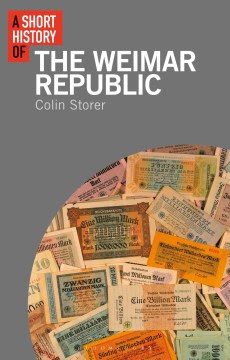
A Short History of the Weimar Republic by Colin Storer
London : Bloomsbury Academic, 2019, c2013.
vii, 239 p. : ill., map ; 23 cm.   

I really love history and when I was putting this new book on the shelf the other day, I realized that I really don't know much about the Weimar Republic, that dynamic and short-lived German republic sandwiched between the ruin of one world war brought about by its preceding imperial government and the ruin of the Nazi, fascist dictatorship that marked the death of the Weimar Republic.

It was a striking thirteen years that Weimar survived, and the author is as interested in pointing out its successes and achievements as he is in documenting its eventual failure and collapse.  This was where I learned quite a lot of new information. 

I had always assumed - as many have done - that it was the crushing reparations forced on Germany after WWI that doomed the Weimar Republic to economic chaos and eventual disaster.  It's not that this was not a crucial factor in its demise, but I hadn't realized the successes that the Weimar government (under Chancellor Stresemann) had in negotiating down the burdens of its reparations. However, the fragility fo Weimar's economy and its dependence on the chaotic international economic system made it especially susceptible to the onset of the great depression in 1929.  

Storer also wants to point out that politically, Weimar managed to survive as a democratic state longer than other Central European states. He also notes the many artistic, scientific and cultural achievements of Weimar.  

There is a lot to mull over (and grieve) when reading about Weimar. Like many books of history leading up to the rise of the Nazis, one knows how it ends, but the pain is seeing that it didn't have to go the way it did and could have turned out much differently and much better, of course.

I'll definitely keep this book in mind if a student has an interest in the period.  It's an accessible and short introduction to this critical time in twentieth century Europe.


Wednesday, April 6, 2016

In Greed We Trust


Griftopia by Matt Taibbi
New York : Spiegel & Grau Trade Paperbacks, 2011.
299 p. ; 21 cm.

How can you not want to read a book by the author who described the sleazy investment bank, Goldman Sachs, as "a great vampire squid wrapped around the face of humanity, relentlessly jamming its blood funnel into anything that smells like money"? Taibbi writes with a lot of emotion (often peppering his prose with well-deserved name calling and occasional cuss words) but also with a quiver full of meticulously documented facts and knowledge.  He manages to make a raucous, fun read out of a subject that is both very complicated - can you say Collateralized Debt Options and Credit Default Swaps? - and very infuriating .  

After reading this book, you will never look at mortgages, investments, bailouts and Wall Street in the same light.  This is a book which will shake your faith in the fairness of the financial system in the US, but it will also make you smarter as you start to understand the outright fraud and criminality that lead to the great crash of 2008.  

And you might even find yourself laughing out loud as you read it.  So what are you waiting for?  Read it!


Tuesday, February 23, 2016

Rough Cotton

The Half Has Never Been Told by Edward E. Baptist
New York : Basic Books, a member of the Perseus Books Group, [2014]
xxvii, 498 p. : ill., maps ; 25 cm.

Read this book!  If you love history, read this book. If you want to see US history in a very new way, read this book.  If you want to have many of your assumptions about slavery and the Civil War turned on their heads, read this book.  The Half Has Never Been Told is long, complicated, riveting, and incredibly well written - read it!  For me this book brought to mind the books - Slavery by Another Name and Guns Germs and Steel - for it's power to tilt one's understanding of history and how power works.

I can't say enough about what an important and interesting book this is.  I'll be recommending it to any students who love history, and to any teachers interested in history.

Lastly, I'd be remiss not to note that I first heard of this book on a list of recommended books from Ta-Nehisi Coates who's book Between the World and Me is another book to recommend again and again!  

Tuesday, January 29, 2013

Bitter Sweet

Sugar Changed the World: a Story of Magic, Spice, Slavery, Freedom and Science by Marc Aronson and Marina Budhos
Boston : Clarion Books, c2010.
ix, 166 p. : ill., maps ; 25 cm.

Just as Kurlansky's book on cod makes the case for the often overlooked importance of cod in world affairs and US history, so too Marc Aronson and Marina Budhos' wonderful book on sugar brings this common food item to life by telling its bloody & compelling history.  There is a painful irony that such a sweet substance is so inextricably tied into the immense holocaust of the African slave trade in the Americas - especially in South America and the Caribbean.

For example, in Sugar Changed the World we learn that in just over 100 years between 1701 and 1810 years, nearly a million slaves were shipped into just two "sugar" islands in the Caribbean - the British sugar/slave islands of Barbados and Jamaica. The book reveals that sugar slavery was an especially brutal and lethal fate for slaves.  Up to the time of Emancipation in the US, about 500,000 slaves were brought into North America, while more than 2 million were taken to the various "sugar" islands - and yet at Emancipation, the slave population in North American had risen 4 million, while the slave population of the islands was 670,000.  The sugar plantations of the Caribbean were places where most slaves were worked to death.

The book conveys the hell that was the sugar plantations of the Caribbean (and eventually of Louisiana in the US) in ways that are factual without being overwhelming for middle to high school readers. In detailing the workings of the sugar slave plantations the book would make an excellent pairing with The Poet Slave of Cuba by Margarita Engle.  A strength of Aronson and Budhos' book is that it not only chronicles the horrors of the the sugar slave world, but presents the culture and resilience of the people who lived and died as slaves in the sugar plantations and as workers in the sugar industry after slavery officially ended.

Aronson and and Budhos do an excellent job of giving the global history of sugar (where it came from, and how it became cultivated), explaining how sugar is processed, and revealing that sugar was an economic engine for the emerging imperialist states of Britain, the US, and France.The authors also devote a significant section of their book to the successful slave revolt in Haiti and the contradictions of the US relations with Haiti.

The book has excellent photos, maps and graphics which make the story interesting and very clear.  I would highly recommend this book for any student interested in the fascinating and brutal history of sugar. Lastly, for any teachers considering using the book in their classrooms, there is a great website for the book - including a Teacher's Guide!