Showing posts with label European history. Show all posts

Friday, April 16, 2021

Rise Above It


Eiffel's Tower for Young People: the Story of the 1889 World's Fair
by Jill Jonnes ; adapted by Rebecca Stefoff.
New York : Triangle Square, 2019.
xi, 354 p. : ill. ; 21 cm.

World's Fairs offer excellent subject matter for history writers.  Think of Eric Larson's macabre and fascinating bestseller about the Chicago World's Fair of 1893. World's Fairs offer a glimpse into the way the dominant culture/s of the time viewed themselves, including who and what was celebrated.  The fairs featured extravagance, spectacle, celebrities and adventure.  The 1889 Paris World's Fair was no exception.  There were bitter rivalries between artists, the spectacle of the Buffalo Bill's Wild West show, a hall of inventions, superstar guests like Thomas Edison, and international rivalries, too. Above all there was the now iconic Eiffel Tower at the center of it all - and at the center of this accessible history - an adaptation for younger readers of Jill Jonnes' Eiffel's Tower. 

I like that this adaptation of Eiffel's Tower moves chronologically, but also builds on storytelling by giving ample time to central characters in the fair: Gustave Eiffel (of course), Buffalo Bill Cody, Annie Oakley, Thomas Edison, the painters James Abbott McNeill Whistler and Paul Gaugin.  Vincent Van Gogh even gets a mention.  Yes, so much was happening at that moment in history.

The book also presents the racism & colonialism running through the fair - exhibits of "model villages and streets" of Frances colonies and targets for colonization. The book also lightly touches on the contradictions of Buffalo Bill's Wild West Show whose company included many Sioux Indians who Cody treated well as workers, but who were also part of the propaganda of the show celebrating the "taming of the US west." 

I'd recommend this book for any student interested in history, especially late 19th century history - a fascinating time when Europe dominated the world not long before descending into the murderous self-destruction of WWI, a period covered in much more detail by Barbara Tuchman in The Proud Tower.   


Monday, November 30, 2020

Remission


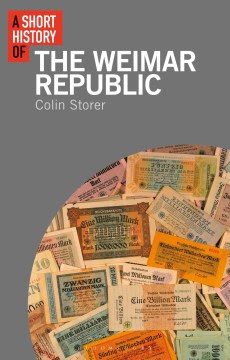
A Short History of the Weimar Republic by Colin Storer
London : Bloomsbury Academic, 2019, c2013.
vii, 239 p. : ill., map ; 23 cm.   

I really love history and when I was putting this new book on the shelf the other day, I realized that I really don't know much about the Weimar Republic, that dynamic and short-lived German republic sandwiched between the ruin of one world war brought about by its preceding imperial government and the ruin of the Nazi, fascist dictatorship that marked the death of the Weimar Republic.

It was a striking thirteen years that Weimar survived, and the author is as interested in pointing out its successes and achievements as he is in documenting its eventual failure and collapse.  This was where I learned quite a lot of new information. 

I had always assumed - as many have done - that it was the crushing reparations forced on Germany after WWI that doomed the Weimar Republic to economic chaos and eventual disaster.  It's not that this was not a crucial factor in its demise, but I hadn't realized the successes that the Weimar government (under Chancellor Stresemann) had in negotiating down the burdens of its reparations. However, the fragility fo Weimar's economy and its dependence on the chaotic international economic system made it especially susceptible to the onset of the great depression in 1929.  

Storer also wants to point out that politically, Weimar managed to survive as a democratic state longer than other Central European states. He also notes the many artistic, scientific and cultural achievements of Weimar.  

There is a lot to mull over (and grieve) when reading about Weimar. Like many books of history leading up to the rise of the Nazis, one knows how it ends, but the pain is seeing that it didn't have to go the way it did and could have turned out much differently and much better, of course.

I'll definitely keep this book in mind if a student has an interest in the period.  It's an accessible and short introduction to this critical time in twentieth century Europe.


Thursday, August 1, 2019

A Terrible History

The African Slave Trade by Basil Davidson
Boston : Little, Brown, c1980.
A rev. and expanded ed.
304 p. : ill., maps ; 22 cm.   

I've seen this book on the shelves many times.  Often when weeding, it comes up as one of our collection's oldest and "outdated" items.  However, the book is often cited as belonging to any non-fiction "Core Collection," and so I have kept it and finally decided to read it.

In many ways it is a really old book. It was first published in 1961 and then this revised version came out in 1980.  I looked for reviews critiquing it as out of date, or recommending a newer treatment of the subject, but did not find anything.

The book is powerful and apparently was a real ground-shifter when it came out.  It provides a very interesting treatment of the European relationships with African states and governments and notes how many of the initial trade relationships were established as between equals, but that the major European states maintained heavy-weapons advantages and eventually assumed a supremacy/colonial attitude toward the African states.  Also the trade in enslaved peoples was initially only part of other trade, but quickly assumed an exclusionary status.  States that resisted had little chance of survival and would face decimation and enslavement if they persisted.

The author emphasizes that the trade relationships brought nothing of real value to the African states while enriching and empowering the European states that shipped and sold the African captives.

Monday, July 8, 2019

Roads of Power

The Silk Roads by Peter Frankopan
New York : Vintage Books, 2017.
xix, 647 pages, 16 unnumbered pages of plates : colored illustrations ; 24 cm.

This is a well-written enjoyable read that sets out to re-establish the historical roots of civilization further east than is common in the "western" canon.  Instead of placing the thread of history as Greece, Rome, Europe, and US-Europe, Frankopan adjusts the narrative to give prominence that part of the world between the eastern Mediterranean and China/India.

In telling the story he conveys how much vibrant politics, culture and trade was occurring in Central Asia both before Greece and Rome came on the scene and during the so called "Dark Ages" too.  There were some interesting parts of the history that I was not familiar with, especially the in roads into Central Asia made by the Vikings as they brought both pillage and trade down the Volga and trafficked heavily in slaves.

The narrative comes fully into the present with the vital role in recent politics that countries like Afghanistan, Pakistan, and India have played and continue to play and the powerful role that the Silk Roads area has played in the era of oil and gas beginning just before WWII and continuing to this day.

The book is a bit of a doorstop for high school readers, but I would recommend it to students needing source material for reports and to any avid history buffs.

Friday, December 16, 2016

Crimes of the Old-Right


The Prisoners of Breendonk by James M. Deem
Boston : Houghton Mifflin Harcourt, [2015]
xi, 340 p. : ill. (some col.), col. maps ; 24 cm.

Deem has done something that is difficult to do - written a fresh Holocaust book that brings something new to light (a nearly forgotten Nazi-run prison in occupied Belgium), reveals the mundane and depraved day to day sadism and savagery of the Nazis, and rescues from oblivion the humanity of the men who suffered and/or were murdered at this prison.

I couldn't read the book cover to cover. It was just too hard to revisit the beatings, starvation, humiliations, tortures, executions, and day-to-day cruelties committed against the prisoners in Breendonk. However, the book uses a great many photographs, and personal testimonies to bring to life the inmates of the prison - and to put faces and names on the perpetrators of this smaller, but still horrible Nazi concentration camp.

I would definitely recommend this book to students who know some of the basic facts about the Holocaust, but who want to really engage with the people who were involved.  With maps, diagrams, artistic sketches from an inmate, reproduced documents, and many stunning photographs, Prisoners of Breendonk is a powerful read.

Finally, the book is a stark reminder of the horrendous crimes of the original Nazis - and the dangers posed by the current neo-Nazis and so-called "alt-right" groups and leaders experiencing a resurgence of power and influence in the US and Europe.


Wednesday, October 19, 2016

Storm of Horrors

Storm of Steel by Ernst Jünger
[translated with an introduction by Michael Hofmann]
New York : Penguin Books, 2016.
xxx, 288 p. ; 22 cm.

A couple of years ago I was reading several books on WWI, and I came across references praising this remarkable memoir of trench warfare by Ernst Jünger. I thought I would get to it sooner, but it's not always easy to find - even though recognized as a classic work of the "Great War." I finally added this new edition to our library and just finished reading it.

It is a stunning work.  As others have pointed out, Jünger makes almost no judgments about the war, but simply presents the events and his participation in them over the course of virtually the entire war.  He is able to offer us an unvarnished look at life in the German trenches on the Western Front.  His passages really convey the unimaginable intensity of massive bombardment and the ever present threat of death or horrific maiming.

And strangely, he doesn't really dwell on the deeper meanings of such violence and horror.  Instead he writes rather matter of factly about his and his comrades actions and situation before, during and after many battles - including the Somme and Passchendaele.

I wouldn't recommend this book to a reader as a first book about WWI, since it provides almost no explanations of the where's, how's and why's of the fighting.  But for a student who has read some about the war and wants something visceral and intense, then this is a book I can highly recommend.

Tuesday, January 5, 2016

A Clash of Expectations

The Crusades: a Beginner's Guide by Andrew Jotischky
London : Oneworld, 2015.
xi, 180 pages : illustrations ; 20 cm    

I guess it's just really, really hard to write a short and memorable introduction to a subject as sprawling and complex as the Crusades.  It might be like asking someone to write a short introduction to contact between Europeans and American Indians - the first 200 years.  There's just so much time and geography to cover, and so many important figures to include.  I liked reading The Crusades by Jotischky, but after finishing it, I retained the broadest outlines of the history.

Perhaps that is the best a lay reader can hope for.  Jotischky does a fine job of laying out the major events of the Crusades which spanned the period of 1095 to about 1291.  He also provides some of the major forces underlying the Crusades (the complex web of papal, nobility, state and royal power, the role of religious belief, the cultural differences of both allies and enemies, etc.).  It is an interesting period for certain, but I'm afraid it's just too much for one short book.

I would recommend this book to a student who is already interested in the Crusades, or one who is researching the Crusades, but I would hesitate giving it to a student who is just interested in a non-fiction work of history.


Friday, January 9, 2015

Wealth Gap Becomes Abyss

The Family Romanov: Murder, Rebellion & the Fall of Imperial Russia by Candace Fleming
New York : Schwartz & Wade Books, [2014]
292 p. : ill., geneal. table, map ; 25 cm.

With the current trend of the rapidly widening gaps between the very rich and everyone else in the US and globally, the sad tale of the Romanov family ought to serve as a cautionary tale.  But how to convey the complexity of the last Russian Tsar - a timid man who desperately did not want to be the ruler of Russia, but also a dictator who gleefully launched waves of repression against dissidents and Jews which killed thousands?  And how to do it for a high school audience?  In The Family Romanov, Candace Fleming has done a remarkable job on meeting the challenge.

Her book is an extremely well researched book, but reads a lot like a novel.  She also balances the "Dowton Abbey" gawking at the obscene opulence of the Russian elite with alternating sections that powerfully describe the horrible poverty and oppression of the Russian peasantry and workers.  
from the LOC (also on the books cover)

I love reading about Russian history and about this period just before and during WWI, and this book is a great addition to that list.  Fleming does a wonderful job of including enough illustrations and of explaining the basics of the Russian Revolution (no easy task).  She also manages to flesh out each of the members of the Tsarist family and conveying the both the historical and human sides of the story of their downfall and eventual murders.

This would be a great book to recommend to any student who is curious about the Russian Revolution, but doesn't want a dry history of the events.  It answers a lot of the basic questions, but also stokes the curiosity of any historically minded person who will definitely want to read more.

Friday, July 11, 2014

Sprawling History, Sprawling Novel

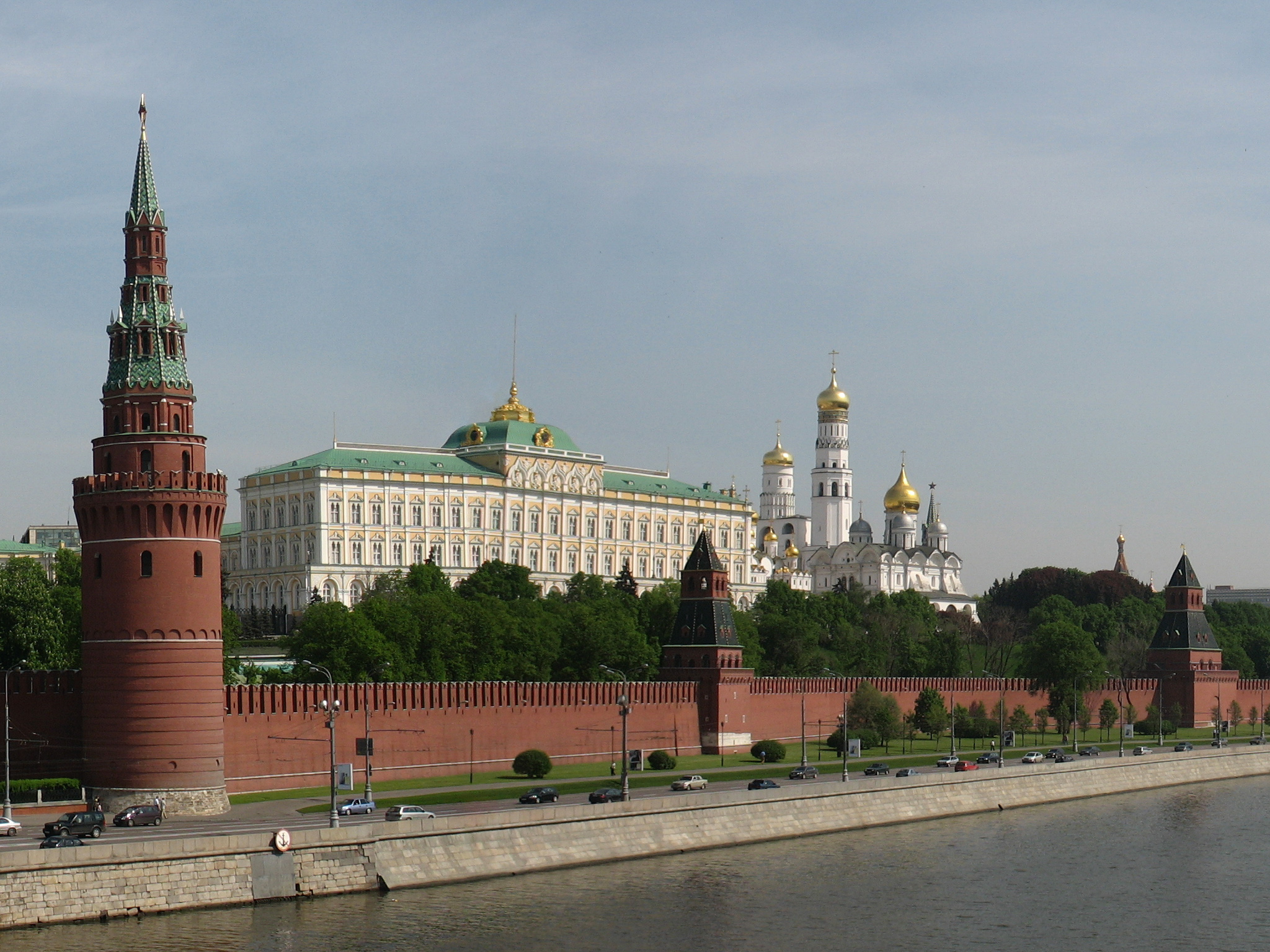
The Kremlin, Moscow, Russia
Dr. Zhivago by Boris Pasternak
New York : Vintage Classics, 2011.
xxviii, 675 p. ; 21 cm.

I've been wanting to read Dr. Zhivago for some time, and given it's length  (675 p.), it seemed like a good choice for a summer read.

I enjoyed a lot about this novel - it richly conveys the crazy reality that war and revolution can force on people, and the ways in which people try to find a meaningful life within that.  It is also a great love story, of course, which is probably part of why the movie version in the 60s was so successful.

I liked the historical content and movement of a lot of the book, but I did find that the plot began to get a bit unwieldy and confusing as the novel went on, and felt rushed to me at the end.  I also just found the increasing number of improbable coincidences became distracting as read the book.

This was a good book, but not a fantastic novel, in the way that Dostoevsky and Tolstoy have their truly magnificent articles.  However, if a student is a fan of Russian/Soviet history and literature and is looking for a good read, Dr. Zhivago may be just what the doctor ordered!

Tuesday, May 27, 2014

Study War No More

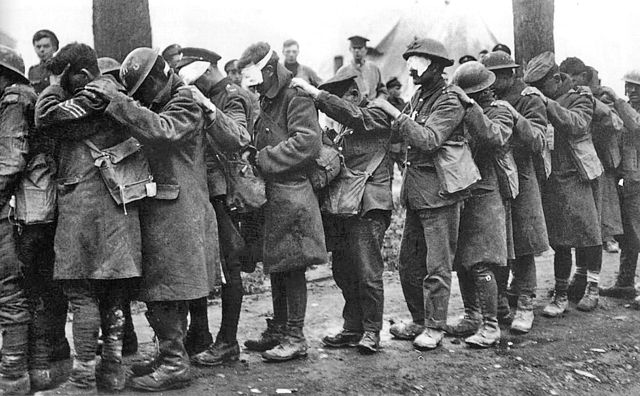
British 55th (West Lancashire) Division troops blinded by tear gas  during the Battle of Estaires, 10 April 1918
The First World War by John Keegan
New York : Vintage Books, 2000.
xvi, 475 p. : ill., maps ; 21 cm.

I've been slogging through a lot of books of European history and especially WWI - The Proud Tower, The Sleepwalkers, and now Keegan's First World War, which I pointedly finished on Memorial Day.

World War One is truly emblematic of the sickening, meaningless, barbarous, and utterly worthless human phenomena of making war - particularly modern warfare.  Especially painful is the fact that WWI essentially lay the groundwork for WWII.  As Keegan states in the closing pages of his book, "The Second World War was the continuation of the First...."

When I finished this book, I was left numbed by the staggering numbers of young men killed in the WWI.  This passage toward the end of Keegan's work gives a sense of the monstrous carnage that WWI unleashed.
"To the million dead of the British Empire and the 1,700,000 French dead, we must add 1,500,000 soldiers of the Hapsburg Empire who did not return, two million Germans, 460,000 Italians, 1,700,000 Russians, and many hundreds of thousands of Turks...."
In what moral universe can a person truly reckon with or comprehend such massive slaughter?  And then to realize that these numbers will be increased by a factor of six or seven (including many more civilians) in the horrors of WWII leaves me feeling despair.

I will say that Keegan has managed to pull together a readable and lucid account of WWI which is no small accomplishment.  He also manages to tell the story with moral conviction, but a light ideological touch, so that the reader is allowed to form her own opinions about where the guilt and responsibility lies for the nightmare that WWI was. I would definitely recommend it to a student who is interested in a detailed but compact history of the "Great War."

Friday, April 25, 2014

Nasty, Brutish, Short...and Helpful

Waterloo: June 18, 1815: the battle for modern Europe by Andrew Roberts
New York : Harper Perennial, 2006, c2005
143 p. : ill., maps ; 21 cm.

Of course I've heard of Waterloo and had a vague idea of when and where it happened.  Also, I've encountered the battle of Waterloo in Les Miserable by Hugo and in Vanity Fair by Thackeray, but never read a history of it.  I enjoyed and appreciated this short book by Andrew Roberts.  This was a great, short and very clear account of the battle.  It really helps the reader appreciate the momentous stakes of the battle, the terrible violence of the conflict, as well as the ways in which the outcome of the battle could have well gone to the French forces under Napoleon instead of to the European forces under Wellington.

It is definitely a short, helpful history of Waterloo that would be useful to any high school student wanting to know more about the last, terrible battle that Napoleon waged - the outcome of which brought the Napoleonic era to a close.

Thursday, March 13, 2014

The Sad Tower

The Proud Tower by Barbara Tuchman
New York, Macmillan [1966]
xv, 528 p. illus., ports. 25 cm.

Barbara Tuchman intrigues me.  A woman who made her mark with several classic histories back in the 1960s when it must have been a daunting task to be a woman trying to get scholarly work published in the field of European history.  Not only did she get published, but is recognized for - not one - but several classic volumes of history such as A Distant Mirror, The Guns of August, and this book, The Proud Tower.  Every May as I've conducted the inventory of our collection, I've seen The Proud Tower, and thought, "I'm going to read that." In this 100th anniversary year of the start of WWI, I've finally gotten around to reading it.  It is a magnificent read, but probably one that would swamp most high school students.  I greatly enjoy history - and European history - but I have to admit that it was a long, dense - though enjoyable - read.

The Proud Tower is subtitled, A Portrait of the World Before the War: 1890-1914, and though, I'd call it a portrait of the Anglo-European-Slavic world, it is a monumental history.  Tuchman surveys the great political and cultural trends that defined the end of the 19th century and the run up to WWI: the declining power of the British aristocracy, the rise of naked US imperialism, Anarchism, Socialism, music, philosophy, and militarism.

I'm glad I read it, especially since I hope to read at least one of the new WWI books that have come out recently.  I can't say that I'd recommend it to just any high school student interested in history.  But if a student is a European history aficionado, or just looking for a rich book on Europe before the "Great War" then I'll definitely think of Tuchman's masterpiece.


Friday, February 7, 2014

Velvet Gloves and Iron Fists

From the Wikipedia article on the 1848 revolutions
1848: Year of Revolution by Mike Rapport
New York : Basic Books, 2010, c2008.
xii, 461 p. : ill., map ; 24 cm.

You might remember that a while back I wanted to read Barbara Tuchman's Proud Tower, but realized that my background knowledge of 18th and 19th century Europe was sorely lacking - and so read a slim little volume about the Napoleonic Wars - and then was going to read 1848. Well, I've read it, and what an intense and complicated time 1848-1850 was!  Revolutions in Paris, Berlin, Vienna, Venice, Rome, Buda and Pest, Naples, and Florence (among others) pitted liberals, reactionaries, nationalists, imperialists, Papists, monarchists, socialists, revolutionaries, the peasantry, and the nobility in violent conflicts to determine the future of regions, kingdoms, and  Europe as a whole.  By the time 1850 rolled around, the forces of authoritarianism, conservatism and reaction sadly had triumphed - but what an incredible time it was...

In spite of the extreme complexities involved (maps would have been an invaluable addition to this book), Rapport writes well and is able to convey many of the significant underlying themes, conflicts, causes and effects of the year 1848.  His book really is relevant, since much of what stoked the conflicts still exists - extreme wealth and extreme poverty, ethnic versus nationalist tensions, majority rule versus minority protections, and individual rights versus the common good.

I can't say I'd recommend this book to just any student, but if there were a student who loved history and was interested in European history, then this is definitely an excellent read!


Tuesday, January 21, 2014

Nice, Little (Book) - Big, Terrible (Wars)

From Wikipedia
The Napoleonic Wars: A Very Short Introduction by Mike Rapport
Oxford, U.K. : Oxford University Press, 2013
xiv, 149 p. : ill. ; 18 cm.

I'm not sure what recently prompted me to want to read European history.  Perhaps it's the 100th anniversary of the start of WWI - which will be commemorated this August - perhaps it's seeing books on the shelf about Napoleon, or perhaps it's just my wanting to get away from fiction for a while.  Whatever the reason, I recently picked up a book I've been wanting to read for some time: Barbara Tuchman's The Proud Tower (about Europe in the decades just before WWI).  Starting it made me realize that I wanted to know more about the period before Tuchman's book, so I picked up Mike Rapport's 1848: Year of Revolution.  Guess what? Yes, I needed some background for 1848 and so I settled on this fine, little introduction to the Napoleonic Wars.

I love these "Very Short Introduction" books from Oxford.  They cover a wide variety of subjects and are written for lay readers by experts in the field being covered, and are short and concise.  As you can see, this one has just 149 pages, and the book is small enough that Napoleon could have it tucked under his buttons in the David portrait above - and we'd never know it!

Joking aside, the book was really eye-opening to the scale of carnage and destruction that the French Revolutionary and subsequent Napoleonic Wars brought to Europe (and the world).  I had always thought that WW I was the first real mass-carnage, total war to take place in Europe - but Rapport makes the case that the percentages and scale of casualties (along with the global nature of the wars) puts the Napoleonic Wars in the same league as WWI.

I also appreciated his attempt to show the conflicting views on the legacies (good and bad) of Napoleon's expansionism - especially in light of the extreme reactionary responses to his aggression.

Now I'm ready to tackle 1848 and then, hopefully, to take on The Proud Tower.