Authority by Jeff Vandermeer
New York : Farrar, Straus and Giroux, 2014.
341 p. ; 19 cm.
Last month I reviewed Annihilation, the first book in the Southern Reach trilogy, and now I'm posting a short review of book two - Authority.
I really enjoyed the first book in this series, but I found that book two - though good - was not quite as enjoyable to me. In this novel, the pace is much slower, as we follow an investigator sent in to head up and straighten up Southern Reach, the thirty-year old research/military/intelligence installation that borders Area X - the bizarre and threatening bio-zone that featured in book one.
In spite of not finding it as compelling as the first book, it is still good and has managed to do something that few other trilogies have managed to do for me - I'm really curious to read the third and final book in the series. If it is a great conclusion, then book two's slower pace will be well worth it, and I will recommend the whole series to students. If book three is a disappointment, then I'll still recommend book one, but let students decide whether plowing on through to the end was worth it.
Tuesday, January 19, 2016
Friday, January 8, 2016
Making His World a Little Colder
Jude the Obscure by Thomas Hardy
New York : Signet Classic, [1999]
xv, 428 p. : map ; 18 cm.
I have a soft spot in my heart for Hardy, and I've wanted to re-read Jude the Obscure for a long time - for over thirty years in fact! With some time off this winter break and a bit of travelling to do, I took Jude along with me and read it. It is a masterful novel, but incredibly bleak and depressing. Did I mention that it is really depressing?
The plot revolves around the tragedies that strike two individuals who dare to break with the conventions of marriage and class in 19th century England. Jude of the title is a young man who is seduced by and marries a woman to whom he is physically attracted, but with whom he has nothing in common, and then falls desperately in love with a cousin who shares his passions for learning, thinking, and defying convention. Jude is also in love with the intellectual life of the university, but finds it closed to him because of his rural, working-class status. Throw in another marriage, an unwanted child, another lifeless marriage, and the censure of community and you have all the elements for a disastrous tragedy - and that is what Hardy gives us.
As bleak as the novel is, it really is stunningly modern, and is considered by many to be one of the great novels in the English canon. Though Hardy is very circumspect about sexual matters - sometimes you have to re-read a section to realize that two people have been intimate with each other - he is ruthless in his dissection of the hypocrisies of religion and marriage. They are both shown as institutions that offer little but constraint and unhappiness to individuals.
I enjoyed reading Jude again after all these years, but I'm not sure high school students would enjoy it so much, unless they are already fans of Hardy - like me!
New York : Signet Classic, [1999]
xv, 428 p. : map ; 18 cm.
I have a soft spot in my heart for Hardy, and I've wanted to re-read Jude the Obscure for a long time - for over thirty years in fact! With some time off this winter break and a bit of travelling to do, I took Jude along with me and read it. It is a masterful novel, but incredibly bleak and depressing. Did I mention that it is really depressing?
The plot revolves around the tragedies that strike two individuals who dare to break with the conventions of marriage and class in 19th century England. Jude of the title is a young man who is seduced by and marries a woman to whom he is physically attracted, but with whom he has nothing in common, and then falls desperately in love with a cousin who shares his passions for learning, thinking, and defying convention. Jude is also in love with the intellectual life of the university, but finds it closed to him because of his rural, working-class status. Throw in another marriage, an unwanted child, another lifeless marriage, and the censure of community and you have all the elements for a disastrous tragedy - and that is what Hardy gives us.
As bleak as the novel is, it really is stunningly modern, and is considered by many to be one of the great novels in the English canon. Though Hardy is very circumspect about sexual matters - sometimes you have to re-read a section to realize that two people have been intimate with each other - he is ruthless in his dissection of the hypocrisies of religion and marriage. They are both shown as institutions that offer little but constraint and unhappiness to individuals.
I enjoyed reading Jude again after all these years, but I'm not sure high school students would enjoy it so much, unless they are already fans of Hardy - like me!
Tuesday, January 5, 2016
A Clash of Expectations
The Crusades: a Beginner's Guide by Andrew Jotischky
London : Oneworld, 2015.
xi, 180 pages : illustrations ; 20 cm
I guess it's just really, really hard to write a short and memorable introduction to a subject as sprawling and complex as the Crusades. It might be like asking someone to write a short introduction to contact between Europeans and American Indians - the first 200 years. There's just so much time and geography to cover, and so many important figures to include. I liked reading The Crusades by Jotischky, but after finishing it, I retained the broadest outlines of the history.
Perhaps that is the best a lay reader can hope for. Jotischky does a fine job of laying out the major events of the Crusades which spanned the period of 1095 to about 1291. He also provides some of the major forces underlying the Crusades (the complex web of papal, nobility, state and royal power, the role of religious belief, the cultural differences of both allies and enemies, etc.). It is an interesting period for certain, but I'm afraid it's just too much for one short book.
I would recommend this book to a student who is already interested in the Crusades, or one who is researching the Crusades, but I would hesitate giving it to a student who is just interested in a non-fiction work of history.
London : Oneworld, 2015.
xi, 180 pages : illustrations ; 20 cm
I guess it's just really, really hard to write a short and memorable introduction to a subject as sprawling and complex as the Crusades. It might be like asking someone to write a short introduction to contact between Europeans and American Indians - the first 200 years. There's just so much time and geography to cover, and so many important figures to include. I liked reading The Crusades by Jotischky, but after finishing it, I retained the broadest outlines of the history.
Perhaps that is the best a lay reader can hope for. Jotischky does a fine job of laying out the major events of the Crusades which spanned the period of 1095 to about 1291. He also provides some of the major forces underlying the Crusades (the complex web of papal, nobility, state and royal power, the role of religious belief, the cultural differences of both allies and enemies, etc.). It is an interesting period for certain, but I'm afraid it's just too much for one short book.
I would recommend this book to a student who is already interested in the Crusades, or one who is researching the Crusades, but I would hesitate giving it to a student who is just interested in a non-fiction work of history.
Friday, December 18, 2015
Two Squared
Girls Like Us by Gail Giles
Somerville, Mass. : Candlewick Press, 2015.
210 p. ; 20 cm.
This was a daring book for Gail Giles to write and a rewarding book to read. In a helpful interview with School Library Journal, Giles says, "I was told by a publisher that I would be 'flayed' if I attempted this. I think trying to get into a mental impairment that you do not have is tricky."
When I first started reading the book, I wasn't sure she was going to pull it off successfully - one character, Quincy, is - as she puts it - "mixed race" and the other, Biddy, has an intellectual disability. Each chapter is written in the voice of either Quincy or Biddy and features their particular slang and grammatical errors. But as the novel goes on - and the smarts, courage and strengths of each of the girls is revealed - the dialect begins to feel both natural and respectful.
There is a lot that is touched on in this short, gritty and uplifting novel - prejudice, rape, friendship, race, bullying, sexual abuse, pregnancy, work, and becoming independent. In spite of this there is a calm and lovely pace to the book and it doesn't usually feel forced.
I'm pleased to see that the book has been well reviewed, was long-listed for the National Book Award, and won the Schneider Family Book Award in 2015. A teacher here at the UHS recommended the book to me and I'll definitely recommend it to students.
Somerville, Mass. : Candlewick Press, 2015.
210 p. ; 20 cm.
This was a daring book for Gail Giles to write and a rewarding book to read. In a helpful interview with School Library Journal, Giles says, "I was told by a publisher that I would be 'flayed' if I attempted this. I think trying to get into a mental impairment that you do not have is tricky."
When I first started reading the book, I wasn't sure she was going to pull it off successfully - one character, Quincy, is - as she puts it - "mixed race" and the other, Biddy, has an intellectual disability. Each chapter is written in the voice of either Quincy or Biddy and features their particular slang and grammatical errors. But as the novel goes on - and the smarts, courage and strengths of each of the girls is revealed - the dialect begins to feel both natural and respectful.
There is a lot that is touched on in this short, gritty and uplifting novel - prejudice, rape, friendship, race, bullying, sexual abuse, pregnancy, work, and becoming independent. In spite of this there is a calm and lovely pace to the book and it doesn't usually feel forced.
I'm pleased to see that the book has been well reviewed, was long-listed for the National Book Award, and won the Schneider Family Book Award in 2015. A teacher here at the UHS recommended the book to me and I'll definitely recommend it to students.
Sunday, December 13, 2015
Cruel Justice
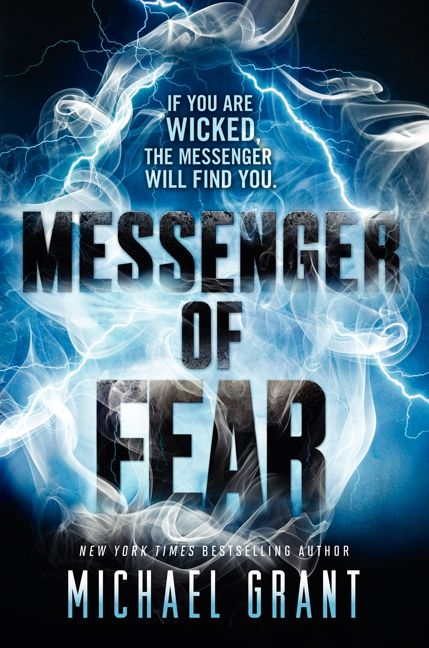
Messenger of Fear by Michael Grant
New York, NY : Katherine Tegen Books, an imprint of HarperCollins Publishers, 2015.
260, 12 p. ; 21 cm.
Michael Grant is no stranger to writing bestsellers - his sprawling Gone series is popular, and I'm guessing this new series will do pretty well, too.
The novel opens with a confused and disoriented main character seemingly lost in a surreal, magical and ominous reality of mists, muted colors and strange characters. As the novel develops the reader learns that it is a supernatural world of spirits, demons, and demigods that lies behind everyday reality - and is the realm in which justice and injustice are exacted against rather puny and powerless humans who transgress against the moral order.
Grant is good at creating a frightening, magical and oppressive atmosphere and conveying the ways in which fear and imagination can be as terrifying as actual physical events.
The writing is a little uneven. I found that it got better as it went along. The plotting is pretty good, though my guess is that readers will question question just how immoral some of the actions of characters are. Is it really so terrible to kill off an animal that has been badly hurt in an accident - does it require the intervention of the cosmic forces of good and evil?
Problems aside, I think that readers wanting a creative horror novel will enjoy this read. As School Library Journal put it in a review, the book will "delight those readers who enjoy a little gore and horror in their books."
New York, NY : Katherine Tegen Books, an imprint of HarperCollins Publishers, 2015.
260, 12 p. ; 21 cm.
Michael Grant is no stranger to writing bestsellers - his sprawling Gone series is popular, and I'm guessing this new series will do pretty well, too.
The novel opens with a confused and disoriented main character seemingly lost in a surreal, magical and ominous reality of mists, muted colors and strange characters. As the novel develops the reader learns that it is a supernatural world of spirits, demons, and demigods that lies behind everyday reality - and is the realm in which justice and injustice are exacted against rather puny and powerless humans who transgress against the moral order.
Grant is good at creating a frightening, magical and oppressive atmosphere and conveying the ways in which fear and imagination can be as terrifying as actual physical events.
The writing is a little uneven. I found that it got better as it went along. The plotting is pretty good, though my guess is that readers will question question just how immoral some of the actions of characters are. Is it really so terrible to kill off an animal that has been badly hurt in an accident - does it require the intervention of the cosmic forces of good and evil?
Problems aside, I think that readers wanting a creative horror novel will enjoy this read. As School Library Journal put it in a review, the book will "delight those readers who enjoy a little gore and horror in their books."
Friday, December 11, 2015
Killer Biology Lessons
Annihilation by Jeff VanderMeer
New York : Farrar, Straus and Giroux, 2014.
195 p. ; 20 cm.
Annihilation is a different kind of science fiction, dystopian horror/thriller. The telling of the story is low key, which makes the occasional violence and unnatural events that much more frightening and shocking. Furthermore, a lot of the weirdness and creepiness of the novel is achieved with psychological and atmospheric touches instead of theatrical events and plot twists. In this novel of a research expedition gone awry - people suddenly disappear, the fatal events of past expeditions are gradually revealed, and the biological weirdness of Area X is sometimes directly narrated (a strange plantlike growth that spells out an enigmatic message or a dolphin with eyes that look unsettlingly human).
A lot happens in this short and creepy little novel. There is hypnosis, strange creatures, government lies, death, and deception. It works as a stand alone and yet intrigues the reader to continue with the Southern Reach trilogy of which it is a part. I'm glad to see that the book has received positive reviews and I would recommend it to readers looking for a fresh take on the horror genre.
New York : Farrar, Straus and Giroux, 2014.
195 p. ; 20 cm.
Annihilation is a different kind of science fiction, dystopian horror/thriller. The telling of the story is low key, which makes the occasional violence and unnatural events that much more frightening and shocking. Furthermore, a lot of the weirdness and creepiness of the novel is achieved with psychological and atmospheric touches instead of theatrical events and plot twists. In this novel of a research expedition gone awry - people suddenly disappear, the fatal events of past expeditions are gradually revealed, and the biological weirdness of Area X is sometimes directly narrated (a strange plantlike growth that spells out an enigmatic message or a dolphin with eyes that look unsettlingly human).
A lot happens in this short and creepy little novel. There is hypnosis, strange creatures, government lies, death, and deception. It works as a stand alone and yet intrigues the reader to continue with the Southern Reach trilogy of which it is a part. I'm glad to see that the book has received positive reviews and I would recommend it to readers looking for a fresh take on the horror genre.
Thursday, December 3, 2015
Fled is that Music
Wake by Lisa McMann
New York : Simon Pulse, 2009, c2008.
210 p. ; 21 cm.
I finally read Wake because it is popular with students and has been reissued (along with its companion books) by Simon & Schuster. It was an easy read, but a bit uneven.
McMann creates a very clever plot - a girl, Janie, who finds that she is uncontrollably drawn into other people's dreams. As she comes of age, she gradually learns to control this condition and even learns that she can shape content and direction of the dream she enters.
A lot of the novel revolves around her growing attraction to a male friend Cabel - a relationship that moves from friendship to a sweet romance.
I found the writing to be uneven at times, occasionally feeling very choppy and disjointed. I found myself wondering why the editor didn't take a more active role in shaping the final production of the novel. I also felt that the introduction of spirituality (a dead person visits Janie in her dreams and it is clear that the spirit is real) undercuts the understated realism of Janie's dreamworld powers. Finally, I found some of the plot twists toward the end to be more like TV show plotting instead of good fiction.
Overall, a strong start, but a vision that fades (and so the title of this post). Problems aside, Wake is a fun read and one that clearly appeals to young readers, so I'll give it a thumbs up with some qualifications.
New York : Simon Pulse, 2009, c2008.
210 p. ; 21 cm.
I finally read Wake because it is popular with students and has been reissued (along with its companion books) by Simon & Schuster. It was an easy read, but a bit uneven.
McMann creates a very clever plot - a girl, Janie, who finds that she is uncontrollably drawn into other people's dreams. As she comes of age, she gradually learns to control this condition and even learns that she can shape content and direction of the dream she enters.
A lot of the novel revolves around her growing attraction to a male friend Cabel - a relationship that moves from friendship to a sweet romance.
I found the writing to be uneven at times, occasionally feeling very choppy and disjointed. I found myself wondering why the editor didn't take a more active role in shaping the final production of the novel. I also felt that the introduction of spirituality (a dead person visits Janie in her dreams and it is clear that the spirit is real) undercuts the understated realism of Janie's dreamworld powers. Finally, I found some of the plot twists toward the end to be more like TV show plotting instead of good fiction.
Overall, a strong start, but a vision that fades (and so the title of this post). Problems aside, Wake is a fun read and one that clearly appeals to young readers, so I'll give it a thumbs up with some qualifications.
Subscribe to:
Posts (Atom)