Friday, June 27, 2014

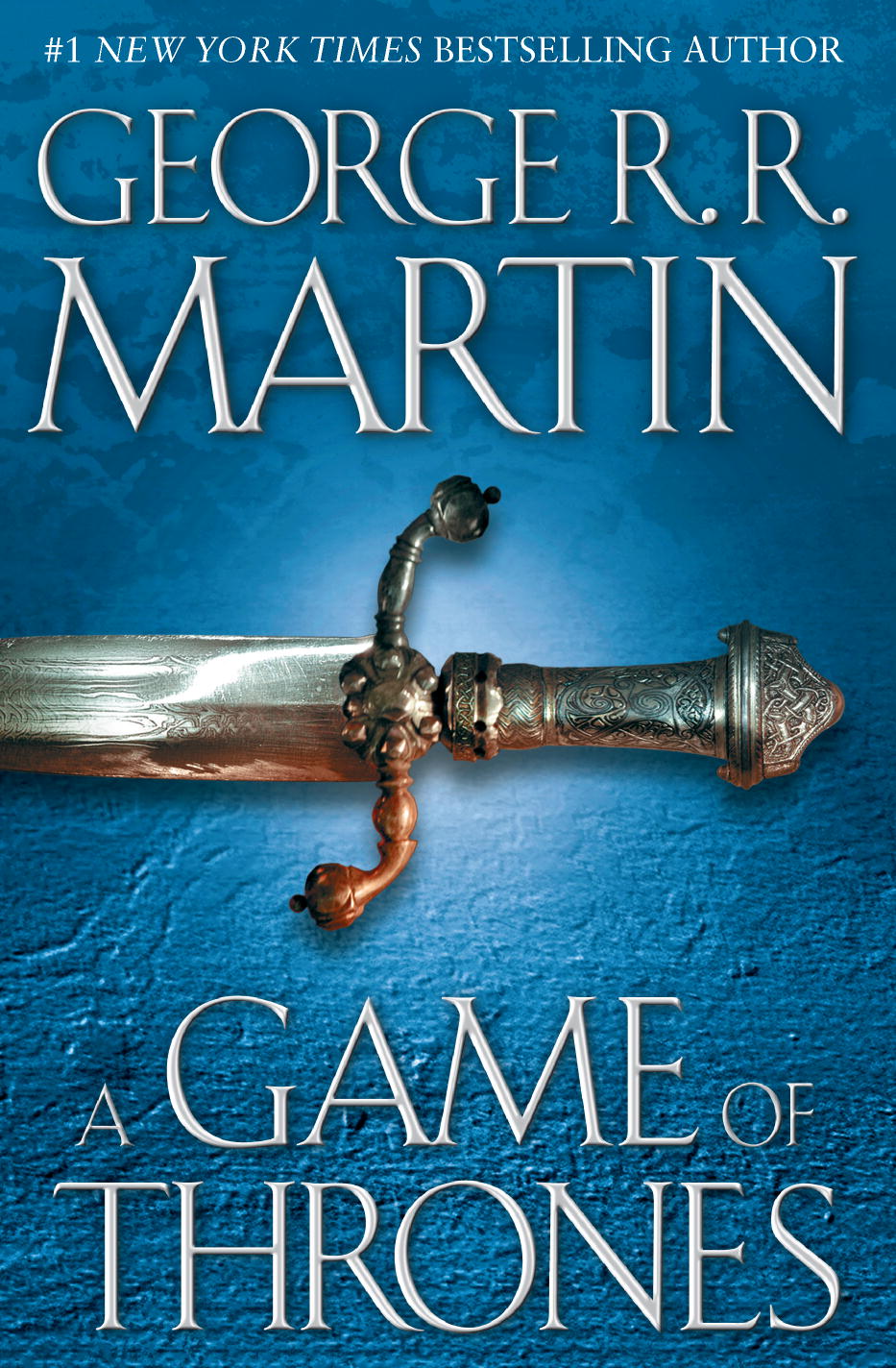
A Game of Thrones
by George R. R. Martin
New York : Bantam Books, 2011, c1996.
835 p. : maps ; 18 cm.

Writing about A Game of Thrones in the London Review of Books, John Lanchester comments that there are many avid readers who will read just about anything, but will absolutely not read fantasy and science fiction.  That is almost an accurate description of me, except I will read a fantasy and sci fi that has become extremely popular, or is recommended to me by students.  A Game of Thrones definitely fits that description, and I'm glad I read it.

A Game of Thrones represents complex, unpredictable storytelling at it's best.  A character being a main character is no guarantee that he or she will still be alive at the end of the novel - and there is so much treachery, clandestine plotting, and violent conflict - that the plot itself presents surprise after surprise.  Likewise the novel may be moving along in an extremely realistic fashion when suddenly a supernatural element appears so seamlessly that I it caused me to do a reader's double-take.

I think the thing that pleased me most about Martin's Game of Thrones was that it really is well written.  I found myself at times quiet taken by the skill of descriptive setting, or the nuanced personality of a character.  Though - like many fantasy worlds of fiction - it can get a bit complicated and the reader may find herself rechecking the maps at the front of the book and the appendices at the back - the book does not disappoint.

This is not a book that a librarian needs to recommend - though written in the 1990s, the book (and series) has become something of a publishing phenomena due to the wildly successful HBO series which it inspired.  The book also has mature content, containing scenes of violence and sexuality.


Tuesday, May 27, 2014

Study War No More

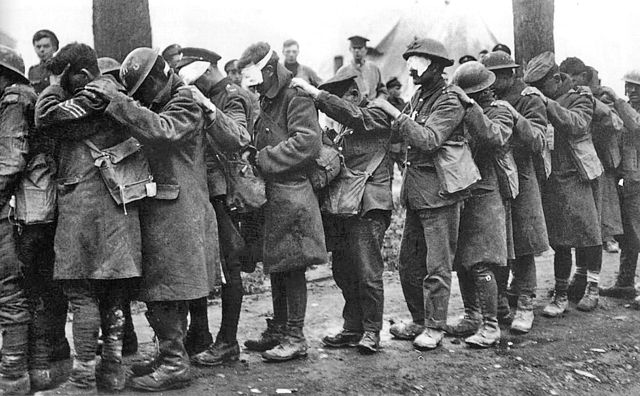
British 55th (West Lancashire) Division troops blinded by tear gas  during the Battle of Estaires, 10 April 1918
The First World War by John Keegan
New York : Vintage Books, 2000.
xvi, 475 p. : ill., maps ; 21 cm.

I've been slogging through a lot of books of European history and especially WWI - The Proud Tower, The Sleepwalkers, and now Keegan's First World War, which I pointedly finished on Memorial Day.

World War One is truly emblematic of the sickening, meaningless, barbarous, and utterly worthless human phenomena of making war - particularly modern warfare.  Especially painful is the fact that WWI essentially lay the groundwork for WWII.  As Keegan states in the closing pages of his book, "The Second World War was the continuation of the First...."

When I finished this book, I was left numbed by the staggering numbers of young men killed in the WWI.  This passage toward the end of Keegan's work gives a sense of the monstrous carnage that WWI unleashed.
"To the million dead of the British Empire and the 1,700,000 French dead, we must add 1,500,000 soldiers of the Hapsburg Empire who did not return, two million Germans, 460,000 Italians, 1,700,000 Russians, and many hundreds of thousands of Turks...."
In what moral universe can a person truly reckon with or comprehend such massive slaughter?  And then to realize that these numbers will be increased by a factor of six or seven (including many more civilians) in the horrors of WWII leaves me feeling despair.

I will say that Keegan has managed to pull together a readable and lucid account of WWI which is no small accomplishment.  He also manages to tell the story with moral conviction, but a light ideological touch, so that the reader is allowed to form her own opinions about where the guilt and responsibility lies for the nightmare that WWI was. I would definitely recommend it to a student who is interested in a detailed but compact history of the "Great War."

Monday, May 5, 2014

a poet 'swonder full i fe!


E. E. Cummings: a poet's life
by Catherine Reef
New York : Clarion Books, c2006.
149 p. : ill. ; 26 cm.

Finishing up April, National Poetry Month, with this biography of the famous US poet, e.e. cummings, seemed like a good idea.  And it was!  Reef has put together a wonderful and accessible biography of Cummings.  I really appreciated that Reef manages to present a lot of information in a manageable number of pages - and yet really develops a fascinating portrait of Cummings as a truly unique artist and human being.

I was really struck by how original Cummings was.  His poetry still has a freshness and vitality, but must have seemed stunningly unique when he published it. Reef also gives attention to Cummings serious work as a painter (as the self-portrait above reveals).

Reef also conveys what an original Cummings was in so many ways.  Though from a very conventional family, he rebelled by moving to Greenwich Village, volunteering to be an ambulance driver in WWI, traveling widely abroad, championing avant-garde artists (e.g. the Armory Show artists).

Reef manages to convey the various milieus that defined Cummings' life - WWI, the 1920s, WWII, the New Deal, etc.  She also brings Cummings to life as a man of great dedication, passion, talent, wit, playfulness and (yes) love - and all in the space of 149 pages enlivened with wonderful photographs and illustrations.

I would definitely recommend this book to any student curious about E. E. Cummings specifically or the life of an artist and writer generally.


Friday, April 25, 2014

Entertaining, That's All

Boy Nobody by Allen Zadoff
New York : Little, Brown and Co., 2013
337 p. ; 24 cm.

It's already been said, but this book echoes The Bourne Identity and James Bond.  The promotional material from Zadoff's website highlights a lot of the positive buzz around the book (and its sequels).  I can't help feeling that it's a bit over-hyped. (Though a movie and sequels may create more success for the book and series).

Yes, the book was entertaining.  It moves along, is well-plotted, and there's suspense, action, and interesting developments.  I'd feel fine recommending it to a student wanting a spy/assassin/action/thriller novel; it delivers...

But I just couldn't care about the characters very much.  I really felt no emotional connection to any of them, and frankly found the female characters more fitting a male-fantasy ideal than any connection to reality.  That said, if you want a fast, action-based clandestine thriller, then Nobody might be just what you want.

Nasty, Brutish, Short...and Helpful

Waterloo: June 18, 1815: the battle for modern Europe by Andrew Roberts
New York : Harper Perennial, 2006, c2005
143 p. : ill., maps ; 21 cm.

Of course I've heard of Waterloo and had a vague idea of when and where it happened.  Also, I've encountered the battle of Waterloo in Les Miserable by Hugo and in Vanity Fair by Thackeray, but never read a history of it.  I enjoyed and appreciated this short book by Andrew Roberts.  This was a great, short and very clear account of the battle.  It really helps the reader appreciate the momentous stakes of the battle, the terrible violence of the conflict, as well as the ways in which the outcome of the battle could have well gone to the French forces under Napoleon instead of to the European forces under Wellington.

It is definitely a short, helpful history of Waterloo that would be useful to any high school student wanting to know more about the last, terrible battle that Napoleon waged - the outcome of which brought the Napoleonic era to a close.

Monday, March 31, 2014

A Winter Read

Image of Antartica is from NSIDC
The Left Hand of Darkness by Ursula Le Guin
New York : Ace Books, 2000, c1969.
304 p. ; 21 cm.

It's been a brutal winter in the Midwest, so this was an excellent book to finish out winter with, and welcome in spring.  Le Guin's masterpiece is set on the planet Gethen - nicknamed "Winter" by the first visitors from earth.  The novel is told from the viewpoint of Genly Ai  - an envoy from earth, who is sent alone to the planet to try and persuade its humanoid dwellers to join the Ekumen - a loose confederation of eighty-plus planets peopled by other human species.

The great twist of Le Guin's novel is that on Winter the humans have no gender until they enter estrus - and the gender that emerges during the 5-7 period of "kemmer" is not set for an individual but is dynamic and requires a partner to fully proceed.  Le Guin uses this lack of fixed gender to explore many political, social and cultural concepts that could play out in such a gender free - and non monogamous culture.  Imagine a world in which individuals might be both a mother and father and in which there was a bond with "kemmer" partners, but not usually a lifelong bond.  Le Guin's spins out her story of Gethen with its two competing "nations" - Karhide and Orgoryen - with skill and creativity, and her storytelling seems effortless and completely believable.

The novel is exciting, interesting, contemplative, and wonderfully satisfying.   I would definitely recommend it to any student who likes science fiction, and would recommend it to any student looking for a really intelligent but fun to read novel.

Thursday, March 13, 2014

The Sad Tower

The Proud Tower by Barbara Tuchman
New York, Macmillan [1966]
xv, 528 p. illus., ports. 25 cm.

Barbara Tuchman intrigues me.  A woman who made her mark with several classic histories back in the 1960s when it must have been a daunting task to be a woman trying to get scholarly work published in the field of European history.  Not only did she get published, but is recognized for - not one - but several classic volumes of history such as A Distant Mirror, The Guns of August, and this book, The Proud Tower.  Every May as I've conducted the inventory of our collection, I've seen The Proud Tower, and thought, "I'm going to read that." In this 100th anniversary year of the start of WWI, I've finally gotten around to reading it.  It is a magnificent read, but probably one that would swamp most high school students.  I greatly enjoy history - and European history - but I have to admit that it was a long, dense - though enjoyable - read.

The Proud Tower is subtitled, A Portrait of the World Before the War: 1890-1914, and though, I'd call it a portrait of the Anglo-European-Slavic world, it is a monumental history.  Tuchman surveys the great political and cultural trends that defined the end of the 19th century and the run up to WWI: the declining power of the British aristocracy, the rise of naked US imperialism, Anarchism, Socialism, music, philosophy, and militarism.

I'm glad I read it, especially since I hope to read at least one of the new WWI books that have come out recently.  I can't say that I'd recommend it to just any high school student interested in history.  But if a student is a European history aficionado, or just looking for a rich book on Europe before the "Great War" then I'll definitely think of Tuchman's masterpiece.