Thursday, December 12, 2013

Bellows and Shrieks

The End Games by T. Michael Martin
New York, NY : Balzer + Bray, [2013]
369 p. ; 22 cm.

If you have any doubts that The End Games has been well-received, check out the praise on T. Michael Martin's website - wow!  I wish I could say I loved this book. I guess I'm just not enough of a zombie fan to completely enjoy the book - though I did appreciate the quality of the writing.  That is a positive trend that I've noticed with many YA books - really top-notch writing across many subjects and genres.

I would agree with critics that the book is very imaginative.  I like how it draws on video-gaming language and knowledge in a way that is thoroughly integrated into the plot.  I also liked the unusual pairing of an older brother with a very young brother who has autism.  The plot device of two characters bound up in a survival/journey ordeal is well traveled (think Huck and Jim in Twain's masterpiece, the father and son of McCarthy's The Road, or the Alex and Darla in Mullin's Ashfall) and is well done here.   But for me, I found several key actions of the plot confusing and overwrought, certain characters almost cartoonish, and just too many actions where I had to suspend disbelief and just accept the improbability. I really found the deranged Capt. Jopek a bit much - his abilities with weapons makes him seem more superhuman than real.  I also just never felt the emotional pull I was supposed to feel with the main character's memories of his troubled homelife that existed before the zombie apocalypse.

But problems aside, the book is fast, exciting, dramatic, action packed, and written with striking and fresh language. It has some gory scenes, but rarely seems written for shock effect. The language is also amazingly free of obscenities, and there is a nice romance woven into the plot with a soft touch.  Not bad for a first novel.  So, if I have a student asking about a good zombie novel - I'll definitely send them looking for The End Games.

Oh, and "Bellow and Shrieks"? Bellows is the name that the main character, Michael, gives to the zombies.  Shrieks?  Well, you'll have to read the novel to figure out that reference.


Wednesday, December 4, 2013

Heartwarming, Sort Of

Back cover illus. by Bosma
Winger by Andrew Smith
New York : Simon & Schuster BFYR, 2013
438 p. : ill. ; 22 cm.

Winger is a readable, entertaining book.  Smith is great with dialogue and humor and the plotting moves along well.  It's a coming of age novel told in the voice of Ryan Dean West, aka "Winger" who is starting his junior year at a boarding school for wealthy kids in the Pacific NW.  He's smart, scrappy, a hard-playing, talented rugby player with heart, apparently cute, but...he's only 14 - two years younger than his peers (and especially Annie, his friend who he desperately loves and hopes will feel the same).  Winger is also immature, crude, completely obsessed with sex and rating the attractiveness of girls and women, and prone to fighting.  The Booklist reviewer nailed it: "In short, Ryan Dean is a slightly pervy but likable teen."

I would have said "somewhat likable" - I found at least one his pranks creepy and repulsive, his constant ranking of females tiresome, and his jealous possessiveness both hypocritical and annoying.  These would not have bothered me so much - except that Smith has written essentially a male fantasy tale.  Winger, in spite of his immaturity, and insistence on what a loser he is, ends up with the two most attractive and interesting girls in the school in love with him. As the School Library Journal reviewer noted about one of the girls: "One wonders what she sees in Ryan Dean."

The novel ends with a shocking act of violence that doesn't seem believable (at least not in the context of the novel) and raises a lot of questionable issues about the supposed motives and behaviors of closeted gay guys. 

In spite of my criticisms, the novel is funny, fun to read, and likely to appeal to both boys and girls.

Monday, December 2, 2013

Kurlansky's Tasty History

The Big Oyster: history on the half-shell by Mark Kurlansky
New York : Random House Trade Paperbacks, 2007, c2006.
xx, 307 p. : ill., maps ; 21 cm. 

What a fun way to learn about the history of New York City!  Kurlansky again finds a way to entertain and inform while presenting his discoveries about another item that humans put in their mouths.  He has tackled salt, and cod (which I reviewed here about a year ago).

Like his other books, this one is well-written, fascinating, and very informative.  In it you'll learn that for many years in the 1800s, New York City was the oyster capital of the world - but that in a short time ballooning population and industrialization led to the demise of the rich oyster beds of the New York harbor - due to pollution and and over-harvesting. Kurlansky does a great

There is a lot to The Big Oyster - it is a practical history of the early years of New York City, with a lot about the earliest European settlement of the area to the bustle of the 19th and 20th centuries.  But it is also a social history and a foodways history - including recipes from various eras.  Finally, it is both an environmental history and cautionary tale about the squandering of precious natural resources.

I would definitely recommend this book to anyone curious about the history and culture of America's most dynamic city, New York.

Tuesday, November 19, 2013

Ka-Boom!

Ashfall by Mike Mullin
Terre Haute, IN : Tanglewood, c2010.
466 p. ; 22 cm.

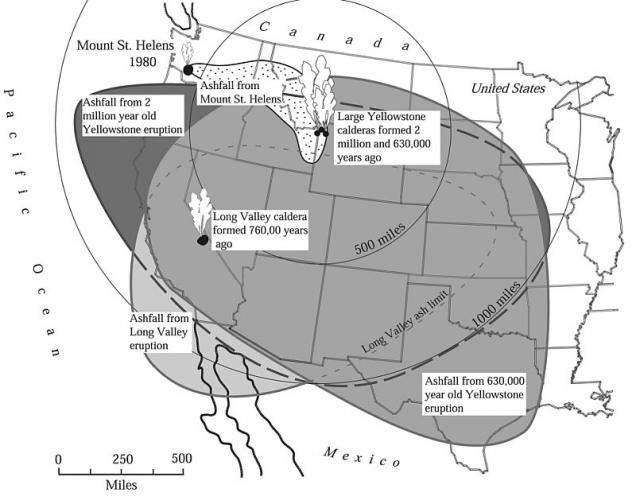
The picture at the top of this post should give you pause.  Yellowstone Park [shaded in green], the US national treasure of hot springs, geysers, mountains, lakes and wildlife is basically the crater - or caldera [large red boundary] of an incredibly massive supervolcano that last had a major eruption about 640,000 years ago.  Ok, 640,000 years ago is a long time, but the problem is that it will erupt again in the future - probably not in our lifetimes (but it could).   It is the unlikely, but theoretically possible event of such a nation-shattering (about 2/3 of the US would be significantly damaged) and world-altering volcanic event that starts Mike Mullin's first novel off with a bang.

The novel is set far away (hundreds of miles) from Yellowstone,  - in Iowa - but not far enough away to escape the devastating noise, ash and ejecta of the eruption.  The event creates a cataclysmic environment through which the hero of the novel - 17 year old Alex - seeks to survive as he heads east toward Illinois where his family is.  His ordeal through this landscape - one that brings to mind Cormac McCarthy's The Road -  forms the plot of this thrilling novel.

As you might imagine this new, altered world brings out the best and definitely the worst in people and institutions that Alex is exposed to.  A bright spot is his joining forces with a remarkable young woman, Darla, whose skills and courage help Alex survive.  Not surprisingly the two eventually fall in love, in a rather believable, and touching way. 

The novel should appeal to all kinds of readers.  There is disaster, survival, action, romance, and some gritty violence and tragedy.  I really appreciated how Mullin allows his novel to really delve into the complex ways that individuals and institutions can trend toward good - and definitely toward evil in situations of grave social disruption.  I could easily recommend this book.  We also recently acquired the sequel - Ashen Winter.

Friday, November 15, 2013

An Addictive Novel

Crank by Ellen Hopkins
New York : Simon Pulse, 2004.
537 p. ; 18 cm.

Hopkins manages to pull you into the mind and world of a high school-aged good kid drawn into a downward spiral due to her growing addiction to methamphetamine (crank).  She does it with really nice verse that allows her to often have the main character's thoughts, spoken words, and dialogue from others all in one poem.

This book, and many of Hopkins very long novels in verse are very popular and I can see why. Her strength is that she deals honestly with the appeal of drug abuse - while at the same time illuminating the horrors and dangers of addiction.  It's a skillful balancing act that keeps her book compelling but not preachy.  Also the variety of poetic line structures works pretty well - allowing calm meditative poems, jumbled high-on-meth poems, broken blocks of verse to reflect multiple voices and perspectives, etc.

In a short "Author's note" at the beginning of the book, Hopkins reveals that much of the substance of her novel in verse is from her own life as a mother with a meth-addicted daughter, though she admits that many events, characters, etc. are composites based on real life experiences.

No need to recommend this book, as it remains very popular.  I'm glad I finally got around to reading it, so I can appreciate its many strengths.

Thursday, November 14, 2013

Hi Tech Guilt

A version of Think Tank 1's cover from the Top Cow Website
Think Tank 1 by Matt Hawkins
Los Angeles : Top Cow Productions, Inc., 2013
1 v. (unpaged) : chiefly ill. ; 26 cm.

David Loren has a guilty conscience.  He is the main character of this new graphic novel series from Matt Hawkins and Rashan Ekedal, and he's begun to question his role as a super-intelligent weapons developer for a Pentagon think tank that recruited him with a full scholarship to Cal Tech when he was just 14.  

In the 10 years since that time he has begun to question the value of what he is doing (reflecting on the human toll that his lethal creations have) and he wants out.  Unfortunately for David, he's pretty much a prisoner on the high-security base where he lives and works.  But given his technical wizardry, he decides he's going to escape - one way or another.

The story is fast-paced, exciting, interesting and ends with a dramatic twist that sets the reader up for the next installment of Think Tank.  Not bad for a debut graphic novel.

I really appreciated the author's scientific and ethical depth.  The novel ends with a section that explains some of the terms and references found in the story (e.g. DARPA, Einstein quotes, etc.) and contains references to some of the real-world hi-tech weaponry currently being developed by the Pentagon and its private contractors.  A good read for the tech-savvy, current-events aware fan of graphic novels.

For more insight into Think Tank take a look at this interview with Matt Hawkins, or this review of Think Tank 1.

Monday, November 4, 2013

Homo Cursorius

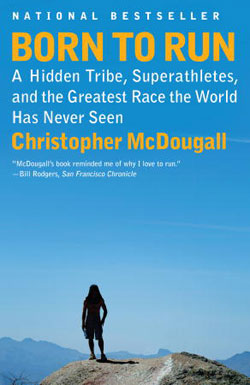
Born to Run: a Hidden Tribe, Superathletes, and the Greatest Race the World Has Never Seen by Christopher McDougall
New York : Vintage Books, 2011, c2009.
1st Vintage Books ed.
287 p. ; 21 cm.

For the past couple of months my son has been insisting that I had to read Born to Run - so I did.  He was right; it was a great read!  Not perfect, but pretty amazing!

The book is an exuberant introduction to the phenomena of ultrarunning, but it is more than that.  It is a celebration of human running, of adventure and determination, and the amazing - and often larger than life -  personalities of ultrarunners.  Even more, the book serves as a provocative look at human origins, evolution and the possibility that modern humans (all of us!) are born with the capacity to run far longer and farther than most of us have ever run - and to do it with minimal injuries.  This last aspect has McDougall casting a rather critical eye on the whole modern running shoe industry.

McDougall's hook for the book is his search for the enigmatic indigenous people of Northwest Mexico, the Tarahumara who survived contact with the Spaniards by avoiding engagement with them, opting instead to live in the very sparse, barren, and rugged terrain of the Copper Canyon in Mexico.  The Tarahumara also happen to be world class endurance runners, and McDougall's renewed interest in long distance running (which had hobbled him with injuries) is rekindled during his successful search for the Tarahumara.  His contact person, almost-mythical gringo runner and hermit called el Caballo, draws McDougall into his wildly ambitious plans to stage a race in the dangerous Copper Canyon pitting the greatest ultrarunners from North America against the greatest Tarahumara runners.  As you can imagine, the outcome is hair-raising and almost unbelievable.

I have to admit that when I first began reading the book, I was a bit put off by McDougall's overblown style and descriptions - every character is the most amazing, most awesome, most eccentric, most etc. etc., that one could imagine.  However, on Googling some of the characters in the book, they have in fact accomplished ridiculously grueling feats of running endurance - and often faster and more energetically than any other humans on the planet.  My only other complaint is that the book would have been much better with at least some photos - particularly of the characters who populate the book.


This book will definitely have you thinking a lot about running, whether you are someone who has never run before or are a seasoned marathoner. And it does it with fun, adventure and a true zest for the subject.  Not bad for a book on something as common as running from here to there!