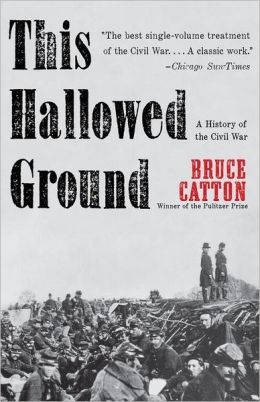
This Hallowed Ground by Bruce Catton
New York : Vintage Books, 2012, c1956.
1st Vintage Civil War library ed.
ix, 437 p. : maps ; 21 cm.
In the 1950s and 60s Bruce Catton was recognized as the essential and most popular historian of the Civil War. He has written many volumes on those terrible years of 1861 to 1865 - such as A Stillness at Appomattox which our library also owns. Though not read as much of late, I was pleased to see this one-volume history of the Civil War reissued in 2012.
I can understand why Catton was so popular. This history is very readable and engaging and offers a great overview of the important events and battles of the Civil War. It lacks some of the more interesting social and personal perspectives that a more recent history of the war might have, but it is nonetheless a compelling read. Catton is able to present the long and complex campaigns of the Civil War in a way that is fairly easy to follow.
I would definitely recommend this book to a student looking for a good introductory narrative of the Civil War.
Tuesday, June 25, 2013
Wednesday, June 19, 2013
Out There with Kafka
New York : Vintage International, 2006, c2005.
1st Vintage International ed.
467 p. ; 21 cm.
This one has a bit of everything: a sophisticated but sensitive 15 year old main character, Colonel Sanders, a downpour of leeches, some sex, an old man who talks to cats, time travel, a road trip with a 29 year old trucker and even a library (yes, a library!) as one of the main settings.
I first read a Murakami novel about 10 years ago - The Wind Up Bird Chronicle and it was a tour de force, so I was looking forward to this one which is on the AP Lit recommended list.
I was not disappointed in this novel. It is extremely creative and interesting with wonderfully memorable characters - from Ms. Saeki, the librarian stuck in her lost love from decades ago, to the endearing Mr. Nakata who is illiterate but wise and able to converse with cats. The novel can definitely be described as magical realism, but it is much more than than that. It is a fable, a murder mystery, a coming of age story, a meditation on love, time, loyalty, goodness and evil.
This is not an "easy" novel, but it should really appeal to students who love to read literature and are looking for something truly unusual, creative and yet with a lot of substance - a book that will stay with you long after you've put it down.
Tuesday, May 21, 2013
Like Coffee with Cream...and Sugar
Why We Broke Up by Daniel Handler
New York : Little, Brown, 2011.
354 p. : col. ill. ; 22 cm.
A really lovely book, that offers several creatively fresh angles on the romance that falls apart between two unlikely teens.
The first nice hook of this book is the premise. The book is the supposed text accompanying the box of returned "artifacts" of this couple's brief love affair which is being ended by the girl after she learns of her boyfriend's secret second girlfriend.
The next appealing aspect of the book are the lovely full color paintings by Maira Kalman which begin each chapter of the book - usually being a chapter describing one item in the box and how it relates to the couple's romance and break-up. These illustrations (like the one at the top of this entry) are simple - but wonderfully colorful and evocative. They also serve to stoke the reader's curiosity and add texture to the novel. I often found myself gazing at them before beginning a chapter, and then looking back at them after reading the chapter.
Another strength of this book are the characters, who are richly developed and complicated. Min Green, the girl who tells the story, is smart, irreverent, artsy and - unfortunately - naive. Her boyfriend the popular, good looking Ed Slaterton is a jock and a bit of a cad, but is also very smart in math and clever and funny.
If I had a complaint for this book, it would be that it was a bit too long. I felt like it lost its pace about 2/3 of the way through, and like other critics of the book I found myself being a bit annoyed with the narrator - her obsession with films and inability to see the flaws of her boyfriend get tiresome toward the end. However, I felt like the book found its footing toward the end and I would definitely recommend it to any student looking for a book about dating, romance, first love, and break-ups.
For me this book called to mind Chbosky's Perks of Being a Wallflower and Cohn's Nick and Norah's Infinite Playlist.
New York : Little, Brown, 2011.
354 p. : col. ill. ; 22 cm.
A really lovely book, that offers several creatively fresh angles on the romance that falls apart between two unlikely teens.
The first nice hook of this book is the premise. The book is the supposed text accompanying the box of returned "artifacts" of this couple's brief love affair which is being ended by the girl after she learns of her boyfriend's secret second girlfriend.
The next appealing aspect of the book are the lovely full color paintings by Maira Kalman which begin each chapter of the book - usually being a chapter describing one item in the box and how it relates to the couple's romance and break-up. These illustrations (like the one at the top of this entry) are simple - but wonderfully colorful and evocative. They also serve to stoke the reader's curiosity and add texture to the novel. I often found myself gazing at them before beginning a chapter, and then looking back at them after reading the chapter.
Another strength of this book are the characters, who are richly developed and complicated. Min Green, the girl who tells the story, is smart, irreverent, artsy and - unfortunately - naive. Her boyfriend the popular, good looking Ed Slaterton is a jock and a bit of a cad, but is also very smart in math and clever and funny.
If I had a complaint for this book, it would be that it was a bit too long. I felt like it lost its pace about 2/3 of the way through, and like other critics of the book I found myself being a bit annoyed with the narrator - her obsession with films and inability to see the flaws of her boyfriend get tiresome toward the end. However, I felt like the book found its footing toward the end and I would definitely recommend it to any student looking for a book about dating, romance, first love, and break-ups.
For me this book called to mind Chbosky's Perks of Being a Wallflower and Cohn's Nick and Norah's Infinite Playlist.
Tuesday, May 14, 2013
The One I Couldn't Read
Marked by P.C. and Kristin Cast
New York : St. Martin's Griffin, c2007.
306 p. ; 21 cm.
What can I say about this book? It's a hot mess of a work - sloppy, uneven, awfully plotted, silly dialogue, boring, unoriginal...and extremely popular - sigh. It is a book that successfully takes advantage of the vampire phenomenon but is such a mix of high and low (pretentious references to myth and American Indian "lore" along with crass commercialism and sexuality) and poor writing that I just could never lose myself in it. Unlike the Twilight series- where I didn't care for the plot and characters - but could appreciate the strong writing and structure of the book, this one just left me completely unsatisfied.
I really tried to give it a go, but around page 125, I signed the papers and pulled the plug (something I almost never do with a book I've started). I just couldn't take anymore lines like the following when the main character sees a "hot" young man at her new vampire school:
And that was one of the better passages of the book. I guess this book and the series it launched (The House of Night series) proves that reading is an incredibly subjective endeavor - even just reading for entertainment. I'm not above reading a book for light fun, but this one just didn't do it for me.
New York : St. Martin's Griffin, c2007.
306 p. ; 21 cm.
What can I say about this book? It's a hot mess of a work - sloppy, uneven, awfully plotted, silly dialogue, boring, unoriginal...and extremely popular - sigh. It is a book that successfully takes advantage of the vampire phenomenon but is such a mix of high and low (pretentious references to myth and American Indian "lore" along with crass commercialism and sexuality) and poor writing that I just could never lose myself in it. Unlike the Twilight series- where I didn't care for the plot and characters - but could appreciate the strong writing and structure of the book, this one just left me completely unsatisfied.
I really tried to give it a go, but around page 125, I signed the papers and pulled the plug (something I almost never do with a book I've started). I just couldn't take anymore lines like the following when the main character sees a "hot" young man at her new vampire school:
"The door opened and oh my dear sweet lord I do believe my heart totally stopped beating. I'm positive my mouth flopped open like a moron. He was the most gorgeous young lad I had ever seen. He was tall and had dark hair that did that adorably perfect Superman curl thing. His eyes were an amazing sapphire blue and..." (p112)
And that was one of the better passages of the book. I guess this book and the series it launched (The House of Night series) proves that reading is an incredibly subjective endeavor - even just reading for entertainment. I'm not above reading a book for light fun, but this one just didn't do it for me.
Wednesday, May 8, 2013
Yum
New York : Penguin Press, 2006.
450 p. ; 25 cm.
I've been wanting to read Michael Pollan's book for quite a while, probably since hearing him interviewed on radio (or TV) back in 2006 when the book first came out. I remember being most intrigued by his findings that, thanks to the industrialization of food, corn has become the basis for nearly all food in the US, and that what is sold as "food" is often a chemically assembled/reassembled mix of corn, fats, salts, sugars, and "natural" flavorings that are rarely healthy or nutritious. Well, living in Illinois - the land of corn - (OK, coming in 2nd place to Iowa) and the home of the villainous "food" giant ADM and "food" behemoth McDonald's, I simply had to read Pollan's book. I wasn't disappointed.
Pollan's book is an interesting read on many counts - as science, natural history, social history, and culture. It is a book that offers a rare glimpse into the extremely destructive nature of agriculture/agribusiness as it is practiced in the US - and the many ways that the worst practices of agriculture (monoculture and complete dependence on fossil fuel) are encouraged and enforced by US law and policy.
His book also looks at agricultural practices that are beneficial to humans and the environment - including the importance of local foods. As a mostly vegetarian eater, I really appreciated his interesting insights into what is good and bad about the "organic" food supply as it has evolved in the US, particularly as it has become a huge multi-billion dollar industry itself. I also found a lot to think about regarding the positive benefits of having livestock on farms - livestock that are allowed to pasture and participate in a rich multi-cultured farm, not livestock that are raised in large-scale confinement operations.
For the leisurely non-fiction reader, the book is a bit on the long side and took me awhile to finish, but I was really pleased when I realized that our library also has an edition of the book for younger readers (still weighs in at about 300 pages) that is really excellent. The young reader's edition has a lot of great photographs and graphics that frankly would have been wonderful in the adult version, so I can definitely recommend it as well.
Tuesday, April 16, 2013
An Unsettling Run
Always Running by Luis Rodriguez
New York : Simon & Schuster, 2005
xix, 262 p. ; 22 cm.
After I read Rodriguez' memoir I told a friend that this book has one of the marks of great writing - it leaves you feeling disturbed, troubled and a little lost in that gray area between right and wrong. On one had, as a reader I felt such empathy for the main character, young Rodriguez - stuck as he is in a world of racism, poverty, run down schools, and violence (from peers, strangers and police) - but also as a reader there is something truly disturbing and repulsive about the violence and misogyny that he participates in. However unsettling the book, it is timely and important to read. We watch the main character make better and better choices as he opts to be a force for organizing change in his neighborhood as he grows and matures (and, importantly, is offered opportunities to be engaged in positive change).
A reader hoping to see mainly the hopeful and positive humanity of gang-involved youths will be disappointed; many of the characters in the world of Rodriguez' memoir ultimately chose a life of predation and violence. Likewise those looking to justify their belief in a punitive, zero tolerance law-and-order approach to youth and gang violence will also be disappointed; Rodriguez' journey from gang-banger to artist and community organizer passionately demonstrates that human beings can change for the better and leave behind violence and nihilism when they are treated with respect and love and have actual opportunities to better themselves.
I'm pleased to see that this book - originally published in 1993 - has been republished in 2005. In spite of this book being the frequent target of challenges (most books that don't offer black and white versions of morality are subject to controversy), it is a thoughtful and well written glimpse into the lives of young people growing up in social situations that no young person should have to navigate - so like many of our young people today.
New York : Simon & Schuster, 2005
xix, 262 p. ; 22 cm.
After I read Rodriguez' memoir I told a friend that this book has one of the marks of great writing - it leaves you feeling disturbed, troubled and a little lost in that gray area between right and wrong. On one had, as a reader I felt such empathy for the main character, young Rodriguez - stuck as he is in a world of racism, poverty, run down schools, and violence (from peers, strangers and police) - but also as a reader there is something truly disturbing and repulsive about the violence and misogyny that he participates in. However unsettling the book, it is timely and important to read. We watch the main character make better and better choices as he opts to be a force for organizing change in his neighborhood as he grows and matures (and, importantly, is offered opportunities to be engaged in positive change).
A reader hoping to see mainly the hopeful and positive humanity of gang-involved youths will be disappointed; many of the characters in the world of Rodriguez' memoir ultimately chose a life of predation and violence. Likewise those looking to justify their belief in a punitive, zero tolerance law-and-order approach to youth and gang violence will also be disappointed; Rodriguez' journey from gang-banger to artist and community organizer passionately demonstrates that human beings can change for the better and leave behind violence and nihilism when they are treated with respect and love and have actual opportunities to better themselves.
I'm pleased to see that this book - originally published in 1993 - has been republished in 2005. In spite of this book being the frequent target of challenges (most books that don't offer black and white versions of morality are subject to controversy), it is a thoughtful and well written glimpse into the lives of young people growing up in social situations that no young person should have to navigate - so like many of our young people today.
Tuesday, April 2, 2013
History Uncovered
Kill Anything that Moves by Nick Turse
New York : Metropolitan Books, 2013.
370 p. : ill., map ; 25 cm.
In 2001 Nick Turse was a graduate student doing research at the National Archives on PTSD among Vietnam Veterans when an archivist working there asked him if a veteran could suffer PTSD from witnessing war crimes. The archivist then presented Turse with the first of many boxes of long (and intentionally) neglected documents of the Pentagon's Vietnam era War Crimes Working Group. So began Turse's 10 year odyssey of research and interviews that would result in this seminal study of US military policy and practice in Vietnam. Turse's contention - backed up with copious notes, Pentagon records, and sworn testimonies by veterans and Vietnamese survivors - is that official US policy from the office of the President on down was to wage war in Vietnam in a way that knowingly targeted millions Vietnamese non-combatants. He argues that My Lai was not an aberration, but typical of the US method of waging war in Vietnam.
This book is sure to become a standard reference to the Vietnam War. It is also likely to be controversial - arguing as it does (and as did Nuremberg prosecutor Telford Taylor) that the highest officers and officials in charge of the Vietnam War warranted proceedings for war crimes.
Kill Anything That Moves is one of those that great histories that calls into question the commonly accepted narrative of US history; in that way it reminds me of Douglas Blackmon's Slavery by Another Name, an expose of the murderous convict labor system in the South, or James Brady's Imperial Cruise, a stunning exploration of the white supremacist ideology in US foreign policy leading up to WWII.
New York : Metropolitan Books, 2013.
370 p. : ill., map ; 25 cm.
In 2001 Nick Turse was a graduate student doing research at the National Archives on PTSD among Vietnam Veterans when an archivist working there asked him if a veteran could suffer PTSD from witnessing war crimes. The archivist then presented Turse with the first of many boxes of long (and intentionally) neglected documents of the Pentagon's Vietnam era War Crimes Working Group. So began Turse's 10 year odyssey of research and interviews that would result in this seminal study of US military policy and practice in Vietnam. Turse's contention - backed up with copious notes, Pentagon records, and sworn testimonies by veterans and Vietnamese survivors - is that official US policy from the office of the President on down was to wage war in Vietnam in a way that knowingly targeted millions Vietnamese non-combatants. He argues that My Lai was not an aberration, but typical of the US method of waging war in Vietnam.
This book is sure to become a standard reference to the Vietnam War. It is also likely to be controversial - arguing as it does (and as did Nuremberg prosecutor Telford Taylor) that the highest officers and officials in charge of the Vietnam War warranted proceedings for war crimes.
Kill Anything That Moves is one of those that great histories that calls into question the commonly accepted narrative of US history; in that way it reminds me of Douglas Blackmon's Slavery by Another Name, an expose of the murderous convict labor system in the South, or James Brady's Imperial Cruise, a stunning exploration of the white supremacist ideology in US foreign policy leading up to WWII.
Labels:
Kill Anything That Moves,
Nick Turse,
US history,
Vietnam War,
war,
war crimes
Subscribe to:
Posts (Atom)