Thursday, January 6, 2022

Bent Twisted Broken


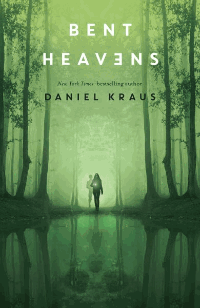
Bent Heavens
by Daniel Kraus
New York : Square Fish, Henry Holt and Co., 2021.
1st Square Fish ed. 
291 p. ; 22 cm.      

Pretty much everything I wrote about Kraus' earlier novel, Scowler, applies to this novel. I wanted to like Bent Heavens, but I found it profoundly unsatisfying on several levels. I feel bad being so negative because Kraus explains (in an author's note at the end of the book) that he wrote this as a protest against the torture regime implemented under the Bush-Cheney administration.  It feels odd to dislike this book so much since it got starred reviews in Booklist and School Library Journal. 

The premise of the book is interesting. High schooler Liv's father (a high school English teacher) had a complete mental breakdown years previous when he insisted he was abducted by aliens. Then after being released he actually disappears and has been gone for two years. He left behind gruesome contraptions for trapping said aliens. Liv and her loner friend, Doug, check the traps weekly until one day, they catch an alien! 

Instead of turning the creature in to the authorities, Doug suggests torturing it as a way of both punishing it for what the aliens did to Liv's father and possibly getting it to reveal what happened (it can't speak but can squeal and whimper). There's a lot of gruesome beatings, cutting, and hurting that goes on in a torture shed on Liv's property - and I just NEVER believed Liv would go along with it.  I also think that Doug is that stereotype oddball loner type that supposedly is predisposed to sadism. By two thirds of the way through the book, I had guessed at the "wow" plot twist that ends the novel and so was neither surprised nor moved (unlike reviewers).

Well, obviously I did not like this novel. Instead of the heavy handed torture, a more subtle use of torture like that endorsed by Bush-Cheney would have been more pointed - e.g. forced nudity, sleep deprivation, sensory deprivation, water-boarding, etc.  Also having the alien able to communicate in some basic ways would have been more effective, too. Instead the plot zig zags into the nonsensical and absurd which left me wondering if I even read the same book as the people who starred this mess.

Tuesday, December 14, 2021

Picture It!


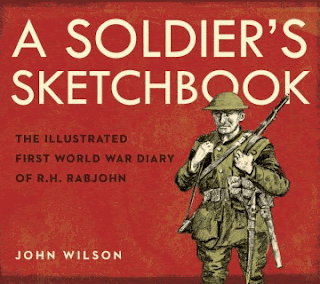
A soldier's sketchbook : the illustrated First World War diary of R.H. Rabjohn
by R.H. Rabjohn/John Wilson
Canada : Tundra Books, [2017]     
112 p. : ill. ; 22 x 24 cm.

I'm always interested in WWI, the war that turned the European violence inward instead of outward and ripped the façade off the elegant civilization of Europe at a cost of the deaths of millions of combatants and many civilians.

This WWI book is a special addition to the literature of that "Great War." It consists of the sketches from the war done by R.H. Rabjohn, a soldier from Canada, who saw combat from April 1917 until the end of the war on November 11, 1918. 


It was Rabjohn's official duties as a soldier-sketch artist that allowed him to carry a sketch book (something that was prohibited to other soldiers). He also kept a diary and the author, John Wilson, has done a fine job of organizing the sketches and diary entries into a logical and easy to follow whole.  Doing drafts and support work at the front meant that Rabjohn was frequently in great danger and witnessed first hand the horrors of trench warfare that marked WWI.  

Given its visual appeal, shortness, and direct narrative, this book would be a great way of introducing World War I to teens and hopefully would interest some in wanting to know more about this nation shattering event - the tragic consequences of which continue into the present.


Friday, December 10, 2021

Piece of My Heart


Janis Joplin: Rise Up Singing
by Ann Angel
New York : Amulet Books, 2010.
vii, 120 p. : ill. (some col.) ; 27 cm.

This is another outstanding biography for young people, which again confirms my suspicion that the best biographies are those written for young adults. I'm thinking e.e. cummings, Georgia O'Keeffe, Yoko Ono, etc. One of the strengths is that these biographies are lean and specific - and if (as in the case of this biography of Janis Joplin) they include great photos and graphics then it's hard to put them down.  

I really liked the breezy and yet serious tone of this biography.  Breezy, in that it tries to convey the liberating influence of the times (1960s) and the excitement of a talented woman coming into her own, but serious in following Joplin's struggles with bullying and boredom as a teen, insecurity as a rising star, and addiction as she became extremely famous (addiction that would kill her by overdose as a young woman).

I also enjoyed learning about Joplin's roots in Port Arthur, Texas, and her rise to fame based solely on her natural talent and hard work developing that talent. It's really hard to believe that she did not come from any musical or singing background.  I also appreciated reading about the widespread and fertile cultural landscape of the 60s as cafes, music venues, and coffeeshops proliferated. 

It's a sad story, too, of course as we follow Joplin's phenomenal rise to fame, the encouragement of excesss from fans and the industry, and her battle with alcoholism and heroin addiction - a wicked combination that would prove to be fatal to her when she was still very young.   

It's a super biography that I would recommend. Oh, and the title of this post, is the title of one of her well-known songs.
 

Tuesday, December 7, 2021

Art Lives!


Shadowshaper
by Daniel José Older 
New York, NY : Arthur A. Levine Books, an imprint of Scholastic Inc., c2015.    
297 p. ; 20 cm. 

I had been wanting to read this book for quite a while. I was going to read it during Hispanic Heritage Month, but a students checked out the copies we had (which is great!). So when they came back in I checked it out to myself and read it.

Shadowshaper is the debut novel writers dream of - it was a "Top Ten" on ALA and YALSA lists, a "Best Book of the Year" at NPR and Publishers Weekly, and received stellar reviews, etc. The praise was not undeserved. It's a wonderfully creative novel - undergirded by concerns of ethnic heritage, sexism, gentrification, cultural appropriation - that manages to be a supernatural thriller, urban fantasy, and coming of age story all at once.

At the heart of the story is Sierra a Puerto Rican teen artist/muralist living in Brooklyn. As the story unfolds she learns that her powers are not just artistic, but connected to an age old spiritual power that allows her to bring spirits into her works of art - literally bringing them to life.  This of course would be a ho-hum story without an evil force that seeks to destroy shadowshapers like Sierra so as to gather all that power into himself.  It is a life-and-death danger and Sierra must confront it head on with the help of a another shadowshaping artist - Robbie - and her friends and brother.  The battle between the forces of Sierra and her allies and their nemesis provides the action of the novel.

For some this action will be what draws and holds them in the story.  For me this was the weakest part of the novel. The climactic battle scenes feel like they owe too much action movie staging. I found the most moving parts of the novel were the beginnings of Sierra's understanding of her powers and the descriptions of the art works coming to life, and her meeting with her grandmother's spirit.  But that's me, and I recognize that the gruesome creatures and the bone-crunching fights will be what keeps many readers going right to the satisfying end.

Thursday, December 2, 2021

Cold (blooded) War - US Style


The Jakarta Method
by Vincent Bevins
New York: Public Affairs, c2020, 2021.
ix, 340 pages : illustrations ; 21 cm  

It's hard to say whether US citizens have very short memories or face such a powerful propaganda apparatus that it takes a bit of hard work and (soul-crushing honesty) to learn the dirty truths of US history and foreign policy. Considering this, books like The Jakarta Method are wonderful (and painful) antidotes to the flood of official misinformation and willful forgetting that plague the US. 

How many US citizens realize that their government actively helped and encouraged the slaughter of about 1 million unarmed, harmless, and law-abiding civilians in Indonesia in 1965 because of their actual or alleged connections to the completely legal and open communist party of Indonesia.  And how many people who know of this vaguely or in more detail, know that it set the pattern for US sponsored/supported ruthless attacks on civilians in Asia, Africa, Central and South America? Bevins does a remarkable job of pulling together this lethal history from the overthrow of Iran to the rise of the extremist president Bolsonaro in Brazil. The reader learns about the deep connections of the Indonesian slaughter with slaughter and atrocities in Brazil, Guatemala, Angola, Vietnam and other states. The numbers and cruelty are truly appalling.

Bevins also does a good job in scoping out to consider the profound effects that such widespread and cold-blooded killing has had in shaping the world we live in now.  He questions what it means to "win" the Cold War when the means were so depraved and terrible.  He wonders about what kind of world we might live in if the pro-democracy, constitutional parties that leaned left or opposed US hegemony had been allowed to survive. Would we see the same appalling wealth inequalities that plague the world, would the rule of law be stronger, and would there be better human rights protections today? 

His book is profound and timely as both in the US and abroad many leaders are encouraging authoritarian rule and promoting lies and violence as a way to preserve their power.

It is a book I highly recommend.

Friday, November 12, 2021

No American Dream


American Street
by Ibi Zoboi 
New York, NY : Balzer + Bray, an imprint of HarperCollins Publishers, [2017]
324 p. ; 22 cm. 

American Street is a super book. I'm glad to see it got a lot of recognition - starred reviews and a finalist for the National Book Award. The book is the story of Fabiola, high school aged young woman who was born in the US, raised in Haiti and has returned to the US with her mother so they can rejoin the mother's sister and her three girls in Detroit. Of course, nothing goes smoothly: the mother (not a US citizen) is detained at the NYC airport by ICE while Fabiola is sent on to Detroit and tries to fit in to her aunt's family - a family full of love - but also serious troubles (debts, drug dealing, a dead father, and a crumbling neighborhood). 

The novel follows Fabiola as she tries to navigate the huge, strange country that is the United States, the dicey/lively city of Detroit, and the complicated relationships of her three cousins, who both form a formidable front, though each young woman has a striking and different personality.  

There are many sources of dramatic tension in the novel. Fabiola desperately wants to get her Mom out of ICE detention, she also falls hard in love, and she has to prove herself to her streetwise cousins, etc. In her desperation to get help for her mother, she makes the mistake of becoming an informant to a narcotics detective and things get VERY complicated and VERY dangerous. 

I won't give away the twists and turns of the plot, but after the first chapter things get very interesting. Readers are also easily introduced to the worldview of vodou through the perspective of Fabiola who believes in it and sees the world through that lens - to the point where there is a blurred boundary between the real and the magical/spiritual in many scenes.  In a lesser writer these could be a real weakness, but in this novel they add to its richness.

As you can tell, I'll definitely be recommending this book to readers.

Tuesday, November 2, 2021

Stunning Science and a Couple of Stunning Mistakes


The Universe in Your Hand
by Christophe Galfard
New York : Flatiron Books, 2017, c2016.
First US edition
386 pages ; 22 cm

Christophe Galfard tries and mostly succeeds in leading the lay reader through the current state of knowledge about cosmology and astrophysics - taking the reader through Newtonian, Einsteinian and quantum physics along the way. It's an ambitious undertaking, and I think Galfard succeeds better than most at creatively introducing the reader to mind-bending worlds of quantum fields and some of the truly bizarre quandaries and realms of modern cosmology - dark matter, dark energy, and string theory.  

His was one of the first books I've read about quantum fields where I started to just appreciate and even accept the way in which our "common sense" understandings of the world (which works fine on most of the scales we evolved in) are just not capable of reckoning with the way particles are manifestations of the quantum fields. It's heady stuff, and I'll probably reread those sections later to try and take in more of what they offer. Given the positives about this book, I have to qualify it with the following observation.

There is such a glaring mistake early in the book that I'm a bit befuddled that editors and early readers didn't check it. Galfard describes the future demise of our sun as being one where it "explodes, firing all the matter it was made of into outer space" (6). A while later he describes this ending as "spreading into space all the atoms the Sun has forged throughout its life while creating some more - the heaviest ones of all, such as gold" (19).  This was so unlike any scenarios of the sun's demise I had ever read that I thought maybe I had misread previous books and explanations - or that the latest science was radically different. I searched books and online astronomy sites, and so far, I've found nothing to indicate that the sun will blow away all its mass or that a star of the sun's size can forge anything heavier than carbon in its last stages. From what I've read it will end up as a white dwarf that will then last for billions and billons of years as it slowly cools. 

So I'll suggest the book for its navigation through quantum realities and string theory, but hedge my praise based on the beginning of the book.