Monday, November 30, 2020

Remission


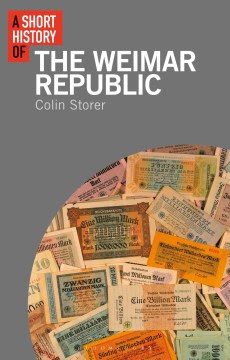
A Short History of the Weimar Republic by Colin Storer
London : Bloomsbury Academic, 2019, c2013.
vii, 239 p. : ill., map ; 23 cm.   

I really love history and when I was putting this new book on the shelf the other day, I realized that I really don't know much about the Weimar Republic, that dynamic and short-lived German republic sandwiched between the ruin of one world war brought about by its preceding imperial government and the ruin of the Nazi, fascist dictatorship that marked the death of the Weimar Republic.

It was a striking thirteen years that Weimar survived, and the author is as interested in pointing out its successes and achievements as he is in documenting its eventual failure and collapse.  This was where I learned quite a lot of new information. 

I had always assumed - as many have done - that it was the crushing reparations forced on Germany after WWI that doomed the Weimar Republic to economic chaos and eventual disaster.  It's not that this was not a crucial factor in its demise, but I hadn't realized the successes that the Weimar government (under Chancellor Stresemann) had in negotiating down the burdens of its reparations. However, the fragility fo Weimar's economy and its dependence on the chaotic international economic system made it especially susceptible to the onset of the great depression in 1929.  

Storer also wants to point out that politically, Weimar managed to survive as a democratic state longer than other Central European states. He also notes the many artistic, scientific and cultural achievements of Weimar.  

There is a lot to mull over (and grieve) when reading about Weimar. Like many books of history leading up to the rise of the Nazis, one knows how it ends, but the pain is seeing that it didn't have to go the way it did and could have turned out much differently and much better, of course.

I'll definitely keep this book in mind if a student has an interest in the period.  It's an accessible and short introduction to this critical time in twentieth century Europe.


Tuesday, November 17, 2020

A Wonder of Wonderland


A Blade So Black
by L.L. McKinney
New York : Imprint, 2018.     
370 p. ; 22 cm.

I wish I liked contemporary fantasy/action better because I think then I would have really loved this novel.  It has some of that familiar territory of dual worlds with only certain people (or characters) having the ability to travel between them.  Alice, the main character of A Blade So Black, is one of these people.  She can visit Wonderland where nightmares come from, and there she can battle them and help keep the human world safe.  

Alice is also a young Black woman, a high-schooler who's father has recently died and whose mother worries dreadfully about her well-being in this real world (Atlanta, GA to be specific) that is so dangerous for young Black women. 

Turns out Alice is also a very talented warrior against nightmares and so is part of an elite group of humans known as Dreamwalkers who do battle against the dangers of Wonderland that threaten to overtake the regular world the rest of us live in.

Oh, and the other fun catch to this novel is that it cleverly echoes the Alice in Wonderland story. As you can see there is A LOT going for this book.  Some reviews have noted some hiccups in the pacing (I would agree) and a bit of vagueness in the "world-building" of Wonderland (also agree), but the reviews also note the great character building and dynamic fight scenes that McKinney has created.  Yes, I would agree.  To students who like Neil Gaiman or Cassandra Clare or who just want something exciting and otherworldly I would definitely recommend this book. The fact that the hero is an African American teen young woman who has to deal with parent-rules, school, crushes, and teen life is an added benefit.

Finally, the book does wrap-up (SORT OF) at the end, but then closes with an epilogue teaser that means there will be more novels taking up the adventures of Alice the Dreamwalker.


Friday, October 16, 2020

Who's Messed Up?


The Field Guide to the North American Teenager
by Ben Philippe
New York, NY : Balzer + Bray, an imprint of an imprint of HarperCollins Publishers, 2018.
372 p. ; 22 cm.      

I wasn't sure how much I'd enjoy this book when I first started it.  It has that YA "thing" of a main character who is so witty and facile with banter and snark that he makes Holden Caulfield look like Greg Brady after a nap. But the book got some favorable reviews and even won a prize from YALSA - the prestigious Morris Award (2020) for debut YA novel. 

Funny thing about this book, though, is that it has a way of growing on you.  The whole set-up of a Haitian-Canadian teen moving to Austin, TX for his junior year of high school has a lot of potential.  As Canada (the nickname Austonians gift Norris with) adjusts to the hellish heat and big strangeness of Texas, USA he starts to pick up some friends, a job, and even a smart, artsy girlfriend.  The relationships really make this novel work.  And some striking twists and turns in friendship and romance help Norris to see that maybe his condescension says something about his own jerkishness, not just everyone else's.  I also like how issues of diversity, multiculturalism, and racism are woven naturally into the story and handles with a light, but substantive touch. 

I couldn't help but like this book, it's clever, funny, and a bit overdone at times, but ultimately it has a lot of heart.  I'd definitely recommend it to a student.


Wednesday, September 30, 2020


We Set the Dark on Fire
by Tehlor Kay Mejia 
New York, NY : Katherine Tegen Books, an imprint of Harpercollins Publishers, [2019]
363 p. ; 22 cm.      

To say that Mejia's debut YA novel has gotten good reviews would be an understatement. Booklist gave it a starred review, it snagged an excellent write up on NPR, and other less notable reviews also highly recommended it. 

I think the praise is well deserved for the premise and set-up of the book; the patriarchal world it creates has it's own origin religion story which underlies it's elite family set-up where husbands have two wives: a Primera who is hard-core business, brains, and no-nonsense, and a Segunda who must be gorgeous, entertaining, and ready to bear children.  The elite - a minority in this fictional world - rely on the exploitation of everyone else, an exploitation enforced by police, violence and legal privilege.  Sounds familiar, doesn't it? Which is exactly what makes it a powerful novel.  I also liked the main characters and the first part of the book's world building.  

My only issues with the book are with the plotting of the resistance and with the rushed descriptions of the rebellion.  I just never believed the main character's acts of joining the rebellion. And the major conflicts of violence seemed a bit rushed and confused to me.  

That being said, it's still an enjoyable read and one that should appeal to a lot of different readers.  It's also got an unexpected lesbian romance simmering away at the center which - though rushed to me - is sweet and unexpected.  

Finally the book is written by a Latinx woman and is touches on issues of xenophobia, border violence, resistance, dangers of patriarchy and economic exploitation - so it is very relevant to the times we are experiencing now in the US. Would I recommend it. You bet.


Thursday, September 17, 2020


Sawkill Girls
by Claire Legrand
New York, NY : Katherine Tegen Books, an imprint of HarperCollins Publishers, 2018.
1st ed.
447 p. ; 22 cm. 

A mother and her two teen daughters relocate to the wrong island to move past the grief of the father's recent death. It's the wrong island because it has a history of being a place where every ten years or so a girl goes missing - and one more has just disappeared before they arrive.  And the pace of these crimes is picking up fast.

This is not a novel about any ordinary human serial killer.  The villain is a supernatural monster whose feasting on its victims is pretty gruesome stuff!  I won't give a ton of spoilers, except to note that the newly arrived family is soon right at the center of the action,  along with two other teen females who live on the island.  Though most on the island have no clue about the monster, it does have allies and enemies among humans - both on the island and back on the mainland.  

A lot of the "fun" of this novel is learning bit by bit what's happening and who's involved - and with the way the plot picks up its pace so that by the end you are turning pages to see just what's going to happen.  Along the way there are deaths, betrayals, love, romance and danger (of course).

For me, I didn't care so much for the supernatural elements of the novel - the natural world is tied up in the paranormal events in which horses, moths, the sea and even the rocks all get involved.  But there is a strong gothic-horror atmospherism to this tale, along with interesting characters, and a strong underlying feminism that keeps it all moving. So if you are into thrilling horror with a strong infusion of action and paranormal energies and monsters then this novel will keep you satisfied right to its last page.      

Saturday, May 30, 2020

Heavy Lifting


Stamped from the Beginning: the Definitive History of Racist Ideas in America
by Ibram X. Kendi
New York : Nation Books, 2017.  
xi, 582 p. ; 24 cm. 
 
Ibram X. Kendi's Stamped from the Beginning is a long read [more than 500 pages], a painful read, a hard read, and yet a necessary and worthwhile read. As a Kirkus review noted, one can dispute that this is the "definitive" history of racist ideas, but the book is an indispensable tool for coming to terms with the anti-Black racism in the US - and is a powerful tool in offering ways to wrestle with it.  

Kendi, positioning himself as an anti-racist, posits that the project of racism in the US advances not only through the efforts of segregationists (who consider Black people as inherently inferior to whites), but also with the help of assimiliationists who consider black people/culture as being pathological (due to racism) and yet capable of eventually achieving the "standards" of  the best of white culture and civilization. For Kendi, anti-racism is the force that can dismantle the damages of segreationism and assimilationism.  It is a powerful idea.

Kendi traces the history of racism and anti-racism in the US through five historic persons - Cotton Mather, Thomas Jefferson, William Lloyd Garrison, W.E.B. Du Bois, and Angel Davis.  I found the section on Angela Davis to be the most satisfying in that I think it best illuminates the way that capitalism and racism are inextricably bound up.  Davis is also a great role model for the importance of intersectionality. 

This book took me almost a month to get through, so it might be a struggle for most YA readers.  But I'll definitely get the YA version written with Jason Reynolds for this library and look forward to reading through it.


Friday, May 1, 2020

What Brown's Gonna Do With You


The Good Lord Bird
by James McBride
New York : Riverhead Books, 2014.
458 p. ; 21 cm.

When a book wins the National Book Award (2013), that definitely puts in on one's radar - and so I brought home The Good Lord Bird with me during the spring and summer pandemic lock-down.  

This novel is a rollicking, funny, provocative and hard to put down read.  It follows the adventures of Henry, an enslaved 12 year old freed in Kansas by the passionate and violent abolitionist, John Brown.  Mistaking Henry to be Henrietta, a girl, Brown "adopts" him into his band and nicknames her "Little Onion." The novel is told by Henry who - with his maturing over about three years, his change from enslaved to free, and his passing as a girl - allows McBride to explore many angles of John Brown's movement and eventual assault on Harper's Ferry.  McBride is able to present shifting and complex takes on fanaticism, recklessness, posturing, violence, racism, slavery, sexism, opportunism, danger, and sacrifice by giving his smart-alecky, wry and cynical main character center stage.

The cover of the book has a quote from the New York Times referencing Mark Twain, and I definitely felt the sensibilities of Twain's character Huck Finn in McBride's Henry.  

The novel is not without provocation.  Henry - suffering the harsh, spartan life of being with a paramilitary band on the frontier - at times wishes he were back being enslaved.  Fredrick Douglass comes in for some harsh treatment as a "diva" of the antislavery circuit and as an intemperate sexual harasser.  But all in all, the novel is a brilliant run through a historical episode in US history that still reverberates to this day.  I would definitely recommend it to a reader who wants a good literary read that will grab them and not let go.