Dear Martin by Nic Stone
New York : Crown, 2017
210 p. ; 22 cm.
Nic Stone has written a really interesting book that picks up on many of the racial issues that are roiling US society today - such as white privilege, racist police violence, profiling, criminal justice, equity, and income inequality. And she manages to do it with a really likable, but complex teen named Justyce who is on scholarship at a prestigious boarding school where the students are predominately white.
Though being a stand-out student, Justyce - doing nothing wrong - finds himself being roughly arrested (and threatened) by police. This experience leads him down a path of questioning and introspection (chronicled in his journal/letters to MLK - the dear Martin of the title).
There is a lot of wrestling with how to fit in, how to advocate for yourself and pride in racial identity, and a nice (and racially complex) love story thrown in for good measure. The plot takes a dramatic turn and I don't want to spoil that for you, but it is the heart of the novel's conflict.
This book - like The Hate U Give - is a good book to recommend for students interested in thinking about issues around Black Lives Matter and would be a good discussion starter. Stone's strength is developing complex characters and she's not bad a spinning out a good plot, too.
I would recommend this novel.
Thursday, February 13, 2020
Tuesday, February 11, 2020
Fallout
Chernobyl's Wild Kingdom: Life in the Dead Zone by Rebecca L. Johnson
Minneapolis : Twenty-First Century Books, [2015]
64 p. : ill. (some col.), col. maps ; 27 cm.
As most people know, there was a devastating nuclear plant disaster in April 1986 at the Chernobyl nuclear power plant in what was then the Soviet Union (but is now in Ukraine). There have been some stories over the years about the city Pripyat, which was rapidly evacuated a few days after the disaster and remains abandoned. But this book looks at the South Carolina sized exclusion zone (which includes the former city of Pripyat), with a focus on the abundance of wildlife in this area where very few humans live.
Remarkably, in spite of some very high levels of radiation in the zone, wildlife is thriving, and what makes this book really engaging is that the author examines two contrary conclusions reached by scientists studying the zone. One scientist and his colleagues study small mammals like mice and voles and have concluded that the long term exposure to low (but dangerous) levels of radiation have made these animals healthier and more resistant. Another team of scientists who study barn swallows arrive at the opposite conclusion, noting very high levels of mutations and tumors in their avian subjects.
The book invites readers to consider both possibilities and provides lots of great information and illustrations about the initial disaster and its decades long after effects. It gets one thinking about unexpected effects of humanity (and the absence of humanity) on the environment. It had me thinking about the Rocky Flats Wildlife Refuge (where the US made nuclear weapons) and the Korean DMZ. And this book does all this in just sixty-four short pages. Not bad.
Minneapolis : Twenty-First Century Books, [2015]
64 p. : ill. (some col.), col. maps ; 27 cm.
As most people know, there was a devastating nuclear plant disaster in April 1986 at the Chernobyl nuclear power plant in what was then the Soviet Union (but is now in Ukraine). There have been some stories over the years about the city Pripyat, which was rapidly evacuated a few days after the disaster and remains abandoned. But this book looks at the South Carolina sized exclusion zone (which includes the former city of Pripyat), with a focus on the abundance of wildlife in this area where very few humans live.
Remarkably, in spite of some very high levels of radiation in the zone, wildlife is thriving, and what makes this book really engaging is that the author examines two contrary conclusions reached by scientists studying the zone. One scientist and his colleagues study small mammals like mice and voles and have concluded that the long term exposure to low (but dangerous) levels of radiation have made these animals healthier and more resistant. Another team of scientists who study barn swallows arrive at the opposite conclusion, noting very high levels of mutations and tumors in their avian subjects.
The book invites readers to consider both possibilities and provides lots of great information and illustrations about the initial disaster and its decades long after effects. It gets one thinking about unexpected effects of humanity (and the absence of humanity) on the environment. It had me thinking about the Rocky Flats Wildlife Refuge (where the US made nuclear weapons) and the Korean DMZ. And this book does all this in just sixty-four short pages. Not bad.
Wednesday, January 29, 2020
Pushing the Limit
Skyward by Brandon Sanderson
New York : Ember, 2019.
513 p. : ill., maps ; 24 cm.
A number of years ago a book club we had at the high school read Elantris by Brandon Sanderson. I recall that I really liked Sanderson's writing - even though I'm not a huge fan of high fantasy. So I was interested when student recommended Skyward to me. The student had it on his reading list for student readers working on the Lincoln Award for this year.
I enjoyed reading this science fiction adventure tale, but didn't love it. The strengths of Skyward are many, though. Sanderson is great at plotting, character development, and descriptive action. The story is also good for having a believable, strong central female character.
The basic plot of the story revolves around Spensa who goes by the name "Spin." She lives on a planet where humans crash-landed a few generations before and where they are under threat from the mysterious space-craft flying Krell. Humans on this planet depend on skilled fighter pilots to protect them from the alien Krell who frequently launch attacks from space using their sophisticated and deadly spaceships. The humans have capable space/jet fighters but seem to be losing a war of attrition. Spin - whose father was a superb pilot until a pivotal battle where was lost and accused of cowardice - wants to be a fighter pilot and redeem her family name. She enters the prestigious fighter training academy and the story unfolds from there.
There are some surprising plot developments, and the battle sequences are thrilling. The parts that didn't grab me are the banter between the pilots in training and their crusty trainer, and the revelation that Spin comes from a group of humans that seem to have supernatural powers on which the survival of Defiant may depend.
In spite of my not being wowed by the book, I would still recommend it to science fiction fans.
Tuesday, January 14, 2020
Still Our America
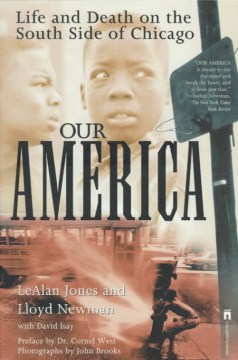
Our America: Life and Death on the South Side of Chicago by LeAlan Jones and Lloyd Newman, with David Isay
New York : Washington Square Press : Pocket Books, c1997.
203 p. : ill. ; 24 cm.
This book is one that is being used as a major text in classes at our high school - part of an "Injustice Project" unit. I wanted to read it since I wondered if it might be dated - having been produced from 1993 - 1996 and published in 1997.
In spite of the book being 20+ years old, it was a compelling read. I really loved that the adult organizing the book, David Isay, wanted it to be the genuine work of young people who lived in the Ida B. Wells housing projects in Chicago. The book came out of an award winning WBEZ radio program Ghetto Life 101 which featured recordings and interviews made by the two young authors who were 13 and 14 years old when the project began.
I will be curious how students respond to the book. A lot has changed since the mid 90s: the high rise projects of the book have been torn down, the crack/cocaine violence has been replaced by other inner city violence, the Internet was a baby, and cell phones did not exist. A lot is still relevant though - extreme poverty and unemployment falling heavily on Black people, gun crime, wealth inequality, etc. Also the book just pulls you into the world of the the two authors - they are smart, unpretentious, honest, and aware. Also the book features great photos by John Brooks, another young man living in the Chicago projects at the time.
I am going to keep my eyes out for something similar to this book, but one that is more contemporary - something like Bus 57. However, if asked for an interesting read about inner city life in the late 20th century, I'll definitely recommend Our America.
New York : Washington Square Press : Pocket Books, c1997.
203 p. : ill. ; 24 cm.
This book is one that is being used as a major text in classes at our high school - part of an "Injustice Project" unit. I wanted to read it since I wondered if it might be dated - having been produced from 1993 - 1996 and published in 1997.
In spite of the book being 20+ years old, it was a compelling read. I really loved that the adult organizing the book, David Isay, wanted it to be the genuine work of young people who lived in the Ida B. Wells housing projects in Chicago. The book came out of an award winning WBEZ radio program Ghetto Life 101 which featured recordings and interviews made by the two young authors who were 13 and 14 years old when the project began.
I will be curious how students respond to the book. A lot has changed since the mid 90s: the high rise projects of the book have been torn down, the crack/cocaine violence has been replaced by other inner city violence, the Internet was a baby, and cell phones did not exist. A lot is still relevant though - extreme poverty and unemployment falling heavily on Black people, gun crime, wealth inequality, etc. Also the book just pulls you into the world of the the two authors - they are smart, unpretentious, honest, and aware. Also the book features great photos by John Brooks, another young man living in the Chicago projects at the time.
I am going to keep my eyes out for something similar to this book, but one that is more contemporary - something like Bus 57. However, if asked for an interesting read about inner city life in the late 20th century, I'll definitely recommend Our America.
Thursday, January 9, 2020
Public Transportation
The 57 Bus by Dashka Slater
New York : Farrar Straus Giroux, 2017
305 p. ; 22 cm.
A friend read this book and told me I should read it. I'm glad she did. It's a timely and interesting non-fiction YA book.
The basic "story" of the book involves two teens from different worlds in Oakland, California whose lives intersect on a city bus when one - a genderqueer student who looks like a boy but wears skirts - is set on fire by another student - a lively, friendly African American young man from another school. The act was a rash "prank" intended more to harass and perhaps humiliate the targeted student, but it ended up seriously injuring the victim, and was treated as a felonious, adult hate crime.
The book delves into the different world of these two young people and manages to convey the terrible nature of the crime and its effects, while also richly fleshing out the perpetrator.
There is a lot to mull over in this book. The roles that race, gender identity, family, poverty, policing and criminal justice play in our society.
I really like that the book jumps right in with the crime, and then proceeds to introduce us to the main protagonists in this drama. It also helps us see the ways that criminal justice serves and does not serve both victims and perpetrators.
This would be a great book to use in a class room to open up discussions of racial justice, criminal justice, gender identity, privilege and income inequality.
In addition to being a relevant read, it's also compelling and well written. I would recommend it.
New York : Farrar Straus Giroux, 2017
305 p. ; 22 cm.
A friend read this book and told me I should read it. I'm glad she did. It's a timely and interesting non-fiction YA book.
The basic "story" of the book involves two teens from different worlds in Oakland, California whose lives intersect on a city bus when one - a genderqueer student who looks like a boy but wears skirts - is set on fire by another student - a lively, friendly African American young man from another school. The act was a rash "prank" intended more to harass and perhaps humiliate the targeted student, but it ended up seriously injuring the victim, and was treated as a felonious, adult hate crime.
The book delves into the different world of these two young people and manages to convey the terrible nature of the crime and its effects, while also richly fleshing out the perpetrator.
There is a lot to mull over in this book. The roles that race, gender identity, family, poverty, policing and criminal justice play in our society.
I really like that the book jumps right in with the crime, and then proceeds to introduce us to the main protagonists in this drama. It also helps us see the ways that criminal justice serves and does not serve both victims and perpetrators.
This would be a great book to use in a class room to open up discussions of racial justice, criminal justice, gender identity, privilege and income inequality.
In addition to being a relevant read, it's also compelling and well written. I would recommend it.
Sunday, December 22, 2019
The Mystery of the Sequel
Truly Devious by Maureen JohnsonNew York, NY : Katherine Tegen Books, an imprint of HarperCollinsPublishers, 2018.
420 p. : ill., map ; 21 cm..
This well written, well-plotted mystery got plenty of good reviews - and it is interesting and fun to read - but I just didn't love it. Okay, confession, I'm not a huge mystery fan to begin with so that has to figure into the mix. However, I think there is more to it than that. I just didn't feel like there was much "at stake" in this boarding school for elite thinkers mystery.
The story involves students who are at an elite, all-expenses paid boarding school founded by an extremely wealthy man in the 1930s who, not long after opening the school, lost his wife and daughter to kidnappers. Additionally, a student at the school was also killed around that time.
Some students come to the school to write novels, direct plays, create art, or just be brilliant and eccentric, but one student is there with her project being to solve the kidnapping/murder case which has never been solved. In the course of the novel, we get to know this modern sleuth, Stevie Bell, and witness new and terrible mysteries evolve in real time.
So what's wrong with that? Well, nothing really. I just found that I didn't care all that much, and never really had that reader's bond with a character which (for me) is one of the joys of reading - even escapist reading.
I think I would have been satisfied if instead of this character bond, I had at least had the satisfaction of a plot ingeniously and surprisingly tied up. But that is precisely what does not happen, and my cynical guess is because Johnson's publishers insisted that a trilogy (yes that dreaded rainmaker of YA lit) was necessary. So hold your breath, and wait for book 2 and book 3 of the "Truly Devious" mysteries to have all your questions answered. Or if you have other reads on your shelf demanding attention, just shrug and say, "Whatever happens eventually, is a mystery to me."
420 p. : ill., map ; 21 cm..
This well written, well-plotted mystery got plenty of good reviews - and it is interesting and fun to read - but I just didn't love it. Okay, confession, I'm not a huge mystery fan to begin with so that has to figure into the mix. However, I think there is more to it than that. I just didn't feel like there was much "at stake" in this boarding school for elite thinkers mystery.
The story involves students who are at an elite, all-expenses paid boarding school founded by an extremely wealthy man in the 1930s who, not long after opening the school, lost his wife and daughter to kidnappers. Additionally, a student at the school was also killed around that time.
Some students come to the school to write novels, direct plays, create art, or just be brilliant and eccentric, but one student is there with her project being to solve the kidnapping/murder case which has never been solved. In the course of the novel, we get to know this modern sleuth, Stevie Bell, and witness new and terrible mysteries evolve in real time.
So what's wrong with that? Well, nothing really. I just found that I didn't care all that much, and never really had that reader's bond with a character which (for me) is one of the joys of reading - even escapist reading.
I think I would have been satisfied if instead of this character bond, I had at least had the satisfaction of a plot ingeniously and surprisingly tied up. But that is precisely what does not happen, and my cynical guess is because Johnson's publishers insisted that a trilogy (yes that dreaded rainmaker of YA lit) was necessary. So hold your breath, and wait for book 2 and book 3 of the "Truly Devious" mysteries to have all your questions answered. Or if you have other reads on your shelf demanding attention, just shrug and say, "Whatever happens eventually, is a mystery to me."
Friday, November 22, 2019
Varnished Unvarnish
Same but Different: Teen Life on the Autism Express by Holly Robinson Peete, Ryan Elizabeth Peete, & RJ Peete.
New York : Scholastic Press, 2016.
183 p. ; 22 cm.
A teacher assistant stopped in recently to ask about a biography dealing with autism. We ended up finding this family biography written mainly by two high school twins - the boy "Charlie" has autism and the girl "Callie" does not.
The book is written in alternating chapters where each sibling talks about the experiences of life being a teen and about life dealing with autism.
The book can be really blunt and honest - the girl talking about frustrations and embarrassing situations, and the boy talking about being frustrated and misunderstood. What brings the book together is the familial love that binds these young people and the that undergirds their whole family.
I think this is a great, easy to read, and interesting introduction to autism. I would definitely recommend it.
New York : Scholastic Press, 2016.
183 p. ; 22 cm.
A teacher assistant stopped in recently to ask about a biography dealing with autism. We ended up finding this family biography written mainly by two high school twins - the boy "Charlie" has autism and the girl "Callie" does not.
The book is written in alternating chapters where each sibling talks about the experiences of life being a teen and about life dealing with autism.
The book can be really blunt and honest - the girl talking about frustrations and embarrassing situations, and the boy talking about being frustrated and misunderstood. What brings the book together is the familial love that binds these young people and the that undergirds their whole family.
I think this is a great, easy to read, and interesting introduction to autism. I would definitely recommend it.
Subscribe to:
Posts (Atom)