The Crossing by Cormac McCarthy
New York : Vintage Books, 1995, c1994.
425 p. ; 21 cm.
I liked the beginnings of this novel a lot. The main character Billy, a young man, gets involved in the trapping of a wolf and his attempt to return it to its range, a quest which leads him on a coming of age journey as he wrestles with the ferocious forces of nature and the sometimes kind and sometimes dangerous/savage forces of the human world.
This second novel of the "Border Trilogy" moves from being a powerful story of a young man and his quest to release a she wolf - into a repetitive and gloomier repeat of his All the Pretty Horses, the first book in the is "Border Trilogy." His next quest involves he and his younger brother seeking the horses stolen from his murdered family and the subsequent sufferings and tragedies they experience.
I enjoy the high style of McCarthy, but after a while I just started to grow weary with it.
If you love McCarthy, you will probably enjoy the novel, but I felt like it could have been far shorter and would have been more powerful if it had been.
Friday, August 28, 2015
Monday, August 24, 2015
More Than a Pretty Horse
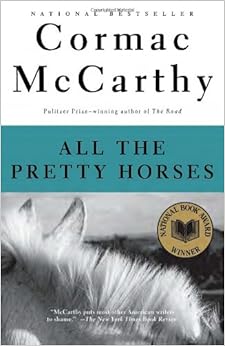
All The Pretty Horses by Cormac McCarthy
New York : Knopf, c1992.
301 p. ; 22 cm.
I first read this book about fifteen years ago. I read it then because it had won the National Book Award and for the first few pages, I was not impressed. It almost seemed like a parody of Hemingway with its short, sparse sentences - but then, wow! it grabbed me with its lush romantic beauty and gorgeous descriptions and never let go. Cormac McCarthy has become something of a major literary figure in American fiction, and so I wanted to revisit his novel ( I had planned to read all three of his "Border Trilogy" works, but only made it through the second one, The Crossing.)
All the Pretty Horses works as a love story, a coming of age novel, a quest novel, and and ode to the end of the horseback riders era in the Texas-Mexico borderlands.
The book is in many ways a tale of moralities. What are the bonds of loyalty, friendship, family, and, of course, love? It is a tale of integrity, of human-animal interdependence, of the beauty of the land and of the powers of goodness and evil.
I would definitely recommend this book to a student looking for a literary, but very readable and compelling novel.
Civil Rights Sailors and the Big Explosion
The Port Chicago 50: Disaster, Mutiny, and the Fight for Civil Rights by Steve Sheinkin
New York : Roaring Brook Press, 2014.
1st ed.
200 p. : ill. ; 24 cm.
From the dynamic cover, to the epilogue - I loved this book. It is an amazing story of unsung Civil Rights heroes who took against racism in the US Navy during WWII and helped force greater opportunities for African Americans in the military - and at great cost to themselves.
This book has all the elements of a great tale - a massive tragic explosion, tales of personal courage, rumors of a conspiracy, the suspense of a trial/court martial, and a positive but not rosy ending. And in telling the tale, Steve Sheinkin brings to life the stories of very young men who simply wanted to be given a fair opportunity to be part of the US war effort in WWII.
I really like this book for bringing together so many important threads - worker safety, segregation and racism during WWII (including extreme violence against enlisted African Americans in the south), the stirrings of the great Civil Rights movements of the 50s and 60s, the early career of Thurgood Marshall, and the ways in which change occurs in fits and starts through resistance and personal courage. And it's all done in the relatively brief space of just over 160 pages (along with great photos and illustrations).
I would recommend this book to any student interested in WWII, disasters, the Civil Rights Movement, the military, and US history in general.
Wednesday, August 19, 2015
Terrific Fair, Fairly Terrible
The Devil in the White City by Erik Larson
New York : Vintage Books, 2004, c2003.
1st Vintage Books ed.
xi, 447 p. : ill., maps, music ; 21 cm.
This is a fantastic and haunting book about the 1893 World's Fair in Chicago. Larson's book manages to convey just how incredible the feat of Chicago's hosting the world's fair was (having just over 2 years to organize and build the entire fair venue) - while also telling the story of serial killer Henry H. Holmes and his immense frauds and scams that helped him elude capture for so long.
The book is a wonderful glimpse into the turn of the century world of the US and Chicago, which had been destroyed by fire only a little over twenty years before.
The reader gets to learn so much about the founding architects of Chicago, the landscaping prowess of John Olmsted - creator of NYC's Central Park - the amazing invention of the Ferris Wheel and the massive turnout of visitors to the fair (including a one day attendance total of over 750,000 people!). Following the story of killer, H.H. Holmes, also gives the reader a feel for the fast and loose business dealings of the day, the ease with which people could assume false identities, and the plodding nature of police investigations at the turn of the century.
I will definitely recommend this book to anyone who is interested in Chicago history, true crime stories, and just an amazing read.
Wednesday, May 27, 2015
Hallucinating Iowa & Genetically Modified Obessions
Grasshopper Jungle by Andrew Smith
New York, N.Y. : Dutton Books, 2014.
388 p. ; 22 cm.
Grasshopper Jungle is a wild ride. It has been critically acclaimed - from the New York Times to making the 2015 Printz honor list. I found it a compelling read - exciting, clever, funny, sometimes gruesome, and sometimes brilliant. However, I ultimately found myself disappointed with the near-manic, writerly wittiness of the main character combined with his obsessive fixation on his (and others' testicles).
Before going further, I should just recap that the novel centers around Austin, a young man in a dinky Iowa town who accidentally unleashes a genetically manipulated plague that turns people into grizzly bear-sized, unstoppable, deadly, exponentially-reproductive mantids. Caught at the center of this apocalyptic nightmare are Austin, his beloved girl friend, Shann, and his best friend Robby - a smart and striking gay young man for whom Austin has more than just feelings of friendship. Austin is in a constant state of being turned on and attracted to practically all females - and confused about his love and attraction to Robby.
There is a great deal of wit, humor, history, politics and pop culture to round out this novel. But I couldn't help getting weary of Austin's fixation on his testicles and the testicles of practically every male that's mentioned in the novel. The novel has a middle school fixation on things bodily and sexual and I found it tiresome.
I would have loved the novel more if the locker room humor had been cut by about half. It still would be a funny, and bawdy story, but it just wouldn't seem like it was trying SO hard to be edgy. I also just find humor about testicles to be kind of boring - something I have felt watching the Daily Show and The Colbert Report. As I read it, I kept trying to imagine a woman writing anything remotely similar...maybe.
Would I recommend the book? Yes, to a mature student looking for a rollicking send-up of the end-of-the-world genre. It is a fun read. Also the ending was really great...no compromise there and pleasantly surprising.
Tuesday, May 12, 2015
Feeling Down About Being Wound Up
The Windup Girl by Paolo Bacigalupi
San Francisco : Night Shade Books, c2010.
361 p. ; 23 cm.
"Feeling down" in the title of this post is not meant to be a negative critique of this book, just a description of how its grim view of the future had me feeling (and thinking) about the grim present we are living in.
Bacigalupi sets his novel in a future Thai kingdom that has survived the collapse of the global carbon economy, survived the ravages of plant and human epidemics sparked by genetically modified organisms, survived catastrophic climate change, and survived the predatory depredations of global corporate raiders. Quite a future, isn't it? But will it survive the infighting of factions within its ruling parties, and the attempts of global genetic corporation raiders from the outside? You'll have to read it to find out!
Notice that I haven't even mentioned the novel's eponymous windup girl, Emiko. She is probably the saddest and most troubling character in the novel. A creation of Japanese geneticists, she is one of the "new people" who is meant to be an obedient servant, secretary, assistant and sexual plaything of the male Japanese elite. Her genetic makeup (along with strict training) compels her to be obedient, and makes her physically stunning. Unfortunately her "owner" has abandoned her in Thailand where "new people" are hated, in constant danger, and not accepted as having any of the rights of other human beings. She survives as the grotesquely exploited show-piece of a tawdry strip-club/brothel, but eventually finds herself at the center of explosive events in the kingdom when a foreign corporate agent takes a liking to her.
Bacigalupi has a wild imagination and has done copious research for this novel. Unlike Ship Breaker, which was clearly a young adult novel, The Windup Girl is an adult novel, but will appeal to sophisticated readers who want to move past The Hunger Games or Divergent for something more complex and weighty.
Friday, May 8, 2015
Schooled in Prison
A Question of Freedom by R. Dwayne Betts
New York : Avery, 2010, c2009.
1st trade pbk. ed.
240 p. ; 21 cm.
There have been some really good books out lately about mass incarceration - such as The New Jim Crow and the comic book format, Race to Incarcerate. A Question of Freedom is a great addition to the literature - and especially for high school age readers - in that it personalizes the story in a compelling and finely written memoir by a young man who was sentenced as an adult to 9 years in prison at the age of 16.
Yes, he committed a serious crime - using a gun to carjack a man in a mall parking lot. And yet under the relatively new draconian laws now on the books in many states, he was sentenced a a sixteen year old to serve years in adult penitentiaries in the state of Virginia.
In prison Betts underwent a transformation from a basically good student who was morally adrift - to a thoughtful and powerful writer. His writing conveys - without melodrama - the really twisted world of the US prison system where who you are as a human being is lost in a bizarre world of regulations, danger, and violence. I was especially struck by how much time Betts spent in "the hole" - solitary confinement for minor rule infractions, and how he ended up in Virginia's infamous Red Onion "super max" prison, supposedly for the "worst of the worst" - even though he never did anything more violent than push a rookie guard's hands off of his genitals when that new guard was over zealous in doing a pat down search.
Again and again, Betts also reflects on the sad racial facts of the US prison system where the majority of prisoners are Black and Latino, and on the draconian "get tough" sentencing that locks people away for decades. He himself could have been sentenced to life in prison!
I really like how Betts does not try to shock us with violent or terrifying episodes from prison, but instead conveys the soul killing world of prison - and the redemptive nature of the decent human beings who were kind or protective of him.
I would highly recommend this book for reading in classes. It is ultimately a hopeful book. The author has gone on to be a successful poet in addition to this fine non-fiction memoir. I will be recommending it to any students looking for something about prisons, biographies, young writers, and mass incarceration.
Subscribe to:
Posts (Atom)