Sunday, January 26, 2014

Pulses, Waves, Plagues and War

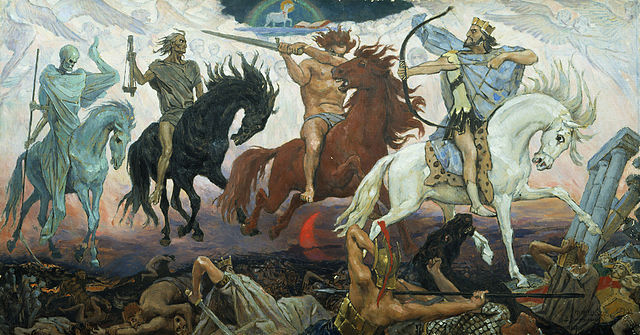
Four Horsemen of Apocalypse, by Viktor Vasnetsov, 1887.
The 5th Wave by Rick Yancey
New York, NY : G.P. Putnam's Sons, 2013.
457 p. ; 23 cm. 

I loved Yancey's Monstrumologist and his wonderful follow-up, The Curse of the Wendigo - but his latest book, The 5th Wave wasn't as satisfying to me.  The writing is really good, the plotting is interesting and engaging, and there is a lot of great action and thrills, but ,ultimately, for me there is just too much that strains credibility.  What I liked about his previous two books was their specificity - a few characters involved in very circumscribed actions.  The 5th Wave on the other hand involves the global (and I mean global) eradication of humanity by a super-advanced invasion force of aliens - but it just happens that a few characters who knew each other before the invasion not only survive the extermination, but successfully resist and sabotage it.  I also just found the most important plot twist involving one of the main characters to be completely unbelievable.  Either he would have never changed his behavior - or the aliens would have never been so stupid as to use such characters in their operations to rid the earth of humans.

But, these incredulities aside, there is a lot to enjoy in this novel.  The waves of destruction (thus the title) by the aliens are frightening and exciting to the imagination: a massive EMP (electromagnetic pulse), induced tectonic upheaval creating worldwide megatsunamis, a very lethal viral pandemic, and sleeper human/alien killers, and... well, you get the picture.

Yancey also creates a strong and interesting female hero - something that is refreshingly more common these days (think Hunger Games, Slated and Divergent).  In spite of not enjoying the book as much as I thought I might, I'd still give it high marks, and not hesitate recommending it to students looking for something exciting and interesting to read.

Friday, January 24, 2014

Goodbye Cruel World

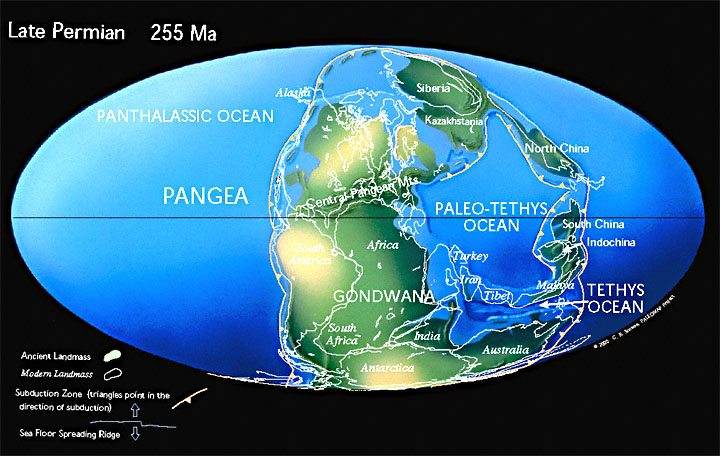
from Scotese.com - an awesome source of paleomaps from earth history
The Great Extinctions by Norman MacLeod
Buffalo, N.Y. : Firefly Books, 2013
208 p. : ill. (chiefly col.), col. maps ; 26 cm.

Confession: I love books about deep time, especially about the earth.  This is a book that satisfied my hankering for science books about the very, very distant past.  And regarding the deep past, what could be more interesting than those rare great extinctions in which enough conditions - sea levels, climate, extraterrestrial impact, volcanism - occurred together that a dramatic percentage of all life on earth was wiped out?  The topic is even more compelling when one thinks about the possibility that we are living at the start of the 6th great extinction event.  However, I'd have to give this book a mixed - though mostly positive - review.

The strengths of this book are it's organization - each great extinction event is presented chronologically and maps, charts, and knowns and unknowns about the event are presented in much the same order.  I also really appreciated the number of illustations and maps in the book.  The author is able to cover a lot of territory in the book and make a lot of it accessible.  A lot, but not all of it - and that is my main critique of this book for a high school collection.  There are times where the data and explanations are very complex and difficult to follow and will turn off and frustrate the general reader.  Therefore I would recommend this book to students researching the science of the great extinctions or students who are avid science readers; the general reader is probably going to get bogged down long before finishing this book.


Tuesday, January 21, 2014

Nice, Little (Book) - Big, Terrible (Wars)

From Wikipedia
The Napoleonic Wars: A Very Short Introduction by Mike Rapport
Oxford, U.K. : Oxford University Press, 2013
xiv, 149 p. : ill. ; 18 cm.

I'm not sure what recently prompted me to want to read European history.  Perhaps it's the 100th anniversary of the start of WWI - which will be commemorated this August - perhaps it's seeing books on the shelf about Napoleon, or perhaps it's just my wanting to get away from fiction for a while.  Whatever the reason, I recently picked up a book I've been wanting to read for some time: Barbara Tuchman's The Proud Tower (about Europe in the decades just before WWI).  Starting it made me realize that I wanted to know more about the period before Tuchman's book, so I picked up Mike Rapport's 1848: Year of Revolution.  Guess what? Yes, I needed some background for 1848 and so I settled on this fine, little introduction to the Napoleonic Wars.

I love these "Very Short Introduction" books from Oxford.  They cover a wide variety of subjects and are written for lay readers by experts in the field being covered, and are short and concise.  As you can see, this one has just 149 pages, and the book is small enough that Napoleon could have it tucked under his buttons in the David portrait above - and we'd never know it!

Joking aside, the book was really eye-opening to the scale of carnage and destruction that the French Revolutionary and subsequent Napoleonic Wars brought to Europe (and the world).  I had always thought that WW I was the first real mass-carnage, total war to take place in Europe - but Rapport makes the case that the percentages and scale of casualties (along with the global nature of the wars) puts the Napoleonic Wars in the same league as WWI.

I also appreciated his attempt to show the conflicting views on the legacies (good and bad) of Napoleon's expansionism - especially in light of the extreme reactionary responses to his aggression.

Now I'm ready to tackle 1848 and then, hopefully, to take on The Proud Tower.

Friday, January 10, 2014

Alt Control Delete

Slated by Teri Terry
New York, N.Y. : Speak, 2013.
346 p. ; 21 cm.

I found Slated to be a good, but not great read.  I love the plot set-up:  in a near-future authoritarian state young criminals are not executed for serious crimes, but are "slated" - they have there memories wiped and are implanted with a surveillance/control wrist monitor (Levo) that physically requires them to moderate their mood - and will short-circuit their central nervous system if they become extremely angry/violent or extremely depressed.  Upon being released from hospital training/confinement after being slated, the offender is place with an adoptive family. 

But things in Slateland are not what they seem.  Feared secret police / paramilitary agents called the Lorders keep a watchful eye on citizens and it seems likely that not all slated individuals were guilty of any crimes at all.

The story deals with main character Kyla who has a few abnormalities for a slated parolee - she has dream/memories and her Levo doesn't keep her from becoming angry or violent.  In the course of the novel she begins to question her identity and status, all the while falling in love with another slated individual, Ben.

There are some exciting plot developments, and thrilling episodes where Kyla and others are in serious danger, but ultimately the publishing demands for a trilogy, force the plot to turn on too many improbables and the novel ends without any serious resolution.

I think this could have been a great young adult novel - with hints of V for Vendetta and the Handmaid's Tale (the Lorders reminded me a lot of Atwood's "Eyes") - if it had been limited to one volume with tight editing.  But that, of course, would have limited the money-making potential for the publisher, and so instead of a satisfying novel, we are left with a third of a novel - a good third, but still a third.

Thursday, December 12, 2013

Bellows and Shrieks

The End Games by T. Michael Martin
New York, NY : Balzer + Bray, [2013]
369 p. ; 22 cm.

If you have any doubts that The End Games has been well-received, check out the praise on T. Michael Martin's website - wow!  I wish I could say I loved this book. I guess I'm just not enough of a zombie fan to completely enjoy the book - though I did appreciate the quality of the writing.  That is a positive trend that I've noticed with many YA books - really top-notch writing across many subjects and genres.

I would agree with critics that the book is very imaginative.  I like how it draws on video-gaming language and knowledge in a way that is thoroughly integrated into the plot.  I also liked the unusual pairing of an older brother with a very young brother who has autism.  The plot device of two characters bound up in a survival/journey ordeal is well traveled (think Huck and Jim in Twain's masterpiece, the father and son of McCarthy's The Road, or the Alex and Darla in Mullin's Ashfall) and is well done here.   But for me, I found several key actions of the plot confusing and overwrought, certain characters almost cartoonish, and just too many actions where I had to suspend disbelief and just accept the improbability. I really found the deranged Capt. Jopek a bit much - his abilities with weapons makes him seem more superhuman than real.  I also just never felt the emotional pull I was supposed to feel with the main character's memories of his troubled homelife that existed before the zombie apocalypse.

But problems aside, the book is fast, exciting, dramatic, action packed, and written with striking and fresh language. It has some gory scenes, but rarely seems written for shock effect. The language is also amazingly free of obscenities, and there is a nice romance woven into the plot with a soft touch.  Not bad for a first novel.  So, if I have a student asking about a good zombie novel - I'll definitely send them looking for The End Games.

Oh, and "Bellow and Shrieks"? Bellows is the name that the main character, Michael, gives to the zombies.  Shrieks?  Well, you'll have to read the novel to figure out that reference.


Wednesday, December 4, 2013

Heartwarming, Sort Of

Back cover illus. by Bosma
Winger by Andrew Smith
New York : Simon & Schuster BFYR, 2013
438 p. : ill. ; 22 cm.

Winger is a readable, entertaining book.  Smith is great with dialogue and humor and the plotting moves along well.  It's a coming of age novel told in the voice of Ryan Dean West, aka "Winger" who is starting his junior year at a boarding school for wealthy kids in the Pacific NW.  He's smart, scrappy, a hard-playing, talented rugby player with heart, apparently cute, but...he's only 14 - two years younger than his peers (and especially Annie, his friend who he desperately loves and hopes will feel the same).  Winger is also immature, crude, completely obsessed with sex and rating the attractiveness of girls and women, and prone to fighting.  The Booklist reviewer nailed it: "In short, Ryan Dean is a slightly pervy but likable teen."

I would have said "somewhat likable" - I found at least one his pranks creepy and repulsive, his constant ranking of females tiresome, and his jealous possessiveness both hypocritical and annoying.  These would not have bothered me so much - except that Smith has written essentially a male fantasy tale.  Winger, in spite of his immaturity, and insistence on what a loser he is, ends up with the two most attractive and interesting girls in the school in love with him. As the School Library Journal reviewer noted about one of the girls: "One wonders what she sees in Ryan Dean."

The novel ends with a shocking act of violence that doesn't seem believable (at least not in the context of the novel) and raises a lot of questionable issues about the supposed motives and behaviors of closeted gay guys. 

In spite of my criticisms, the novel is funny, fun to read, and likely to appeal to both boys and girls.

Monday, December 2, 2013

Kurlansky's Tasty History

The Big Oyster: history on the half-shell by Mark Kurlansky
New York : Random House Trade Paperbacks, 2007, c2006.
xx, 307 p. : ill., maps ; 21 cm. 

What a fun way to learn about the history of New York City!  Kurlansky again finds a way to entertain and inform while presenting his discoveries about another item that humans put in their mouths.  He has tackled salt, and cod (which I reviewed here about a year ago).

Like his other books, this one is well-written, fascinating, and very informative.  In it you'll learn that for many years in the 1800s, New York City was the oyster capital of the world - but that in a short time ballooning population and industrialization led to the demise of the rich oyster beds of the New York harbor - due to pollution and and over-harvesting. Kurlansky does a great

There is a lot to The Big Oyster - it is a practical history of the early years of New York City, with a lot about the earliest European settlement of the area to the bustle of the 19th and 20th centuries.  But it is also a social history and a foodways history - including recipes from various eras.  Finally, it is both an environmental history and cautionary tale about the squandering of precious natural resources.

I would definitely recommend this book to anyone curious about the history and culture of America's most dynamic city, New York.