Tuesday, September 17, 2013

Maybe a Masterpiece

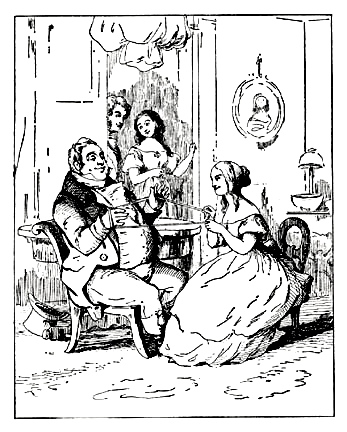
Image scanned by Gerald Ajam

Vanity Fair by William Makepeace Thackeray
London ; New York : Penguin Books, 2001.
xl, 866 p. : ill. ; 20 cm.

This should really go under my "summer break" reads, but I only finished it this weekend - so here it is as an fall semester post. As you can see from the page count (866!) it is a bit of a long book.  I had been wanting to read Vanity Fair for some time, and since summer is a good time to take on a thick book, Vanity Fair was on my list.

I found it fairly enjoyable and an interesting read.  It is hard not to be entertained by the pretenses, schemes, dishonesty and greed that infects the cast of characters from various classes of mid-19th century English society that are the subjects of Thackeray's novel.  He has a rather cynical and sarcastic tone throughout much of his work - in some ways closer to a satirist, than a straight novelist. 

The book wouldn't be the success it is without two characters in particular - the shrewd and scheming Rebecca Sharp - and the long-suffering lover, William Dobbin.  Rebecca, or Becky as she is more commonly called, has nasty character flaws - duplicity, appalling mothering, and scorn and ridicule for those she pretends to care about - but the reader can't help but appreciate her intelligence, cunning, and resourcefulness (and realize that she is no worse than the majority of characters that people Vanity Fair). 

Dobbin, as the introduction points out, is surely modeled after the author himself - who, like the character, endured unrequited love for years of his life, enamored of an already married woman.  Dobbin really is the only truly redeeming character in the book and serves as a foil to the many scoundrels populating the novel.

In the introduction to the book, John Carey argues that Vanity Fair is as great a masterpiece as Tolstoy's War and Peace.  I'm doubtful.  It's been more than ten years since I read War and Peace, but only two years since I read Anna Karenina, and I really don't think Thackeray's work is on par with Tolstoy.  I agree that it comes close at times, but Thackeray's general misanthropy and caustic view of humanity ends up depriving Vanity Fair of the pathos needed to overwhelm the reader, the way Tolstoy does.  Nevertheless, Vanity Fair is a remarkable work of fiction, and I would recommend it to any student asking for a recommendation from the classics of English fiction.

Friday, September 13, 2013

To Boneville - Finally!

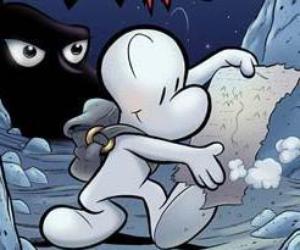
Graphic is from Out of Boneville and comes from the Comic Book Legal Defense fund's article about a school library challenge being defeated.
Bone: out from Boneville by Jeff Smith
New York : Graphix, 2005.
1st Scholastic Ed.
138 p. : col. ill. ; 24 cm. 

I've been meaning to read Bone for a long time.  Too long!  When I first started in school librarianship over 10 years ago, and was looking for graphic novel recommendations, Jeff Smith's Bone consistently appeared in many graphic novel "Best" lists.  Bone has had great publishing and critical success.

I enjoyed Bone a lot, though I'm a little surprised (and pleased!) at how popular it is in the high school library.  I think I am surprised because it is so good-natured, likable, and lacking violence, sexual situations, and obscenities and even makes references to Moby Dick! It is a comic book series that continues to circulate frequently at my library.  Perhaps this is due to the fact that there is a lot of humor, likable characters, action, adventure and ambitious (dare one say epic?) plotting to the Bone tale.
I don't think I'll be reading all of the Bone books (we currently have numbers 1-8), but I can recommend the book and say that it does not disappoint. Fans of Bone might want to visit the author's lively web page.

Monday, July 22, 2013

A Terrible January

A torchlight parade of SA formations passes in review before President Paul von Hindenberg, who sits in the window of the chancellery, on the night when Hitler was made Chancellor of Germany - USHMM
Hitler's Thirty Days to Power: January 1933 by Henry Ashby Turner, Jr.
Reading, Mass. : Addison-Wesley, 1996.
xii, 255 p., [32] p. of plates : ill. ; 23 cm.

This was a very readable and informative book.  It is also a very disturbing and painful book to read, since I had not realized that the fortunes of the Nazis were very much in decline at the start of New Year, 1933. It really is a remarkable look at how Hitler insisted on an all or nothing offer of power, in spite of many pressures from within and without of the Nazi party for him to accept a coalition role in governing Germany.

There is much to ruminate over in this short, powerful look at the fateful month of January 1933: the willingness of the bourgeoisie to accept the violent and racist rule of the Nazis, the role of the rule of law in allowing the rise of dictatorial powers, the mistakes of elites in assuming they can control the representatives of vulgar right-wing populism.  There is also just the awful realization of what handing the reins of power to Hitler will mean for the Germans, the Jews, and the world.

I would definitely recommend this book to any student interested in the rise of the Nazis.

Monday, July 8, 2013

Southern Gothic

The Violent Bear it Away by Flannery O'Connor
New York : Noonday Press : Farrar, Straus and Giroux, c1988.
243 p. ; 21 cm.

I saw the movie Wise Blood a long time ago in college, back when I was living in the South, and Flannery O'Connor fascinated me with her brooding and disturbing portrayals of people lost in moral quagmires of obsessions and religion.

Well, The Violent Bear it Away, does not stray far from religious obsessions - and their troubling effects on the subjects of the novel.  The novel develops the intense conflict between Tarwater, an orphan raised to be a great prophet by his religiously crazed uncle and his nephew, Rayber - the strict rationalist - who is out to "cure" Tarwater of the effects of his upbringing.

The forces and personalities at the heart of the conflict hint at irreconcilable tragedy and the ending will leave the reader either satisfied at the resolution, or - as in my case - feeling that it was a bit contrived and rushed.

I can't say I'd recommend the novel to students, but a student looking for a southern writer to read and research might find O'Connor fascinating.  Her writing is also interesting and tinged with dark humor.

Monday, July 1, 2013

Not Your Great Grandfather's War

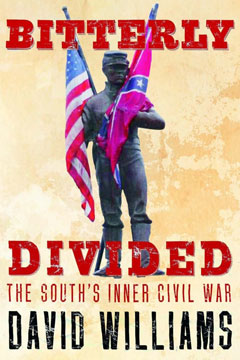
Bitterly Divided by David Williams
New York : New Press, 2010, c2008.
Pbk. ed.
310 p. : ill. ; 21 cm.

This is one of those great history books that causes you to rethink the things you thought you knew about a major event.  In this case, the author is reexamining the Civil War - particularly the prevailing view of the Confederacy as society committed in wartime to the success of an overwhelmingly popular cause - the the desire to preserve secession and the white southern way of life.

Williams instead details how the secession movement was an anti-democratic takeover of southern legislatures by powerful elites - especially the large slaveholders.  He presents a wealth of documentation showing that secession never had a popular mandate - until armed conflict actually broke out.  Williams also points out that the Confederacy had to rely on severe conscription laws to fill the ranks of the army and how the exemption of large slaveholders created mass discontent. Finally Williams documents how the large landholders of the Confederacy contributed to the defeat of the South by dedicating much of their land to luxury items on which they could make exorbitant profits (due to the blockade) instead of foodstuffs that would have helped feed the soldiers and their families who struggled to feed themselves due to shortages and the lack of manpower.

The book is a powerful indictment of war profiteering and the exploitation of the lower classes by the rich southern aristocracy during the Civil War - themes that still have resonance in the current US landscape of war and wealth inequities.

Tuesday, June 25, 2013

Bloody Times

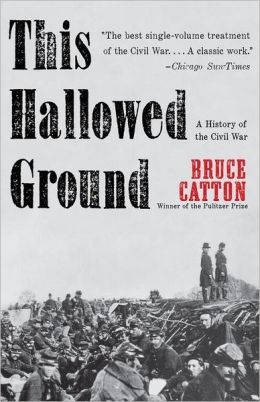
This Hallowed Ground by Bruce Catton
New York : Vintage Books, 2012, c1956.
1st Vintage Civil War library ed.
ix, 437 p. : maps ; 21 cm.

In the 1950s and 60s Bruce Catton was recognized as the essential and most popular historian of the Civil War.  He has written many volumes on those terrible years of 1861 to 1865 - such as A Stillness at Appomattox which our library also owns.  Though not read as much of late, I was pleased to see this one-volume history of the Civil War reissued in 2012.

I can understand why Catton was so popular.  This history is very readable and engaging and offers a great overview of the important events and battles of the Civil War.  It lacks some of the more interesting social and personal perspectives that a more recent history of the war might have, but it is nonetheless a compelling read.  Catton is able to present the long and complex campaigns of the Civil War in a way that is fairly easy to follow.

I would definitely recommend this book to a student looking for a good introductory narrative of the Civil War.

Wednesday, June 19, 2013

Out There with Kafka

Kafka on the Shore by Haruki Murakami
New York : Vintage International, 2006, c2005.
1st Vintage International ed.
467 p. ; 21 cm.

This one has a bit of everything: a sophisticated but sensitive 15 year old main character, Colonel Sanders, a downpour of leeches, some sex, an old man who talks to cats, time travel, a road trip with a 29 year old trucker and even a library (yes, a library!) as one of the main settings.

I first read a Murakami novel about 10 years ago - The Wind Up Bird Chronicle and it was a tour de force, so I was looking forward to this one which is on the AP Lit recommended list.

I was not disappointed in this novel. It is extremely creative and interesting with wonderfully memorable characters - from Ms. Saeki, the librarian stuck in her lost love from decades ago, to the endearing Mr. Nakata who is illiterate but wise and able to converse with cats. The novel can definitely be described as magical realism, but it is much more than than that. It is a fable, a murder mystery, a coming of age story, a meditation on love, time, loyalty, goodness and evil.

This is not an "easy" novel, but it should really appeal to students who love to read literature and are looking for something truly unusual, creative and yet with a lot of substance - a book that will stay with you long after you've put it down.