Tuesday, April 2, 2013

History Uncovered

Kill Anything that Moves by Nick Turse
New York : Metropolitan Books, 2013.
370 p. : ill., map ; 25 cm.

In 2001 Nick Turse was a graduate student doing research at the National Archives on PTSD among Vietnam Veterans when an archivist working there asked him if a veteran could suffer PTSD from witnessing war crimes.  The archivist then presented Turse with the first of many boxes of long (and intentionally) neglected documents of the Pentagon's Vietnam era War Crimes Working Group.  So began Turse's 10 year odyssey of research and interviews that would result in this seminal study of US military policy and practice in Vietnam.  Turse's contention - backed up with copious notes, Pentagon records, and sworn testimonies by veterans and Vietnamese survivors - is that official US policy from the office of the President on down was to wage war in Vietnam in a way that knowingly targeted millions Vietnamese non-combatants. He argues that My Lai was not an aberration, but typical of the US method of waging war in Vietnam.

This book is sure to become a standard reference to the Vietnam War.  It is also likely to be controversial - arguing as it does (and as did Nuremberg prosecutor Telford Taylor) that the highest officers and officials in charge of the Vietnam War warranted proceedings for war crimes.

Kill Anything That Moves is one of those that great histories that calls into question the commonly accepted narrative of US history; in that way it reminds me of Douglas Blackmon's Slavery by Another Name, an expose of the murderous convict labor system in the South, or James Brady's Imperial Cruise, a stunning exploration of the white supremacist ideology in US foreign policy leading up to WWII.

Monday, April 1, 2013

Another Southerner

The Optimist's Daughter by Eudora Welty
New York : Vintage Books, 1990.
180 p. ; 21 cm.

The past several years I've been updating our library's collection of literary criticism and noticed the availability of several volumes of Bloom's criticisms for Eudora Welty.  I acquired two and added a couple of her novels, too.  I had heard of Welty, but had never read any of her novels so I picked The Optimist's Daughter - the novel that brought Welty a Pulitzer Prize in 1973.

In some ways the novel is more of a meditation than a novel.  Very little really "happens" in the novel - a daughter returns to the south to be with her father for a surgery that does not turn out well, and has to deal with the shallow new wife that her father recently married.

Before returning to Chicago where she lives and works, the main character, Laurel revisits the home of her childhood and ruminates on the people her mother and father were.

It's not an incredibly compelling read, but I enjoyed it and appreciated its subtle and light-handed touch, a touch which does not take away from seriousness of the subject matter. I'd definitely recommend Welty for a student looking for an author to research for an English class.

Welty's novel reminded me a bit of Carson McCullers, and made me want to go back and reread some Flannery O'Connor - which I have not read in many, many years.

Thursday, March 28, 2013

Profoundly Disturbing

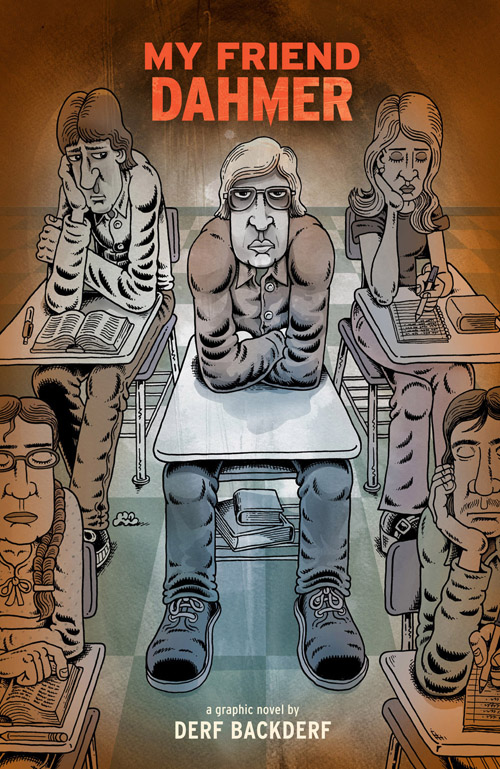
My Friend Dahmer by Derf Backderf
New York : Abrams ComicArts, 2012
221 p. : chiefly ill. ; 25 cm. 

This is an excellent graphic novel - profound and disturbing.  It revisits one of the most lurid serial killer stories - that of  Jeffrey Dahmer - but manages to avoid being lurid or sensational at all.  Instead it is a compassionate telling of the middle and high school years of the young Jeff Dahmer, told by Derf Backderf, a classmate and erstwhile pal of Dahmer.

The book presents a very honest portrait of the lives of young people in an Ohio community in the mid 1970s.  Backderf is able to retell the rather low humor and insensitive world of high school guys he hangs out with - but with a deft and sensitive touch.  He is also able to subtly convey the outrageous ways in which all the adults of Bath, Ohio ignore the clear signs that Dahmer was an extremely troubled young man - especially his intense alcohol abuse during school hours.

To me the greatest strength of this graphic novel is Backderf's ability to have compassion for Dahmer, and yet not excuse or minimize the horrid crimes that he committed.  Within the telling of My Friend Dahmer, there is never a moment where one feels like Backderf is trying to forgive or excuse what Dahmer did.  However, he is able help the reader consider Dahmer as a human being - one with a history in a real time and a very real place - albeit, one who eventually became a merciless and grotesque killer of over a dozen young men.

Tuesday, March 12, 2013

Don't Miss This Trane

A Love Supreme: the Story of John Coltrane's Signature Album by Ashley Kahn
New York : Viking, 2002.
xxiii, 260 p. : ill. ; 25 cm.

I picked up this book at a library book sale this year and read it as someone who likes jazz, but frankly is pretty ignorant about many aspects of jazz.  The book was a treat in that it is very accessible for the lay person interested in jazz, but also makes many references to various jazz artists, techniques, movements, recording studios, etc.  In this way it expanded my limited knowledge, tempted me to learn more, but managed not to overwhelm me - not bad! Kahn's book really conveys the heady times that the mid-1960s were for jazz - and explains why A Love Supreme is one of the iconic albums in the history of jazz.

I really enjoyed learning about John Coltrane's rise to fame - his rigorous practice habits, his brilliance as a performer and composer, his addiction and recovery from heroin, his work with Miles Davis, his role as leader of the quartet that created A Love Supreme, and sadly, his premature death from cancer in 1967. 

It was especially fun to listen to the album - which I bought from iTunes - while reading this book.  Chapter 3 of the book (p. 83-127) provides a thoughtful analysis of the album, section by section, so it serves in effect as a listener's guide. Though not necessary, I'd definitely recommend that readers get their hands on a copy of Coltrane's album to enjoy while they read this fine book.

Monday, March 11, 2013

Another Great Graphic Novel

Fun Home by Alison Bechdel
Boston : Houghton Mifflin, 2007.
232 p. : chiefly ill., maps ; 24 cm.

Alison Bechdel has been creating comics for many years for her syndicated Dykes to Watch Out For which has a small but significant following.  Her book Fun Home, which had both popular and critical success is likely to bring her work to a much wider audience - something she apparently was not prepared for.

The praise for this work - which calls to mind another standout graphic novel Stitches - is well deserved.  It is a rich memoir/graphic novel which is subtle and nuanced as it tells the story of Bechdel's complex, rich, and troubled family of origin - led by parents whose frustrated dreams and repressed sexuality created an intense environment of simmering anger and emotional detachment.

The amazing thing about Fun Home is that in addition to illustrating the conflicts and tensions in her home,  Bechdel is able to convey what a rich and tangled upbringing she had.  Her father and mother were both aspiring intellectuals/artists and much of the power of her work lies in her ambivalence toward the legacy of her family - and her refusal to either condemn or condone the shortcomings of her parents.  Her memoir also deserves praise the ways in which it circles around themes and events the story instead of following a singular straightforward narrative and the ways in which she finds echos of her upbringing in film, myths and novels.

I would highly recommend this graphic novel to students who are interested in a multi-layered, complex coming of age stories and family stories dealing with secrets, conflict and even death - since her father's apparent suicide (possibly an accident) is at the heart of this fine work.  The novel does deal with some mature emotional and sexual issues, so it might not be suitable for immature readers.

Tuesday, February 26, 2013

Payback and Karma

Getting Revenge on Lauren Wood by Eileen Cook
New York : Simon Pulse, 2010.
261 p. ; 21 cm.

Well written fun! What more can I say about this very readable revenge tale.  The plot seems straight-forward enough: 8th grader gets horribly betrayed and humiliated by her best friend (a popularity-aspiring "mean girl"); moves away for 3 years; and then returns for her senior year with a very different look, and a lusciously detailed plan for payback. 

As you might guess, her campaign for revenge doesn't go in exactly a straight line, but instead leads her to discover a few truths about herself and the costs of deception and revenge.  All of this is woven into a very enjoyable, thoughtful, occasionally humorous and believable story that is hard to put down.

Getting Revenge is not a great novel, but it doesn't aspire to be that - but it is a novel that exceeds its modest aims, and has more depth to it than you might think on just glancing at it's appealing cover (see the graphic above), and the humorous by-line on the cover: "This time, the mean girl is going down."

Next time a student asks for something "good to read" and is looking for something fun, I won't hesitate suggesting this solid work of teen revenge and self-discovery fiction.

Wednesday, February 20, 2013

Trouble in the Windy City


Divergent by Veronica Roth
New York : Katherine Tegen Books, 2012, c2011.
487 p. ; 21 cm.

Okay, so the Chicago of Divergent is not quite the ruined city of the Great Fire of 1871 (picture above), but it is a run-down, post-war future Chicago where human society is structured around five factions representing five personality types - Erudite, Dauntless, Candor, Amity, and Abnegation.  

Veronica Roth has developed a great set-up for her novel, envisioning a society where the factions have developed ways to live in harmony by having each faction contribute to the well-being of society with their unique, but mutually beneficial roles, but since conflict is at the heart of a good novel, some faction leaders are not satisfied with the role of their faction and want to overturn the social order. Furthermore, every citizen must chose their faction and be initiated into it at the age of 16.  Most chose their faction of origin, but not everyone, and there's the rub.

There is a great deal to admire about Divergent.  The plotting is crisp, characters are interesting and usually multidimensional, and the setting is evocative and imaginative.  The narrative is rarely dull, and there are some thoroughly enjoyable imagined scenes of post-war Chicago, and excellent plot developments that keep the reader engaged.  Roth has also created a compelling heroine, Beatrice/Tris, who will definitely put readers in mind of Catniss from the Hunger Games. She is smart, complex, competitive, and develops throughout the novel.  My main frustration with the novel, is the ways in which the demands of leaving the novel open to a trilogy occasionally compromise the plot.  There were a couple of times toward the end of the novel where I thought to myself, "That character would never have done that," but felt like the action was required to keep certain other characters alive for future installments in the trilogy.

Overall, I would highly recommend Divergent, especially to any reader who is looking for a thrilling dystopian adventure.  The fact that the novel is set in our home state of Illinois - and is scheduled to be a feature film in 2014 - doesn't hurt either!