Monday, November 28, 2011

Uglies a Pretty Good Read

Uglies by Scott Westerfeld
New York : Simon Pulse, 2005.
1st Simon Pulse ed.
425 p. ; 18 cm.

Uglies is the first of the trilogy by Scott Westerfeld exploring a utopian/dystopian future where everyone is surgically made beautiful when they turn 16.  In the tradition of Aldous Huxley's Brave New World, all is not perfect in the perfect world of those who are turned into "pretties" and set to live out a life of fun, beauty and light-hearted distraction.

The main character, Tally, discovers that there are those who opt out of becoming "pretty" and live in a hidden settlement called the Smoke.  Tally's interest in the Smoke brings her to the attention of the ultra authoritarian Specials who run her society, and leads Tally into some serious ethical dilemmas.

There is a lot of substance to Westerfeld's Uglies.  The book holds an uncomfortable mirror up to our current social situation with its obsessions with appearance, shallow pursuits, conformity, and social controls.  The plotting of Uglies is deft and draws one in quickly so that you really want to know what's going to happen.

Another positive aspect to Westerfeld's Uglies is that there is something for both male and female readers in this novel - relationships, romance, thrills, danger, violence, excitement and a creatively imagined future world. Lastly, my experience in a high school library is that the book is popular and circulates frequently - as do the follow up books to the trilogy: Pretties and Specials - and there's nothing ugly about that!

Monday, November 14, 2011

Dessen Does Not Disappoint

Someone Like You by Sarah Dessen
New York : Viking, 1998.
281 p. ; 22 cm.

Novels by Sarah Dessen are popular at UHS Library and I've been meaning to read one of her novels for a long time. After finishing The Handmaid's Tale for our book club, I decided to pull Someone Like You off the shelf and take it home to read.

The novel focuses on two senior high school friends, Scarlett and Halley who are neighbors and best friends. Early in the novel Scarlett is pregnant and Halley is changing from her parents' "good girl" into a young woman interested in serious dating, and breaking rules. Halley's coming of age is complicated by having a mother who's professional life is being a writer/expert on raising adolescents. It sounds all rather boilerplate and boring, but...

Dessen has an extraordinary ear for dialogue and for subtlety that escapes many less capable YA authors. Her strength is very rich character development that avoids stock characters and stereotypes. Additionally her plotting is interesting and moves along briskly; I found the book hard to put down. Probably the most refreshing aspect of this book was the way in which almost all the characters in the book are sympathetic, but imperfect. Reading it, I found my sympathies shifting between characters as they developed and confronted situations that showed their deeper qualities...

I would definitely recommend Sarah Dessen to anyone interested in the "problem novel" who wants a well written, complex, character-driven but enjoyable story.

Tuesday, August 30, 2011

The Unbeaten

Source of graphic: Robbie Veldwijk

Sucker Punch by David Hernandez
New York: Harper Teen, c2008.
217 p. ; 19 cm.

I first knew of David Hernandez as a poet (check out this poem of his or his web page), so I was intrigued when he came out with Sucker Punch, a work of fiction for young adults.

I enjoyed this book about two brothers who bear the scars of an abusive father who has recently abandoned his family when the novel opens. The older brother, Marcus was not beaten by the father, but Enrique, the younger - more attractive, more physical - brother was often attacked by the father. These dynamics play out in the action of the novel, which revolves around the complicated emotional ties and tension between the two young men as they pursue revenge plot on their father who is planning on returning home after a year away.

Though the writing is gritty, mature and harsh at times, there is a lot of subtlety to Hernandez' style - and his characters are fleshed out in full. Thankfully, the novel ends without being tied up neat and tidy - instead the reader is left to wonder how the plot will continue and if the characters will be able to overcome the weight of their past and the demons that haunt them.

Monday, August 15, 2011

Science Times Ten


The Ten Most Beautiful Experiments by George Johnson
New York : Alfred A. Knopf, 2008.
xiv, 192 p. : ill. ; 20 cm.

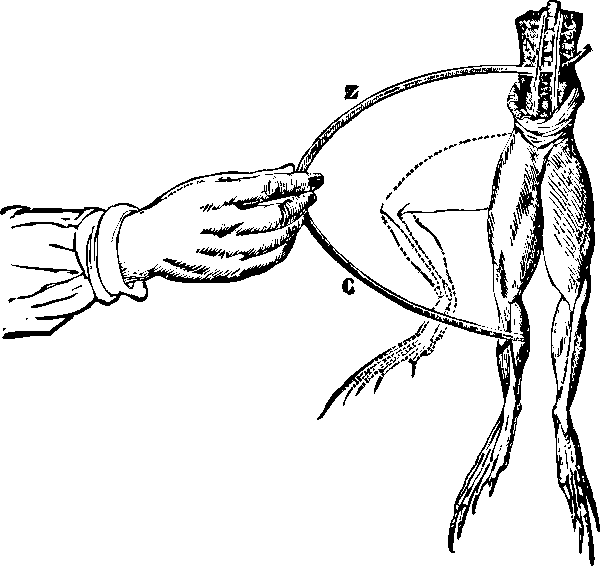
I enjoy books of science and this one was pretty good. The author has chosen what he considers to be ten experiments that capture the power and aesthetic of the scientific method because of the creative, straightforward and elegant means used to arrive at various scientific conclusions. Experiments range from Galileo's experiments with the constant acceleration of falling objects to Lavoisier's conclusions about oxygen to Galvani's experiments (see the graphic above) with bioelectrical impulses.

My only complaint of the book is that the brevity given to each episode can make them either a bit difficult to appreciate or forgettable. However, the shortness makes the book excellent for on the spot reading and does not require the reader to read the book beginning to end - on the contrary it is an excellent book for sampling a chapter here or there.

Wednesday, August 3, 2011

Bygone Prairie

My Ántonia by Willa Cather
Boston : Houghton Mifflin, c1988.
238 p. ; 21 cm.

I've been meaning to read Willa Cather for a long time and this summer I chose her first novel My Ántonia. It's really a beautiful novel, capturing a lost period of US/European settlement of the prairie frontier in Nebraska. The novel is told from the perspective of a young man, who is sent to Nebraska from West Virginia at the end of the 19th century when his parents die. He lives with his well established and kindly grandparents and becomes friends with a girl his age, Antonia - newly arrived with her family from Bohemia (modern day Czech Republic).

The novel is an unabashed fond look back at childhood on the plains of Nebraska. The novel doesn't shy away from the hard life of early settlers and farmers, but brings out the magic of the geography as seen through the eyes of a child and growing young man.

The writing is vivid and Cather's gifts for setting and characterization are in full force in this novel. She is able to convey the stark and sometimes harsh beauty of the Nebraska frontier and conveys the various interesting characters of the prairie farms and towns.

Monday, July 25, 2011

Finally Baldwin

Go Tell It on the Mountain by James Baldwin
New York: Dial Press Trade Paperbacks, 2005.
226 p. ; 21 cm.

As a former English major and a librarian for ten years, I'm a bit embarrassed to admit that I had not read any James Baldwin novels until now. I decided that as a newbie, I'd start with his first novel, Go Tell it on the Mountain. I was not disappointed.

Set in Harlem in the 1950s, this novel uses the setting of a small Harlem independent Christian Gospel church to unfold the layers of stories buried within one African American family of the time. The main character, teen John Grimes moves toward a spiritual rebirth as the novel tells the stories of several important characters who's lives are tied together by family and religion.

It is not a novel that stuns with amazing techniques or plot development, but as a first novel the writing is sure-footed and rich and the unfolding stories behind the characters is satisfying and very interesting.

The novel also richly conveys the atmosphere of a Bible-based, Holy Spirit centered small African American church in the thriving New York City area of Harlem in the 1950s.

A teacher recommended that my next Baldwin novel be Giovanni's Room, and I will definitely add it to my must-read list.

Sunday, July 3, 2011

Bad Scientist Equals Bad Monster

Frankenstein by Mary Shelley
New York: Signet Classic, c[2000]1963.
212 p. ; 21 cm.

So I finally got around to reading this classic of British literature and of the horror genre. I enjoyed reading it, but did find that a lot of the writing was quite overwrought - consider this little excerpt:
"My abhorrence of this fiend cannot be conceived. When I thought of him I gnashed my teeth, my eyes became inflamed, and revenge burst all bounds of moderation."
However, in spite of the dated feel of the tone, the plot is fun and compelling. There is also quite a bit to think on regarding the relation of humans to their exploitation of nature through science and the relation of the artist to what they create. Considering the monster, there is also much to think about regarding alienation, existential despair, and the cruelty of the human experience.

Finally, one has to respect the originality of the plot and its development in the hands of the Mary Shelly.