Monday, August 15, 2011

Science Times Ten


The Ten Most Beautiful Experiments by George Johnson
New York : Alfred A. Knopf, 2008.
xiv, 192 p. : ill. ; 20 cm.

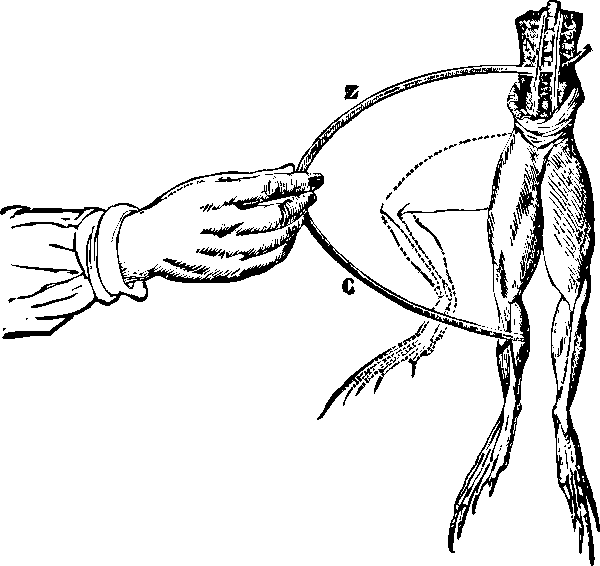
I enjoy books of science and this one was pretty good. The author has chosen what he considers to be ten experiments that capture the power and aesthetic of the scientific method because of the creative, straightforward and elegant means used to arrive at various scientific conclusions. Experiments range from Galileo's experiments with the constant acceleration of falling objects to Lavoisier's conclusions about oxygen to Galvani's experiments (see the graphic above) with bioelectrical impulses.

My only complaint of the book is that the brevity given to each episode can make them either a bit difficult to appreciate or forgettable. However, the shortness makes the book excellent for on the spot reading and does not require the reader to read the book beginning to end - on the contrary it is an excellent book for sampling a chapter here or there.

Wednesday, August 3, 2011

Bygone Prairie

My Ántonia by Willa Cather
Boston : Houghton Mifflin, c1988.
238 p. ; 21 cm.

I've been meaning to read Willa Cather for a long time and this summer I chose her first novel My Ántonia. It's really a beautiful novel, capturing a lost period of US/European settlement of the prairie frontier in Nebraska. The novel is told from the perspective of a young man, who is sent to Nebraska from West Virginia at the end of the 19th century when his parents die. He lives with his well established and kindly grandparents and becomes friends with a girl his age, Antonia - newly arrived with her family from Bohemia (modern day Czech Republic).

The novel is an unabashed fond look back at childhood on the plains of Nebraska. The novel doesn't shy away from the hard life of early settlers and farmers, but brings out the magic of the geography as seen through the eyes of a child and growing young man.

The writing is vivid and Cather's gifts for setting and characterization are in full force in this novel. She is able to convey the stark and sometimes harsh beauty of the Nebraska frontier and conveys the various interesting characters of the prairie farms and towns.

Monday, July 25, 2011

Finally Baldwin

Go Tell It on the Mountain by James Baldwin
New York: Dial Press Trade Paperbacks, 2005.
226 p. ; 21 cm.

As a former English major and a librarian for ten years, I'm a bit embarrassed to admit that I had not read any James Baldwin novels until now. I decided that as a newbie, I'd start with his first novel, Go Tell it on the Mountain. I was not disappointed.

Set in Harlem in the 1950s, this novel uses the setting of a small Harlem independent Christian Gospel church to unfold the layers of stories buried within one African American family of the time. The main character, teen John Grimes moves toward a spiritual rebirth as the novel tells the stories of several important characters who's lives are tied together by family and religion.

It is not a novel that stuns with amazing techniques or plot development, but as a first novel the writing is sure-footed and rich and the unfolding stories behind the characters is satisfying and very interesting.

The novel also richly conveys the atmosphere of a Bible-based, Holy Spirit centered small African American church in the thriving New York City area of Harlem in the 1950s.

A teacher recommended that my next Baldwin novel be Giovanni's Room, and I will definitely add it to my must-read list.

Sunday, July 3, 2011

Bad Scientist Equals Bad Monster

Frankenstein by Mary Shelley
New York: Signet Classic, c[2000]1963.
212 p. ; 21 cm.

So I finally got around to reading this classic of British literature and of the horror genre. I enjoyed reading it, but did find that a lot of the writing was quite overwrought - consider this little excerpt:
"My abhorrence of this fiend cannot be conceived. When I thought of him I gnashed my teeth, my eyes became inflamed, and revenge burst all bounds of moderation."
However, in spite of the dated feel of the tone, the plot is fun and compelling. There is also quite a bit to think on regarding the relation of humans to their exploitation of nature through science and the relation of the artist to what they create. Considering the monster, there is also much to think about regarding alienation, existential despair, and the cruelty of the human experience.

Finally, one has to respect the originality of the plot and its development in the hands of the Mary Shelly.

Saturday, June 25, 2011

Judging Anna

Anna Karenina by Leo Tolstoy
New York: Penquin Books, c2002.
837 p. ; 22 cm.

I tried reading this novel last summer and simply ran out of time, and so this summer I started it in early June and finished it by the end of the month. Several people had recommended Anna Karenina to me and I was not disappointed.

I think the best quality of the book is how sympathetic and complex all the main characters are and how intricately developed personal relationships are in the novel. Whether its the adulterous Anna, her lover Voronsky, the initially superficial Kitty, or the country estate owning Levin- the reader can expect to find her sympathies changing as the characters change and develop throughout the course of this long novel.

I also was pleasantly surprised by several plot twists that caught me completely unawares and reveal the hand of a truly masterful storyteller in Tolstoy.

I read the introduction to the book after finishing the novel and I'm glad I did since there were several plot spoilers in the introduction. But I appreciated the information about Tolstoy's first intentions for the novel - to make it a morality tale about adultery - which he let go of as he developed and came to like the complex main character of the novel, the eponymous Anna Karenina.

Finally, I should note that I read this novel on an eReader, a Nook, and quite liked it.

Tuesday, April 26, 2011

Cut and Thrust

The Book of Swords by Hank Reinhardt
Riverdale, NY, Baen, c2009.
235 p. ; 24 cm.

This book, written by a sword aficionado, is a great introduction to the history of swords and their use by humans. Since the writer is passionate about the subject and is not an academic, there is a fresh and personal tone to the writing. Reinhardt, had spent most of his adult life collecting, testing, talking about, and reading about swords and he brings this to his writing on the subject.

The reader will learn about early metallurgy and the development of iron and steel weaponry. Reinhardt is interested in explaining the basic structure and function of swords - and dispelling myths about swords.

This book should appeal to any reader with a passing interest in the subject of swords, but especially to any students interested in Roman, Viking, or Medieval times - or fantasy fiction where swords play a major role. The book also benefits from generous illustrations that are clear and supportive of the text.

Wednesday, March 9, 2011

Plowing Through Betrayal

The Betrayal of Natalie Hargrove by Lauren Kate
New York: Razor Bill, c2009.
235 p. ; 21 cm.

This book was recommended by the Wilson Senior High Core Collection 2010 supplement, and I can't say I would have recommended it. It's shallow, overwrought, and filled with cardboard characters.

The central figure is a soulless high school senior named Natalie, whose only ambition in life is to see her and her boyfriend crowned Palmetto Queen and King: a goal she achieves, only to see it unravel over her guilty attempt to cover up a prank gone awry. She comes from the poor side of town and wants nothing to do with that old life with its stereotyped "trashy" inhabitants - opting instead for the snideness and snobbery of her elite friends (and the equally unpleasant adults). In the world of this book almost everyone seems to be crass, superficial, and hedonistic.

I guess being too judgmental of this book is to miss the point entirely; it's pure escapist fantasy and really meant only to entertain (though the author has attempted to have the story echo Macbeth). For myself, I just have to care a little bit more about the characters to lose myself in the entertainment of a book - or the plot has to be so compelling that I'm willing to forgo better character development. This book just didn't have enough of either for me, but I'll see how it circulates with students before completely writing it off.